The Internet Has Discounts Everywhere but No Way to Find Them
Every day, brands and creators share discounts across newsletters, Instagram pages, group chats, Telegram channels, and scattered promotional posts. The problem is not that discounts are rare. The problem is that they are invisible unless you already know where to look.
Most users miss out on deals not because they are unavailable, but because they are fragmented across too many platforms. Discovery is broken.
This is the gap Snagged is built to fix.
What Snagged Is Building
Snagged is a global discount discovery platform designed to centralize and organize deals from across the internet.
The simplest way to describe it is this: Snagged is Google Maps, but for finding discounts.
Instead of searching randomly across social media or relying on word of mouth, users can use Snagged to search and explore discounts in one structured place. It aggregates scattered deals and makes them searchable, accessible, and easy to navigate.
The goal is not to sell products. The goal is to help people find where the value already exists.
From Scattered Deals to Structured Discovery
Today, discounts live in isolated pockets. A fashion brand might post a flash sale on Instagram. A SaaS company might send a limited offer through email. A creator might share a promo code in a Telegram group.
Each of these works independently, but there is no unified system connecting them.
Snagged introduces structure to this chaos. It organizes discounts so users can discover them intentionally instead of stumbling upon them by chance.
This transforms promotions from scattered content into a searchable discovery layer.
Why snagged?
Brands spend heavily on promotions, but distribution is inefficient. A discount can go viral in one channel and remain invisible in another. At the same time, users actively want to save money but do not have a reliable way to find all available offers in one place.
This creates a clear mismatch between supply and discovery.
Snagged sits in the middle of this gap by making discounts easier to find, compare, and access.
The Google Maps Analogy
Snagged uses a familiar mental model to simplify a complex problem.
Just like Google Maps organizes physical locations into a navigable system, Snagged organizes discounts into a searchable map of value across the internet.
Users do not need to know where a deal was posted. They only need to search for it in one place.
This shifts discovery from passive scrolling to active searching.
Early Stage But Actively Evolving
Snagged currently has a live version and is still under active development. The platform is being refined based on how users interact with it and how discounts behave across different sources.
The long term focus is on improving search relevance, expanding deal coverage, and making discovery faster and more intuitive.
The Value Behind Snagged
Snagged creates value by bridging the gap between brands and consumers in a more efficient way. Brands get better visibility for their offers. Users get a centralized system for finding savings. The platform becomes the infrastructure that connects both sides.
Over time, this opens opportunities around featured listings, deal amplification, and partnerships with brands that want structured distribution for their promotions.
A New Layer for Internet Commerce Discovery
The internet has made it easy to post deals but difficult to find them. Snagged is building a discovery layer that sits on top of existing platforms and organizes discounts into a usable system.
Instead of relying on chance, users get intentional access to value that already exists online.
The biggest problem with discounts today is not creation. It is discovery.
Snagged is building a system that makes finding deals as simple as searching a map. If successful, it could become the default way people discover value across the internet.
Children today spend a large portion of their time with digital content, yet much of it does not nurture imagination, values, or cultural identity
That realisation is where Auxtoria began.
As a team passionate about technology, education, and storytelling, we started observing children’s cartoons and digital content more intentionally, trying to understand the narratives shaping young minds. It quickly became clear that while many stories entertain, they often fail to reflect the values, cultural experiences, and moral foundations children need.
This sparked a bold idea to change that narrative.
Auxtoria was created as a digital interactive playground where children can explore stories, games, and learning experiences that nurture imagination, positive values, Christian virtues, and African culture. By focusing on interactive storytelling and gamified learning, children do more than consume content. They participate, make decisions, solve challenges, and learn in engaging ways.
The vision is simple but powerful: help children learn, imagine, and grow beyond the traditional four walls of the classroom.
Stories profoundly shape how children see the world, how they treat others, and who they aspire to become. Yet many digital platforms prioritise entertainment over character formation. This gap, combined with Africa’s rich storytelling tradition, shaped Auxtoria’s direction.
For generations, storytelling has been used to pass down wisdom, values, and identity. Auxtoria reimagines this tradition for the digital age, combining storytelling, technology, and gamification to help children grow intellectually, morally, and creatively.
Building Auxtoria came with its own challenges
One of the earliest was translating a broad and ambitious idea into a practical product experience. Building for children requires more than functionality. It demands careful attention to safety, engagement, and educational value.
There was also the challenge of integrating different disciplines — technology, storytelling, and education — into one cohesive platform. Each operates differently, and bringing them together required continuous experimentation and iteration.
At the same time, the team had to build in a market already dominated by global entertainment platforms competing for children’s attention.
Yet despite the crowded space, a clear gap remained.
While digital content is abundant, there is still a shortage of platforms focused on meaningful and value-driven experiences. Parents are becoming more aware of what their children consume and are increasingly seeking safer, more intentional digital environments.
They are not necessarily trying to eliminate screen time. They want better screen time.
Technology has always been central to Auxtoria’s vision.
The platform transforms stories into interactive experiences where children actively participate in the narrative. Instead of simply reading or watching, they explore story worlds, make choices, and solve problems. This level of engagement strengthens both learning retention and emotional connection.
Built on modern digital architecture, Auxtoria supports multiple formats including interactive stories, comics, audiobooks, animated narratives, and educational mini-games. This creates a dynamic ecosystem where both creators and children can engage in meaningful storytelling experiences.
Technology also enables instant distribution, allowing creators to publish content digitally and reach audiences without geographical limitations. A story created in one part of Africa can reach children across the world within seconds.
As a digital platform, Auxtoria’s growth is driven by content expansion, creator partnerships, and user adoption.
As more storytellers, educators, and creatives contribute, the platform becomes richer and more engaging. At the same time, user behaviour continues to evolve. Parents and educators now expect more than passive entertainment. They want content that nurtures creativity, reinforces values, and engages children actively.
Children, in turn, respond better to experiences that allow them to participate and interact.
These shifts reinforce Auxtoria’s core focus.
At its foundation, Auxtoria remains deeply rooted in storytelling and cultural authenticity
Every story is intentionally designed to reflect real experiences, environments, and values. This ensures that even as the platform grows globally, it remains grounded in its purpose — helping children see themselves in the stories they consume.
Looking ahead, Auxtoria aims to grow into a comprehensive digital ecosystem for children’s storytelling and interactive learning.
Future plans include expanding its content library, introducing multiple African languages, and empowering children to create their own stories and content. The goal is to move children from passive consumers to active creators.
What excites us most is the opportunity to shape a generation of children who grow up with stories that inspire creativity, empathy, courage, and strong moral values.
Stories influence how children see themselves and the world.
When they are intentional, interactive, and rooted in positive values, they spark imagination, curiosity, and critical thinking.
Children deserve digital environments that nurture their creativity and help them imagine better futures.
For many businesses across Africa, customer communication remains fragmented and inefficient. Important messages are often split across multiple tools, from SMS gateways to email platforms and separate WhatsApp solutions. This creates operational complexity, especially for startups and growing businesses trying to scale customer engagement.
At the same time, customer expectations are rising. Users want instant updates, secure authentication, and timely marketing messages delivered through the channels they already use.
This gap between need and infrastructure is what SmarthiveSMS is addressing.
What SmarthiveSMS Is Building
SmarthiveSMS is a communication platform that enables businesses to engage their customers through SMS, Email, and WhatsApp from a single system.
The platform is designed to serve both technical and non technical users. For tech startups, SmarthiveSMS provides APIs that allow seamless integration into existing products. These APIs can be used for OTP delivery, transactional alerts, and automated marketing campaigns.
For non technical businesses, the platform offers a simple web interface where messages can be created and sent without coding.
The result is a unified communication system that reduces friction across multiple channels.
From Multiple Tools to One Platform
Traditionally, businesses have had to rely on different providers for different communication needs. One tool handles SMS. Another handles email. Another is used for WhatsApp messaging. This separation creates inefficiencies in both cost and workflow.
SmarthiveSMS simplifies this structure by bringing all major communication channels into one platform. This allows businesses to manage customer engagement from a single dashboard or API layer.
Instead of switching systems, teams can focus on sending the right message at the right time.
Why Multi Channel Communication Matters
Customer engagement is no longer limited to one channel. Users may expect a verification code via SMS, a receipt via email, and a promotional update through WhatsApp. Businesses that cannot coordinate across these channels risk losing customer trust and engagement.
SmarthiveSMS is built to solve this by enabling consistent communication across multiple touchpoints.
This creates a more reliable and scalable system for businesses that depend on timely customer interactions
Built for Startups and Growing Businesses
One of the key strengths of SmarthiveSMS is its flexibility. Startups can integrate its APIs directly into their products to automate communication flows. This is especially useful for authentication, onboarding, and transactional messaging.
At the same time, smaller or non technical businesses are not left behind. They can still access the platform through a simple interface that does not require development experience.
This dual approach makes the platform accessible across different levels of technical capability.
The Value Layer Behind SmarthiveSMS
SmarthiveSMS sits at the intersection of infrastructure and customer engagement. Businesses rely on it to communicate reliably with their users, which makes messaging a critical part of product experience and marketing performance.
The platform’s value is driven by message volume, API usage, and business adoption across sectors such as fintech, e commerce, logistics, and service based industries.
As businesses scale, the demand for reliable communication infrastructure continues to grow.
A Simpler Way to Reach Customers
SmarthiveSMS is positioning itself as a unified communication layer for businesses that want to engage customers more effectively without managing multiple tools.
By combining SMS, Email, and WhatsApp into one system, it reduces complexity while improving speed and consistency of communication.
Getting Started
Businesses can begin using the platform by creating an account at app.smarthivesms.com.
From there, they can access both the web interface and API tools depending on their needs.
Lagos is one of Africa’s most dynamic cities. It is filled with energy, commerce, and endless opportunity. Yet for many residents, daily life comes with a hidden cost. Finding trusted services, discovering new places, or even identifying what is happening nearby often requires effort, guesswork, and multiple platforms.
For millions of Lagosians, the city remains fragmented. Information is scattered across social media, informal networks, and disconnected apps. This fragmentation creates friction that slows down everyday life.
This is the challenge MyLagosApp is built to solve.
What MyLagosApp Is Building
MyLagosApp is a city focused platform designed to simplify how people experience Lagos. It brings together essential services, local businesses, events, and opportunities into a single digital environment.
The goal is simple but powerful. Instead of switching between platforms or relying on inconsistent information, users can access what they need in one place. The app turns Lagos into a structured and navigable digital experience.
At its core, MyLagosApp is about making the city easier to use.
From Chaos to Clarity
What makes MyLagosApp stand out is not just aggregation. It is the ability to make Lagos more understandable and accessible in real time.
The platform is designed around how people actually move through the city. It focuses on relevance, proximity, and immediate need. This means users are not just browsing information. They are discovering options that are useful in the moment.
In a city where time and distance directly impact daily decisions, this approach changes how people interact with their environment. Lagos becomes less overwhelming and more actionable.
Building With Local Context
Many global platforms have attempted to organize urban living, but Lagos operates differently. Informal systems play a major role in commerce. Trust is often built through personal networks rather than digital platforms. Reliable data can be difficult to find.
MyLagosApp is built with these realities in mind. Its approach is not about copying global solutions but adapting to local behavior. This local intelligence gives it a stronger foundation to succeed where generic platforms struggle.
Why This Matters Now
Lagos continues to grow rapidly, both in population and economic activity. As the city expands, the complexity of navigating it increases.
This creates a clear need for platforms that reduce friction and improve access. When people can find what they need faster, they save time, make better decisions, and participate more actively in the economy.
MyLagosApp sits at the center of this shift. It is not just a convenience tool. It is part of a broader movement toward digitizing everyday urban experiences in Africa.
The Business Behind the Platform
Beyond user convenience, MyLagosApp creates value across multiple layers of the ecosystem. Local businesses gain visibility and access to customers. Service providers connect with demand more efficiently. Users benefit from a more organized and reliable experience.
This positions the platform to capture value through business visibility, service transactions, and partnerships tied to urban commerce. As usage grows, the data generated also becomes a powerful asset for understanding consumer behavior in Lagos.
A Smarter Way to Experience Lagos
The long term vision for MyLagosApp goes beyond discovery. It is about building the digital infrastructure that supports daily life in Lagos.
By connecting people to services, opportunities, and experiences in a seamless way, the platform has the potential to reshape how the city is navigated. It moves Lagos closer to becoming a smarter and more accessible urban environment.
There is a version of Lagos that thrives on spectacle. LED screens, demo-day theatrics, founders exchanging LinkedIn QR codes in crowded rooms that promise access but rarely deliver clarity. It is the Lagos of branded lanyards and pitch competitions where the winner is photographed and then largely forgotten. It is loud, visible, and for a certain kind of founder building a certain kind of business, almost entirely useless.
And then there was Baraza Lagos.
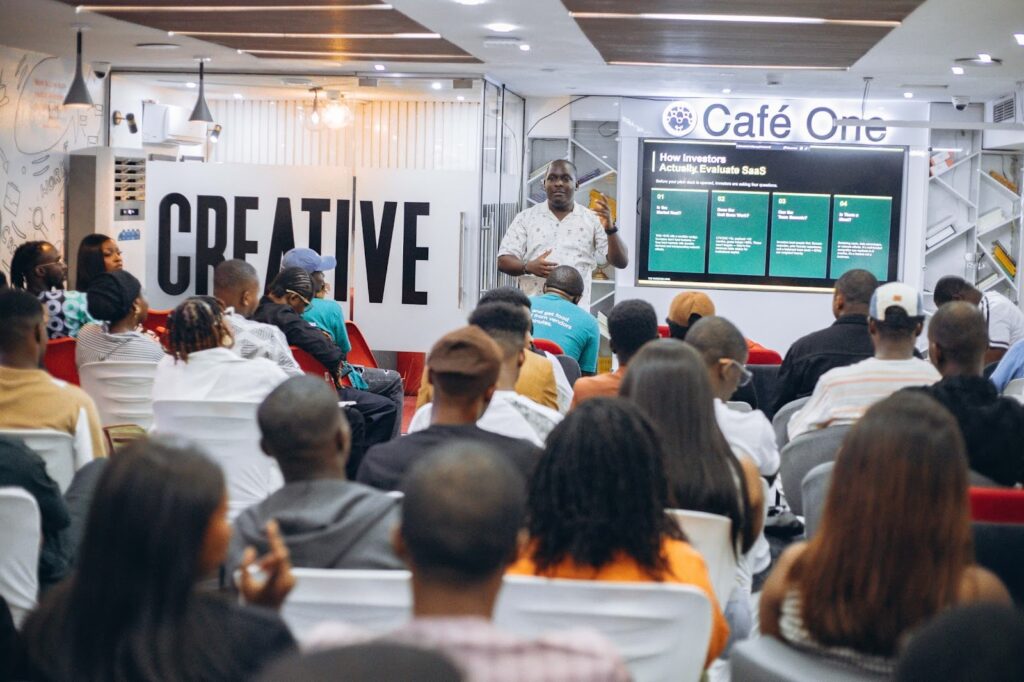
On February 21, 2026, at Café One in Yaba, the energy was noticeably different. The room held roughly a hundred founders, operators, legal advisors, and investors – and what distinguished it was not who was present but what they were doing.
No oversized branding installations. No performative networking rounds with a timer. People were leaning in, not posturing, notebooks were open. When the sessions broke into smaller clusters, nobody was debating valuations in the abstract or rehearsing their elevator pitches on each other.
They were asking specific questions about specific problems. Cap table structures that had been assembled hastily in year one and were now creating friction in year three, compliance obligations that had been deferred and were now threatening deals, governance arrangements that looked fine on paper and were quietly becoming liabilities.
The conversations were, by any conventional measure of tech event programming, deeply unglamorous. They were also exactly the conversations most African founders most need to be having – and almost never are.
Not fundraising hype, not valuation optics. Structure.
Because across African startup ecosystems, failure is rarely caused by lack of ambition. The ideas are frequently correct – correctly identified problems, correctly sized markets, correctly intuited solutions. What kills startups is the infrastructure of bad decisions made before the business had the revenue or the resilience to absorb them: equity structured carelessly in year one, compliance ignored until it becomes expensive in year three, governance reactive rather than proactive throughout, documentation incomplete precisely when due diligence arrives.
Baraza has chosen to sit directly inside that tension.
Kigali: Testing a thesis about serious rooms
Baraza did not begin in Lagos.
The first edition was held in Kigali on November 18, 2025, positioned as a pre-event mixer ahead of Norrsken Africa Week. Not designed to compete with large conferences – designed, rather, to filter them.
The theme was direct: “Funding the Future: What smart money looks for in African founders.”
Behind the design of that room was Semudara Abayomi, the convener known across Lagos’s startup corridors as Bayomi – who had spent enough time inside Africa’s ecosystem events to understand what most of them got wrong. The signal-to-noise problem, the tendency to pack rooms with people and empty them of depth, the gap between the conversations that happened on stage and the conversations founders actually needed to be having with each other.
He had a clear instinct: that the value of a gathering is not proportional to its headcount. That a room of fifty people asking uncomfortable questions is worth more than a hall of five hundred applauding comfortable answers.
Rather than chasing attendance volume, Baraza Kigali focused on curation. Founders, investors, and ecosystem leaders from across seven countries convened in a controlled room where the conversation centred on capital readiness, not capital aspiration.
The thesis that shaped the programming was simple and strategic: serious capital requires serious structure.
In an ecosystem where visibility can be mistaken for viability, Baraza emphasised that investor confidence is built on disciplined cap tables, governance alignment, compliance hygiene, and operational clarity – not on the size of the pitch deck or the ambition of the vision statement.
Intimate rooms, when designed with intention, generate more actionable ecosystem value than conference halls full of badges. Founders didn’t leave with tote bags. They left with clarity.
It proved something important enough to test again. Lagos became the next logical stress test.
Lagos: When compliance became competitive advantage
If Kigali was about funding readiness, Lagos was about structural survival. The theme was unapologetically direct: “Building Compliant, Scalable and Investment-Ready Tech Startups.” The tone shifted from what investors want to what founders must fix – and the room felt that shift from the first session.
Speakers were selected not for inspiration but for operational authority. Practitioners who had lived inside the problems they were discussing and had earned the right to speak to them.
Segun Cole set the temperature early. His point was precise and, for many founders in the room, quietly devastating: a pitch deck does not secure capital. It secures a meeting. What closes the gap or collapses it is disciplined economics, a defensible structure, and the founder’s ability to answer hard questions without deflecting.
Several people in the room, by their own admission afterward, realised mid-session that they were not as ready as they had assumed. That realization was the point.
Omoruyi Edoigiawerie pushed on a different pressure point. The instinct to model African startups on Western templates, to build for a version of a market that exists in San Francisco rather than the one that exists in Lagos, Accra, or Nairobi – is, he argued, one of the more expensive mistakes a founder can make. The frameworks are borrowed. The assumptions embedded in them frequently do not survive first contact with local regulatory and market realities.
Founders who understand this early build differently. They localise not just their product but their operating logic.
Cynthia E. Chisom’s session was the one people were still discussing as they stood in the car park afterward. She drew the line between governance architecture, stakeholder management, and long-term revenue durability in a way that reframed compliance entirely – not as legal overhead bolted onto a business after the fact, but as enterprise infrastructure built into its foundations.
A business with weak governance is not just a compliance risk. It is a revenue risk, a retention risk, a fundraising risk. The room went quiet in the way rooms go quiet when a speaker articulates something the audience already knew but had never heard said directly.
By the end of the evening, the conversation in the room had shifted. Not ‘How do I raise?’ but ‘What needs restructuring before I raise?’ That difference is subtle and transformative.
The format held everything together: short, dense sessions; direct Q&A that ran long because the questions were real; breakout discussions that formed organically and refused to end on schedule.
Founders were not leaving inspired in the vague sense the word usually implies at tech events. They were leaving with specific things to fix.
Why the timing is not accidental
African startup ecosystems are entering a maturity phase, and the terrain is shifting in ways that reward structural discipline. The early era of unchecked experimentation is narrowing. Investors are more cautious, regulatory bodies are more observant, cross-border expansion requires legal clarity that founders of three years ago could afford to defer.
The next generation of African builders will not be measured only by growth curves. They will be measured by governance quality, by the cleanliness of their cap tables, by whether their compliance posture can survive the scrutiny of institutional capital.
In that context, Baraza is less an event series and more a signal. It signals that the ecosystem is recalibrating – from noise toward durability, from visibility toward viability. The founders who treat compliance as leverage rather than liability will likely be the ones still standing when funding cycles shift again. The rooms shaping that mindset are only getting sharper.
The Architecture Behind the Room
A well-run event and a well-told story about a well-run event are two entirely different achievements. Baraza Lagos earned both. The second achievement required a specific and uncommon kind of expertise.
Hype Empire came into the Baraza Lagos story not as a vendor executing a brief but as a strategic communications partner that understood what the event needed to become. The question was never simply how to promote it. It was more foundational than that: how do you translate a room full of serious, non-performative conversations into a public narrative that is equally serious, equally unperformed, and still compelling enough to reach the founders who were not in the room? Events that deliberately resist hype are harder to tell stories about than events designed for it.
The instinct in communications is to reach for the dramatic, the quotable, the shareable spectacle.
Hype Empire’s discipline built over years of working inside Africa’s ecosystem – was to resist that instinct and find the harder, more durable story: that the quietest room at a tech event is sometimes the most important one.
There is a difference between publicity and positioning. Publicity fills a moment. Positioning builds a narrative that compounds. Hype Empire understands that difference, and the Baraza Lagos amplification strategy was built on it.
From pre-event ecosystem framing to post-event media syndication, from curated social heat to visual storytelling that preserved the room’s focused intensity without manufacturing spectacle, the strategy delivered one outcome above all others: Baraza Lagos was perceived not as another tech meetup on the Lagos calendar, but as a structural intervention in how African founders think about building. That perception did not happen by accident. It was engineered.
The involvement of the Nigerian Bar Association, Lagos Branch added institutional gravity. Compliance was not discussed as an afterthought but as architecture. Legal structure treated as foundational to innovation, not antagonistic to it.
Media partners including Africa Tech Journal reinforced the reach, amplifying the discourse beyond Yaba and signalling that this was not a private gathering but a directional shift.
Depth met reach. Substance met visibility. That combination is rare in African tech communications, and it was engineered deliberately. This is what it looks like when PR is treated as strategy rather than afterthought – when the story of an event is designed with the same care and intention as the event itself.
Bayomi’s take
In the short video Baraza released, now making rounds on X and Instagram, convener Semudara Abayomi known across the ecosystem as Bayomi, sounded quietly proud, the way someone does when a bet pays off.
He described Baraza as building “spaces where founders leave with maps, not just memories.”
He spoke about reframing compliance from “that scary legal thing” into “the boring superpower that lets you raise, scale, and sleep at night.” It was a subtle but radical repositioning. Compliance not as constraint. Not as bureaucratic friction. But as leverage.
You could hear relief in his voice. The room had done exactly what it was designed to do.
Less than 48 hours later he was already teasing next moves on X: “Baraza Lagos… Abuja next or Nairobi?”
The continental horizon
Less than 48 hours after Lagos concluded, conversations had already shifted to the next question: Abuja, or Nairobi?
Each city carries a different strategic weight.
Abuja is policy-proximate in ways Lagos is not – a city where decisions inside ministries and regulatory agencies shape the operating terrain for every startup in Nigeria. A Baraza room there would tilt toward regulatory engagement, public-sector dialogue, and the structural realities of building close to federal power. For founders navigating that interface, such a room barely exists today.
Nairobi represents a different frontier. It is Africa’s deepest startup density outside Lagos – cross-border by default, seasoned in fintech regulation, and experienced in scaling across markets with varying compliance demands. The conversation there would not be about whether structure matters, but about which structures to build, in what order, and for which markets.
Different cities. Same DNA: curated rooms, structural honesty, zero performance.
If Kigali tested the thesis and Lagos refined it, the next editions will determine whether Baraza becomes a continental standard – the series serious African builders treat as essential rather than optional.
Build with Hype Empire
At Hype Empire, we don’t just report on what’s happening in Africa’s startup ecosystem, we help shape how it’s understood. The Baraza story is one example of what happens when communications strategy is built with the same intentionality as the event it serves.
If you are building something meaningful and need it positioned with clarity, depth, and long-term narrative relevance – not just a press release, a post-event recap, but a story that compounds over time, Hype Empire is the team that knows how to build it.
Nigerian companies are no longer building products and services, they are shaping the narratives. And Podcasting has quietly become one of the strategic storytelling tools.
The need for founder visibility, vision-driven growth, proper documentation, distribution control, and owning one’s narrative has led to the rise in the adoption of podcasting.
The rising cost and high barrier to entry of traditional media is driving founders and business owners to target cost-effective approaches like podcasting.
Between 2021 and 2022, Spotify recorded a whopping 222% increase in podcast listenership in Nigeria, placing Nigeria as number 2, behind South Africa who is leading the charts in Africa.
Turntable Charts also reported Gen Z and Millennials leading the demography charts in podcast listenership here in Nigeria.
This signals more than entertainment consumption, it represents an opportunity for brands to build sustained attention and own their narrative.
Nigerian companies have recognized this shift and are leveraging podcasting in distinct but strategic ways.
Companies like Fincra, Cowrywise, and Paystack have adopted podcasting to tell their story thus controlling the narrative and connecting more with their users through storytelling.
Individual podcasts like Afrobility, Afropolitan, The Open Africa Podcast, Founders Connect,Totally on Brand etc feature founders and provide a platform for them to leverage an existing listener base to tell their stories and build brand authority.
At the core of it all, is the ability to connect more with those who matter; the users and target audience.
When Piggyvest’s COO, Odunayo Eweniyi appeared on the 210 episode of the London Fintech
Podcast to shed more light on the origin story of Piggyvest, she wasn’t just telling Nigerians who they were, she was positioning Piggyvest in the global fintech conversation.
When Nathan Nwachukwu appeared on the Afropolitan Podcast to talk about how Nigeria needs sovereign intelligence, he wasn’t just marketing Terra Industries, he was shaping the intellectual narrative around Africa owned deep tech.
By creating The Afincran Playbook, Fincra shifted from a fintech infrastructure provider to becoming a thought leader in championing cross-border trade across Africa.
For Cowrywise, Ope’s Money Diary moves beyond product marketing. It humanizes decision-making, allowing Cowrywise to build emotional equity, not just financial trust.
As more Nigerian tech companies embrace podcasting as a trust and distribution tool, the differentiator is strategy. With the right partner, podcasting moves from being content to becoming infrastructure.
Nigerian companies are no longer waiting to be invited into conversations; they are creating them and inviting the world to listen.
Nkem Creatives helps brands move beyond simply recording episodes to building intentional podcast ecosystems that drive visibility, authority, and measurable growth.
From narrative positioning and guest strategy to multi-channel repurposing and distribution, we ensure every episode works as a business asset, not just content.
If your company is ready to turn conversations into community and influence, partner with Nkem Creatives and build a podcast that moves your business forward.
For years, Africa’s tech narrative has revolved around large corporations, venture capital funding, While those stories dominate headlines, they don’t fully capture where real momentum is building. The truth is quieter and more powerful. Africa’s tech future is increasingly being shaped by creators.
Creators In this context are not just Influencers . They are developers building niche tools from their bedrooms. Designers launching digital products on low budgets. Writers monetizing knowledge online. Educators running tech communities. Small founders solving hyper local problems with simple but scalable solutions.
Unlike large corporations, creators move with speed. They are not slowed down by heavy bureaucracy or shareholder pressure. They experiment quickly, respond directly to their audiences , and build products rooted in lived experience. In a continent as diverse and dynamic as Africa, this agility matters.
Technology has also lowered the barrier to entry. With access to no code platforms, AI tools Fintech APis, and global distribution channels, individuals can now build and monetize ideas without massive capital. A laptop, internet access, and skill are often enough to start. This democratization of innovation is changing the power structure of tech.
Corporation will always have a role especially in infrastructure and large scale investment. But creators understand culture. They understand language, behavior, and community. They build solutions that feel personal, not imposed. And in emerging markets, trust and relatability are currency.
Across Africa, we are already seeing this shift. Independent developers are launching fintech tools tailored to specific communities. Content creators are education thousands about coding, investing, and digital skills. Small tech founders are building for real problems not pitch decks.
The next wave of African innovation may not come from towering headquarters, it may come from shared work spaces, small studios, and home offices. It will come from people who see gaps in their immediate environment and decide to build.
Africa’s strength has always been its entrepreneurial spirit. Technology is simply amplifying it.
The future will not belong solely to corporations with capital. It will belong to creators with courage, clarity, and connection.
Five finalists will pitch their ideas to leading voices in Nigeria’s AI, innovation and tech ecosystem on Saturday, April 4, 2026 in Lagos Nigeria
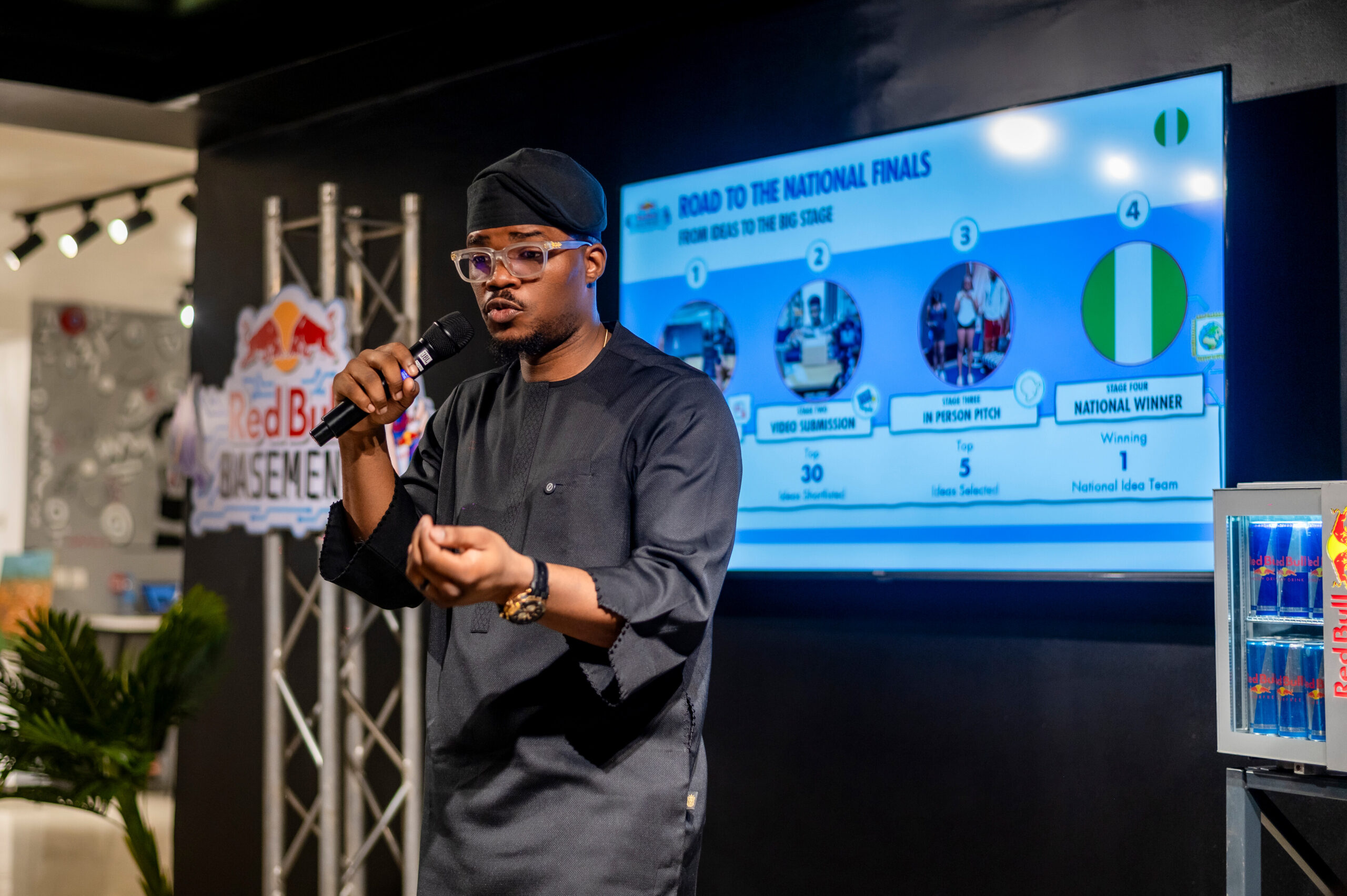
After attracting more than 3,000 applications from aspiring innovators across Nigeria, Red Bull Basement 2026 is set to host its Nigeria National Final on April 4, where five standout individual/teams will pitch their technology-driven ideas to a panel of influential leaders from the country’s AI, Innovation and tech ecosystem.
The finalists represent the most promising ideas selected from thousands of submissions nationwide, reflecting the creativity and ambition of Nigeria’s growing community of student founders and early-stage entrepreneurs.
Red Bull Basement is a global innovation programme that empowers student founders and first-time entrepreneurs to transform bold ideas into real-world solutions.
Alexander Ehanire interacts with a participant during the Red Bull Basement Innovation Workshop at Cafe One in Abuja, Nigeria on February 28, 2026. // Adelugba Oluwapelumi / Red Bull Content Pool // SI202603160070 // Usage for editorial use only //
By combining AI-powered technology, mentorship, and global exposure, the programme helps young innovators develop ideas that can positively impact industries and communities worldwide.
From Thousands of Applications to Five Finalists
This year’s edition saw an overwhelming response from young Nigerians, with more than 3,000 applications submitted from universities, tech communities, and startup hubs across the country.
Applicants proposed solutions tackling a wide range of challenges, including:
Expanding access to education
Sustainable innovation
Health and wellness technology
Digital tools for creators and entrepreneurs
Community-driven tech platforms
Following multiple rounds of evaluation, the strongest ideas were shortlisted, eventually narrowing the field to five finalist teams who will now present their prototypes live at the National Final.
The National Final: Ideas Under the Spotlight
At the Red Bull Basement Nigeria National Final, each team will deliver a two-minute pitch and prototype presentation before a panel of three respected figures from Nigeria’s technology and innovation space.
The judges will assess each concept based on:
Innovation and originality
Potential impact on communities or industries
Scalability and feasibility
The strength of the founding team
The winning team will be crowned Nigeria’s Red Bull Basement champion, earning the opportunity to represent the country as the programme continues globally later this year.
Fueling Nigeria’s Next Generation of Builders
Through Red Bull Basement, participants gain access to powerful tools that help turn ideas into working prototypes, even for those without traditional technical backgrounds.
The programme is run in collaboration with Microsoft, AMD, and Red Bull Ventures, giving innovators access to AI-powered technology, development resources, and mentorship from experts in the tech ecosystem.
For the five finalists, the National Final represents a chance to showcase the power of Nigerian innovation and the potential of young founders to create solutions that can scale beyond their communities.
For more information check out @redbullng and go on www.redbullbasement.com to secure a spot to attend
Peerless, a modern enterprise technology company, has officially announced the launch of SeaBaas Lite. This core banking solution is built to support the digital transformation of microfinance institutions (MFIs) and fintechs across Africa.
The product represents a standardized version of the company’s flagship SeaBaas core, designed for rapid deployment and operational efficiency.
The Nigerian financial sector currently faces significant infrastructure hurdles. High capital expenditure on hardware, foreign exchange volatility affecting software maintenance, and the complexity of local regulatory compliance have created barriers for many institutions.
SeaBaas Lite addresses these challenges by offering a cloud-native platform hosted on Huawei Cloud with local data residency. This ensures that Nigerian financial data stays within the country, meeting the requirements of the Central Bank of Nigeria (CBN) and the Nigeria Data Protection Regulation (NDPR).
SeaBaas Lite is built on an API-first modern core. This technical foundation allows for seamless integration with external channels, facilitating automatic verifications and faster customer onboarding. By removing the need for manual data entry and disjointed verification processes, institutions can reduce their transaction processing time by 60%.
The platform also solves a major pain point for compliance officers through built-in regulatory reporting templates. These templates are pre-mapped to local requirements, allowing banks to generate reports for regulators with a single click. This automation reduces the risk of manual errors and the potential for regulatory fines.
Data is a central component of the new offering. SeaBaas Lite provides robust analytics that give banks rich insights into customer behavior. These data-driven tools help institutions move beyond simple record-keeping to identify new revenue opportunities and improve credit scoring models.
“Peerless is on a mission to remove the high barriers of entry that have historically held back African financial institutions,” says Dr. Joachim Adenusi, Co-Founder and CEO of Peerless. “SeaBaas Lite gives MFBs and regional banks access to world-class infrastructure without the heavy price tag of legacy systems. We believe every institution deserves a core that supports growth instead of hindering it.”
Support remains a key differentiator for Peerless. Unlike global competitors that often manage support from different time zones, Peerless maintains a top-quality technical and customer support team based in Lagos. This proximity allows for one-hour response times and a deeper understanding of local integration rails and network conditions.
The track record of the SeaBaas infrastructure is substantial. The platform has served over 12 million end users and processed more than 4 billion transactions. These operations have led to over $30 million in operational savings for Peerless customers. The system maintains a 99.99% availability rate, providing stability even during peak transaction periods.
Olumide Odeyemi, Marketing & Growth Manager at Peerless, notes that the transition from traditional hardware ownership to cloud access is a necessity in the current economic climate. “The cost of maintaining rigid legacy systems consumes budgets that should go toward innovation. SeaBaas Lite moves these costs from a heavy upfront investment to a predictable operational expense.”
SeaBaas Lite is now open for subscription. Interested institutions can visit https://bepeerless.co/product/seabaaslite to learn more about the platform’s capabilities and the 30-day deployment promise.
About Peerless
Peerless is a modern enterprise technology company purpose-built to support the digital transformation of institutions in emerging markets. With offices in Nigeria and the UAE, Peerless provides core digital infrastructure including core banking software, business process automation, and customer relationship management tools.
Because I just got admitted to study Computer Science at Miva Open University, I’ve had to study the basics of computer science again. In a lecture, we were taught something we’ve all heard before:
“The CPU is the brain of the computer.”
Of course, this isn’t new. We learned it in primary school. We repeated it in secondary school. It almost feels too basic to think about seriously.
But because I’ve also been reading deeply about AI agents, that simple statement started to feel different.
It just wouldn’t leave my mind.
What if AI agents are not revolutionary in structure, but evolutionary in abstraction?
What if we’re simply rebuilding the computer — at a higher cognitive layer?
The CPU Is Not “Smart.” It Coordinates.
When we say the CPU is the brain, we don’t mean it is intelligent in the human sense.
What it actually does is:
Fetches instructions
Decodes them
Decide what needs to run
Schedules execution
Coordinate between memory and storage
Call the appropriate operations
It is simply a control system.
The CPU’s power lies not in performing every operation, but in deciding which operation runs, when, and in what order.
It is an orchestrator.
And this is where something clicked for me.
Now Look at Modern AI Agents
An AI agent built around an LLM behaves similarly.
At runtime, the system:
Receives input
Interprets intent
Determines whether reasoning alone is sufficient
Decides whether to call a tool
Selects which tool to call
Incorporates external retrieval (RAG) if necessary
Integrates results
Produces output
The LLM is not doing everything by itself either.
It is coordinating execution across external capabilities.
Sound familiar?
Yes, just like the CPU.
Skills Feel Like Installing New Software
In another lecture, we were told there are two types of software on a computer: the system software and the application software.
An application software is installed by the user to perform a specific task or solve a specific problem, e.g. Microsoft Word, Spreadsheet, Design Tools, etc.
Most importantly, we were told that without application software, a computer would have just been an ordinary electronic device that can only do basic operations.
In some AI agent frameworks, you can extend capabilities by defining new skills, sometimes as simple as a structured markdown file.
When I saw that, I couldn’t help but think:
Isn’t this similar to installing new software on a computer?
A computer becomes more powerful when you install applications.
An AI agent becomes more capable when you add skills.
Same pattern, but just a different abstraction layer.
RAG Looks Like External Memory
Then there’s RAG, Retrieval-Augmented Generation, which adds another layer to this parallel.
Instead of relying only on what’s inside the model’s parameters, the RAG system:
Inject it into the context window (working memory?)
Uses it to reason
That feels a lot like what we’re used to in a traditional computer:
Fetching from disk
Loading into memory (RAM)
Then executing
Again, the same architectural principle.
Tool-Calling Feels Like System Calls
In classical operating systems:
User applications do not directly control hardware.
They invoke system calls.
The OS mediates execution.
In agent architectures:
The model does not directly execute code.
It emits a structured tool call.
The orchestration layer executes the function.
The result is fed back into context.
This means we have recreated system calls, but now the caller is a probabilistic model instead of a deterministic user application.
So, this isn’t magic?
Is the LLM Becoming a Software-Level CPU?
Now, this is the thought that keeps forming in my mind:
Within an agent system, the LLM functions like a software-level CPU.
Not hardware, but a high-level control plane; because:
It does not execute arithmetic directly.
It does not access memory directly.
It does not perform input/output operations directly.
Instead:
It decides.
It sequences.
It orchestrates.
That sounds familiar.
And, in that sense, we are witnessing the emergence of a new abstraction layer:
From:
Hardware CPU controlling instructions
To:
Software model controlling capabilities
The locus of control has shifted upward, from silicon to probability distributions.
Why This Matters (At Least To Me)
Revisiting foundational Computer Science concepts while watching AI evolve has been humbling for me.
It reminds me that every technological leap feels magical at first. But when you understand the foundations deeply, new technologies stop looking magical.
You start seeing patterns. And once you see patterns, you can build better systems.
I don’t have this fully formed yet. But I know this much:
The more I study first principles, the more AI makes sense.
And that’s a good place to be.
References
Patterson, D. A., & Hennessy, J. L. Computer Organization and Design: The Hardware/Software Interface.
Lewis, P., et al. (2020). Retrieval-Augmented Generation for Knowledge-Intensive NLP Tasks.