
There is a version of Lagos that thrives on spectacle. LED screens, demo-day theatrics, founders exchanging LinkedIn QR codes in crowded rooms that promise access but rarely deliver clarity. It is the Lagos of branded lanyards and pitch competitions where the winner is photographed and then largely forgotten. It is loud, visible, and for a certain kind of founder building a certain kind of business, almost entirely useless.
And then there was Baraza Lagos.
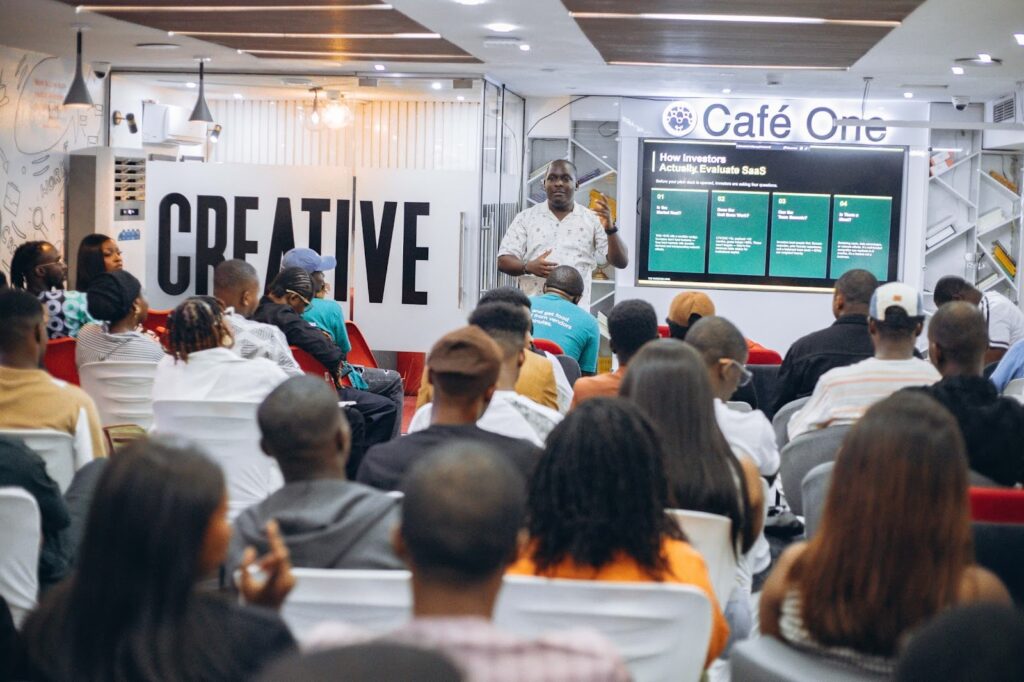
On February 21, 2026, at Café One in Yaba, the energy was noticeably different. The room held roughly a hundred founders, operators, legal advisors, and investors – and what distinguished it was not who was present but what they were doing.
No oversized branding installations. No performative networking rounds with a timer. People were leaning in, not posturing, notebooks were open. When the sessions broke into smaller clusters, nobody was debating valuations in the abstract or rehearsing their elevator pitches on each other.
They were asking specific questions about specific problems. Cap table structures that had been assembled hastily in year one and were now creating friction in year three, compliance obligations that had been deferred and were now threatening deals, governance arrangements that looked fine on paper and were quietly becoming liabilities.
The conversations were, by any conventional measure of tech event programming, deeply unglamorous. They were also exactly the conversations most African founders most need to be having – and almost never are.
Not fundraising hype, not valuation optics. Structure.
Because across African startup ecosystems, failure is rarely caused by lack of ambition. The ideas are frequently correct – correctly identified problems, correctly sized markets, correctly intuited solutions. What kills startups is the infrastructure of bad decisions made before the business had the revenue or the resilience to absorb them: equity structured carelessly in year one, compliance ignored until it becomes expensive in year three, governance reactive rather than proactive throughout, documentation incomplete precisely when due diligence arrives.
Baraza has chosen to sit directly inside that tension.
Kigali: Testing a thesis about serious rooms
Baraza did not begin in Lagos.
The first edition was held in Kigali on November 18, 2025, positioned as a pre-event mixer ahead of Norrsken Africa Week. Not designed to compete with large conferences – designed, rather, to filter them.
The theme was direct: “Funding the Future: What smart money looks for in African founders.”
Behind the design of that room was Semudara Abayomi, the convener known across Lagos’s startup corridors as Bayomi – who had spent enough time inside Africa’s ecosystem events to understand what most of them got wrong. The signal-to-noise problem, the tendency to pack rooms with people and empty them of depth, the gap between the conversations that happened on stage and the conversations founders actually needed to be having with each other.
He had a clear instinct: that the value of a gathering is not proportional to its headcount. That a room of fifty people asking uncomfortable questions is worth more than a hall of five hundred applauding comfortable answers.
Rather than chasing attendance volume, Baraza Kigali focused on curation. Founders, investors, and ecosystem leaders from across seven countries convened in a controlled room where the conversation centred on capital readiness, not capital aspiration.
The thesis that shaped the programming was simple and strategic: serious capital requires serious structure.
In an ecosystem where visibility can be mistaken for viability, Baraza emphasised that investor confidence is built on disciplined cap tables, governance alignment, compliance hygiene, and operational clarity – not on the size of the pitch deck or the ambition of the vision statement.
Intimate rooms, when designed with intention, generate more actionable ecosystem value than conference halls full of badges. Founders didn’t leave with tote bags. They left with clarity.
It proved something important enough to test again. Lagos became the next logical stress test.
Lagos: When compliance became competitive advantage
If Kigali was about funding readiness, Lagos was about structural survival. The theme was unapologetically direct: “Building Compliant, Scalable and Investment-Ready Tech Startups.” The tone shifted from what investors want to what founders must fix – and the room felt that shift from the first session.
Speakers were selected not for inspiration but for operational authority. Practitioners who had lived inside the problems they were discussing and had earned the right to speak to them.
Segun Cole set the temperature early. His point was precise and, for many founders in the room, quietly devastating: a pitch deck does not secure capital. It secures a meeting. What closes the gap or collapses it is disciplined economics, a defensible structure, and the founder’s ability to answer hard questions without deflecting.
Several people in the room, by their own admission afterward, realised mid-session that they were not as ready as they had assumed. That realization was the point.
Omoruyi Edoigiawerie pushed on a different pressure point. The instinct to model African startups on Western templates, to build for a version of a market that exists in San Francisco rather than the one that exists in Lagos, Accra, or Nairobi – is, he argued, one of the more expensive mistakes a founder can make. The frameworks are borrowed. The assumptions embedded in them frequently do not survive first contact with local regulatory and market realities.
Founders who understand this early build differently. They localise not just their product but their operating logic.
Cynthia E. Chisom’s session was the one people were still discussing as they stood in the car park afterward. She drew the line between governance architecture, stakeholder management, and long-term revenue durability in a way that reframed compliance entirely – not as legal overhead bolted onto a business after the fact, but as enterprise infrastructure built into its foundations.
A business with weak governance is not just a compliance risk. It is a revenue risk, a retention risk, a fundraising risk. The room went quiet in the way rooms go quiet when a speaker articulates something the audience already knew but had never heard said directly.
By the end of the evening, the conversation in the room had shifted. Not ‘How do I raise?’ but ‘What needs restructuring before I raise?’ That difference is subtle and transformative.
The format held everything together: short, dense sessions; direct Q&A that ran long because the questions were real; breakout discussions that formed organically and refused to end on schedule.
Founders were not leaving inspired in the vague sense the word usually implies at tech events. They were leaving with specific things to fix.
Why the timing is not accidental
African startup ecosystems are entering a maturity phase, and the terrain is shifting in ways that reward structural discipline. The early era of unchecked experimentation is narrowing. Investors are more cautious, regulatory bodies are more observant, cross-border expansion requires legal clarity that founders of three years ago could afford to defer.
The next generation of African builders will not be measured only by growth curves. They will be measured by governance quality, by the cleanliness of their cap tables, by whether their compliance posture can survive the scrutiny of institutional capital.
In that context, Baraza is less an event series and more a signal. It signals that the ecosystem is recalibrating – from noise toward durability, from visibility toward viability. The founders who treat compliance as leverage rather than liability will likely be the ones still standing when funding cycles shift again. The rooms shaping that mindset are only getting sharper.
The Architecture Behind the Room
A well-run event and a well-told story about a well-run event are two entirely different achievements. Baraza Lagos earned both. The second achievement required a specific and uncommon kind of expertise.
Hype Empire came into the Baraza Lagos story not as a vendor executing a brief but as a strategic communications partner that understood what the event needed to become. The question was never simply how to promote it. It was more foundational than that: how do you translate a room full of serious, non-performative conversations into a public narrative that is equally serious, equally unperformed, and still compelling enough to reach the founders who were not in the room? Events that deliberately resist hype are harder to tell stories about than events designed for it.
The instinct in communications is to reach for the dramatic, the quotable, the shareable spectacle.
Hype Empire’s discipline built over years of working inside Africa’s ecosystem – was to resist that instinct and find the harder, more durable story: that the quietest room at a tech event is sometimes the most important one.
There is a difference between publicity and positioning. Publicity fills a moment. Positioning builds a narrative that compounds. Hype Empire understands that difference, and the Baraza Lagos amplification strategy was built on it.
From pre-event ecosystem framing to post-event media syndication, from curated social heat to visual storytelling that preserved the room’s focused intensity without manufacturing spectacle, the strategy delivered one outcome above all others: Baraza Lagos was perceived not as another tech meetup on the Lagos calendar, but as a structural intervention in how African founders think about building. That perception did not happen by accident. It was engineered.
The involvement of the Nigerian Bar Association, Lagos Branch added institutional gravity. Compliance was not discussed as an afterthought but as architecture. Legal structure treated as foundational to innovation, not antagonistic to it.
Media partners including Africa Tech Journal reinforced the reach, amplifying the discourse beyond Yaba and signalling that this was not a private gathering but a directional shift.
Depth met reach. Substance met visibility. That combination is rare in African tech communications, and it was engineered deliberately. This is what it looks like when PR is treated as strategy rather than afterthought – when the story of an event is designed with the same care and intention as the event itself.
Bayomi’s take
In the short video Baraza released, now making rounds on X and Instagram, convener Semudara Abayomi known across the ecosystem as Bayomi, sounded quietly proud, the way someone does when a bet pays off.
He described Baraza as building “spaces where founders leave with maps, not just memories.”
He spoke about reframing compliance from “that scary legal thing” into “the boring superpower that lets you raise, scale, and sleep at night.” It was a subtle but radical repositioning. Compliance not as constraint. Not as bureaucratic friction. But as leverage.
You could hear relief in his voice. The room had done exactly what it was designed to do.
Less than 48 hours later he was already teasing next moves on X: “Baraza Lagos… Abuja next or Nairobi?”
The continental horizon
Less than 48 hours after Lagos concluded, conversations had already shifted to the next question: Abuja, or Nairobi?
Each city carries a different strategic weight.
Abuja is policy-proximate in ways Lagos is not – a city where decisions inside ministries and regulatory agencies shape the operating terrain for every startup in Nigeria. A Baraza room there would tilt toward regulatory engagement, public-sector dialogue, and the structural realities of building close to federal power. For founders navigating that interface, such a room barely exists today.
Nairobi represents a different frontier. It is Africa’s deepest startup density outside Lagos – cross-border by default, seasoned in fintech regulation, and experienced in scaling across markets with varying compliance demands. The conversation there would not be about whether structure matters, but about which structures to build, in what order, and for which markets.
Different cities. Same DNA: curated rooms, structural honesty, zero performance.
If Kigali tested the thesis and Lagos refined it, the next editions will determine whether Baraza becomes a continental standard – the series serious African builders treat as essential rather than optional.
Build with Hype Empire
At Hype Empire, we don’t just report on what’s happening in Africa’s startup ecosystem, we help shape how it’s understood. The Baraza story is one example of what happens when communications strategy is built with the same intentionality as the event it serves.
If you are building something meaningful and need it positioned with clarity, depth, and long-term narrative relevance – not just a press release, a post-event recap, but a story that compounds over time, Hype Empire is the team that knows how to build it.
Follow Hype Empire and join the conversation:
X : https://x.com/hypeempire001
Instagram : https://instagram.com/hypeempire001