By Tosin Oladokun
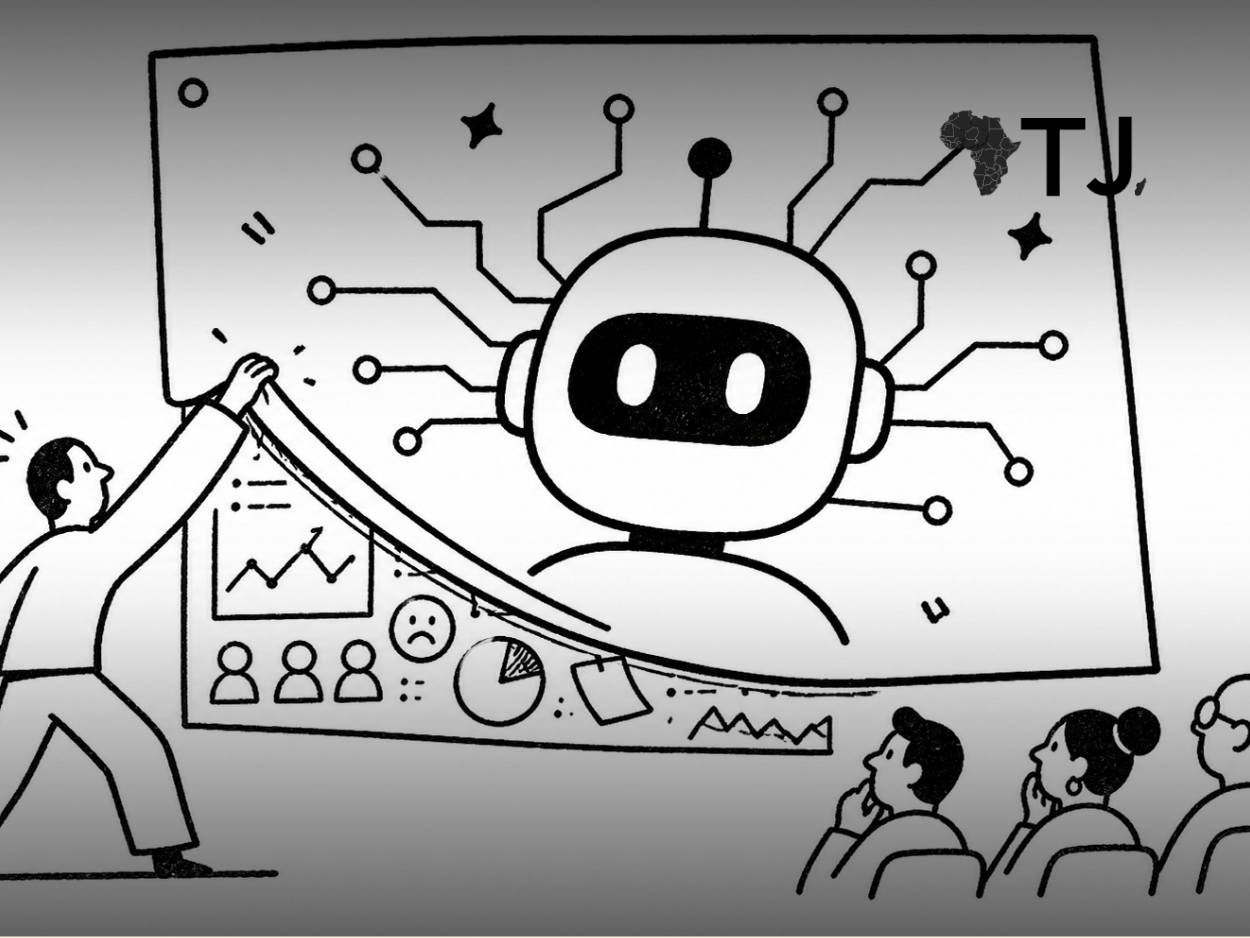
I’ve been reviewing startup pitches lately, and there is a shift that I cannot miss. Two years ago, decks led with the problem being solved, including the customer pain points, market gaps and real user needs. Now, slide one is almost always about AI. “We’re using AI to revolutionise…” “Our AI-powered platform…” “Leveraging artificial intelligence to transform…” My first instinct was to write this off as hype-chasing, another buzzword cycle like blockchain or the metaverse. However, after watching it repeat across dozens of pitches from founders who are clearly not stupid (PhDs, cracked engineers/operators), I think something more structural is going on.
The surface explanation is that founders put AI on slide one because investors want to see it. Fine, but that doesn’t explain why investors want to see it. The deeper thing is that AI has become shorthand for an answer to the question investors have always cared about most: “How do you scale this without it breaking?” Every scalable business eventually hits the same wall. You need more people to deliver more value, i.e., more customer service reps, more analysts, more operations staff and then the math stops working. AI became the credible answer to that problem, and once it did, it stopped being a feature and became infrastructure.
The timing matters too. In 2019, machine learning was expensive, complicated, and unreliable for most use cases. You needed specialised teams and massive datasets just to get something mediocre. By 2025, the technology could handle complex decisions with enough accuracy to actually change how a company operates day to day. So founders aren’t just slapping AI onto their decks for decoration — many of the business models that work now genuinely require it to function.
Founders, though, are missing the point of startup pitching.
When you build something that works because you figured out regulatory navigation, or you nailed the user experience, or you found a real gap in the market, and then you lead your pitch with “AI-powered platform” – you’ve buried the thing that actually makes it valuable. I’ve seen companies facilitate hundreds of business incorporations not because of some machine learning model, but because they understood how to work with regulatory authorities and make an intimidating process feel simple.
If those same companies pitched today, I guarantee slide one would say “AI-powered business incorporation.” And that framing would completely miss the point. The better pitch is just: “We solve X problem. Solving it requires doing Y at a massive scale. AI is how we keep the unit economics from falling apart.” That’s a tools-in-service-of-the-mission framing. What we’re getting instead is “We’re an AI company that happens to work in X industry,” which is a fundamentally different claim about what the company is.
There’s a split coming, and you can already see the edges of it. One camp is companies where AI genuinely is the product — they’re building models, infrastructure, foundational technology.
Leading with AI makes sense for them because AI is what they sell. The other camp is companies using AI as plumbing to solve real problems in specific industries, and for them, the industry problem should probably come first. Right now, both camps use the same pitch deck template, which muddies what’s actually being built. And most of the AI features being added to products right now aren’t that transformative anyway.
They’re helpful, they might improve efficiency by 10 or 20 percent, but they’re not the reason the business will succeed or fail. The companies I keep paying attention to are the ones that can tell you what problem they’re solving and why it matters before they ever mention their tech stack.
When I see a deck leading with AI now, I’ve started asking a simpler question: would this business work without it?
If the answer is no, I want to understand why. If the answer is yes, I start wondering what they’re not telling me about the actual business and whether AI on slide one is covering for a pitch that doesn’t know what it’s really about.
Tosin Oladokun is currently pursuing his MBA at UC Berkeley’s Haas School of Business. He previously worked as a Senior Product Manager-Technical Intern at Amazon and has built digital products across Nigeria and the United States.