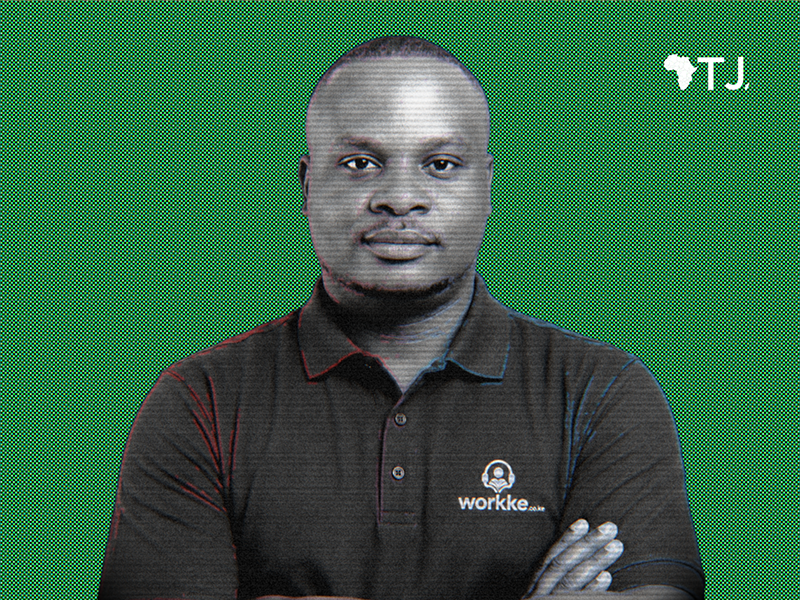
The Kenyan startup is moving beyond the traditional freelance marketplace to connect businesses with skilled professionals while addressing trust, payments, skills and access to digital work.
There are many skilled people across Africa who can design, write, develop software, manage social media, analyse data and provide other digital services.
There are also businesses that need those skills.
The problem is that having the skill and having access to the internet does not always translate into reliable earning opportunities. For businesses, finding someone online can raise questions about quality, accountability, trust and payment.
This gap became the starting point for WorkKE, a Kenyan digital work platform founded by Kennedy Mokaya Asiago in 2025.
The initial idea was relatively straightforward. Businesses could find skilled professionals while freelancers could find work.
But as people began using the platform, Kennedy and his team realised that connecting talent with businesses was only one part of the problem.
Access to digital work also depends on payments, trust, relevant skills, productivity tools, connectivity and, for some people, access to suitable devices.
That has gradually changed what WorkKE is trying to build.
Rather than becoming another freelance marketplace, the company wants to build a broader digital work ecosystem designed around African realities.
The problem is bigger than finding freelance work
Kennedy’s background in technology, digital systems and project management shaped his thinking about the opportunity.
He had seen talented young people using the internet while still struggling to convert their skills into sustainable income. At the same time, businesses often needed a graphic designer, developer, virtual assistant, marketer or data specialist for specific projects without necessarily needing to hire someone permanently.
There was a clear opportunity to connect the two sides.
But Kennedy was also interested in a broader question: what should digital work look like when the platform is designed around African users from the beginning rather than adapted from somewhere else?
That question continues to influence WorkKE’s product decisions.
The company started lean, relying on technology experience, knowledge of the local environment and the ability to build, test and learn from users.
That approach also brought another part of the African digital economy into focus: cybercafés.
There is often an assumption that participation in the digital economy requires a laptop, reliable broadband, strong digital skills and a comfortable place to work. That is not always the case.
For some communities, cybercafés remain important access points.
WorkKE is exploring whether these businesses can evolve beyond printing, internet access and government services into local gateways for digital work and commerce. More than 181 cybercafés are already part of the WorkKE ecosystem.
Trust is part of the product
One of the earliest challenges was trust.
When a business meets a freelancer online for the first time, it wants to know whether the person will deliver.
The freelancer has a similar concern: whether they will receive payment after completing the work.
For WorkKE, solving this problem meant thinking about secured payments, verification, milestones, reputation and dispute handling.
There was also the challenge of marketplace liquidity. A platform needs enough businesses and opportunities to attract professionals, while businesses need enough quality professionals to see value in using the platform.
At the same time, much of hiring in Kenya still happens through referrals, WhatsApp groups, friends and existing networks.
These channels are familiar and useful, so moving some of that behaviour onto a structured platform requires the platform to provide a clear reason for doing so.
The company also had to consider the economics of smaller jobs.
Not every business needs a large software project or a long-term consultant. Someone may need a poster designed, a document formatted, data entered or a short video edited.
Individually, these jobs may appear small, but collectively they represent another layer of economic activity.
That led WorkKE to think about micro-jobs and how smaller digital transactions could be made practical while maintaining quality, trust and fair value for the professional doing the work.
From a freelance marketplace to digital work infrastructure
WorkKE was digital from the beginning, but its understanding of what the technology needed to solve has changed.
Initially, the focus was largely on connecting businesses with freelancers. The company later recognised that matching talent was not enough.
A functioning digital work ecosystem also needs payments, reputation, trust, relevant skills and productivity tools.
WorkKE has since expanded into micro-jobs, digital products and skills development through WorkKE Academy, while also incorporating AI-enabled tools.
The company sees AI as potentially changing the economics of digital work, not only because of the possibility of automation, but because skilled professionals can use AI to become more productive.
A designer can explore ideas faster. A developer can build and test faster. A marketer can analyse and create faster. A virtual assistant can automate repetitive tasks.
That creates another opportunity for WorkKE: helping people become more productive and competitive as the nature of digital work changes.
The company’s workflow is increasingly structured around a journey that moves from discovery to agreement, secured payment, delivery, reputation and repeat work.
The numbers behind WorkKE’s first year
Since launching in 2025, WorkKE has grown to more than 7,936 registered users, including over 7,436 freelancers and 181 cybercafés.
The platform has also facilitated more than KES 5 million in freelancer payouts.
For Kennedy, however, registrations are not the strongest measure of progress.
A more meaningful outcome is when a business finds someone who can solve a real problem, the work is completed successfully and a professional earns money from their skill.
That distinction is important for a marketplace business. A large number of registrations can indicate interest, but completed work and actual earnings provide a clearer indication that the platform is creating economic value.
WorkKE’s growth is also not limited to Nairobi.
The company believes technology can reduce the importance of geography when it comes to accessing work. A professional in Kisii, Kisumu or Bungoma should not necessarily have to relocate to Nairobi to work with a Nairobi-based business.
Over time, the same principle could apply across African markets, allowing professionals to work with clients based elsewhere based primarily on capability rather than location.
Why the cybercafé network matters
One of the more unusual parts of WorkKE’s model is its relationship with cybercafés.
Rather than seeing them as remnants of an earlier phase of the internet, the company sees an opportunity to turn some of them into local nodes of the digital economy.
A cybercafé already has computers, connectivity, people with some digital skills and relationships within its community.
WorkKE is exploring whether these spaces can become places where someone creates their first professional profile, learns a digital skill, accesses freelance opportunities, sells digital products or provides services to businesses elsewhere.
With more than 181 cybercafés already represented in the ecosystem, the company sees the network as a possible bridge between physical access and digital opportunity.
Building locally without limiting the ambition
For Kennedy, building an African technology company does not mean simply taking a global business model and adding local features.
It means allowing the realities of the market to influence product decisions.
That includes local payment methods, affordability, smaller transactions, different devices and connectivity conditions, as well as the continued role of cybercafés in many communities.
The goal is to build technology that can compete globally without losing the local understanding that made the product relevant in the first place.
This also informs one of Kennedy’s central lessons from building WorkKE: start with the problem rather than the technology.
Technology changes quickly, but many human and business problems change much more slowly.
He also believes founders need to pay attention to what users actually do rather than relying only on what they say they want. Several WorkKE product decisions have come from observing how people interact with the platform.
Another lesson is that African founders should not automatically assume that localisation means copying a successful global product and adding local payments. In some cases, the environment requires a fundamentally different product.
What WorkKE wants to build next
WorkKE’s ambition is now bigger than becoming another freelance marketplace.
The company wants to become part of the infrastructure supporting digital work across Africa.
That means improving how businesses discover talent, strengthening trust and payments, helping professionals develop relevant skills, using AI to increase individual productivity and expanding access to the digital economy.
The cybercafé network will be an important part of that plan.
If the model works, a cybercafé in a smaller Kenyan town could become a place where someone creates their first professional profile, learns to use AI, accesses their first freelance opportunity or provides digital services to a business hundreds of kilometres away.
The company is also thinking about what happens as AI becomes more integrated into professional work.
Rather than framing the future entirely as humans versus AI, Kennedy sees an opportunity for professionals who know how to work effectively with AI to become significantly more capable.
The challenge will be ensuring that technology increases people’s ability to create value rather than simply driving prices down.
If funding or strategic partnerships become available, WorkKE plans to prioritise four areas: trust infrastructure, demand, skills and AI-enabled productivity, and access and distribution.
The objective is not simply to acquire more users. It is to increase the amount of real economic activity and opportunity created through the ecosystem.
A wider opportunity for African talent
The long-term opportunity WorkKE sees is not limited to Kenya.
Across Africa, talent exists in places that are often disconnected from the companies and opportunities that could benefit from those skills.
Technology can reduce some of that distance, but technology alone is not enough.
Professionals need skills. Businesses need trust. Both sides need reliable payment systems. People need access to devices and connectivity. Businesses also need to become more comfortable hiring based on capability rather than proximity.
That is why WorkKE’s ambition goes beyond creating another website where companies post jobs.
For Kennedy, the larger possibility is an ecosystem where a skilled person in a smaller Kenyan town can create value for a company in Nairobi, Lagos, Johannesburg, London or somewhere else entirely.
Kenya is the starting point, but the longer-term opportunity is African.
If WorkKE can connect talent, businesses, technology, trust and local access infrastructure, it could become part of the infrastructure through which more African talent participates in the digital economy.
WorkKE is still early in that journey. But its approach points to a broader question for Africa’s future of work: how do we build digital systems that do not only connect people to opportunities, but also give them the trust, skills, payments and access needed to actually participate?
This article is based on an interview with Kennedy Mokaya Asiago, founder of WorkKE, conducted by African Tech Journal.