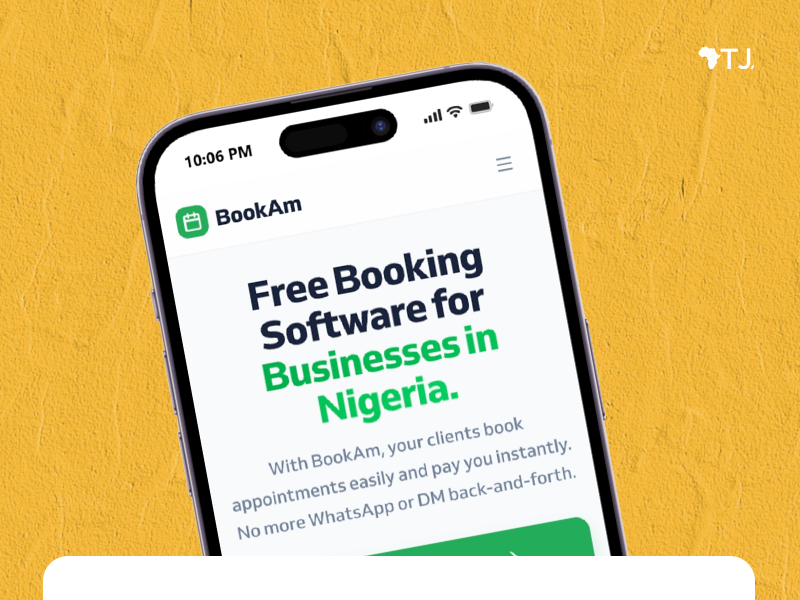
The Nigerian-built booking platform is helping service professionals replace WhatsApp back-and-forth with a simpler way to manage appointments, collect deposits, and keep customers informed.
For many service businesses in Nigeria, a booking can begin with a simple WhatsApp message.
A customer asks for availability. The business owner checks their schedule, responds, confirms a time, sends payment details, waits for a transfer screenshot, and then manually records the appointment.
Then comes another message.
And another.
As the business grows, so does the number of conversations to manage.
For barbers, makeup artists, photographers, tutors, consultants, fitness trainers, salons, and other appointment-based businesses, WhatsApp has become an important part of how they communicate with customers. But it was never designed to be a booking management system.
That gap is what BookAm is building around.
From WhatsApp conversations to structured bookings BookAm is a booking and payment platform built specifically for Nigerian service businesses.
The idea is straightforward: instead of asking customers to message a business every time they want to book, businesses can create a professional booking page that handles the process for them.
A business owner can add their services, prices, working hours, and availability. They can then share their personal BookAm booking link through WhatsApp, Instagram, TikTok, or anywhere else their customers already find them.
Customers open the link, choose a service, select an available time, and pay a deposit or the required amount to secure the appointment.
The booking is then confirmed automatically.
For the business owner, the entire process is managed from a single dashboard.
The goal is not to replace the conversations businesses have with their customers. It is to remove the repetitive conversations that do not need to happen in the first place.
Why the problem matters
The problem with manual booking becomes more obvious as a service business gets busier.
A business owner may be working with a customer while another person is asking about availability. Someone else may be requesting a price. Another customer may have sent a payment screenshot that needs to be confirmed.
Then there are the customers who forget their appointments.
For businesses where every appointment represents a limited and valuable time slot, a missed appointment can mean lost revenue that cannot be recovered.
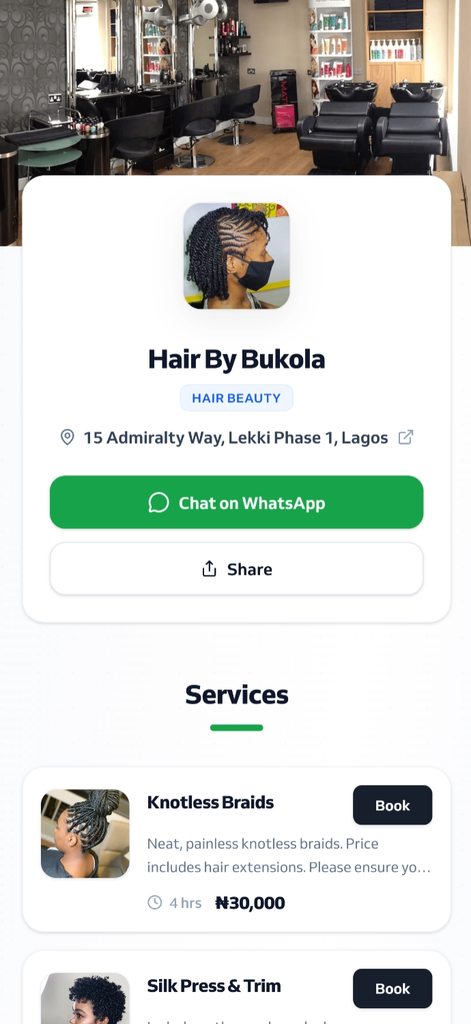
BookAm approaches these problems by turning the booking process into a structured workflow.
Customers can see the services available, choose a time based on the business’s availability, and make the required payment without waiting for the business owner to respond manually.
BookAm also sends automated booking confirmations and appointment reminders through WhatsApp and email, reducing the amount of manual follow-up required from the business.
Built around how Nigerian businesses already operate
One of BookAm’s biggest design decisions is to avoid forcing service professionals to completely change how they reach customers.
Many already have an audience on WhatsApp, Instagram, TikTok, or other social platforms. BookAm gives them a booking link they can place where their customers already are.
There is no mobile app that customers need to download before making an appointment. A customer can simply open the booking page in a browser, select a service and time, and complete the booking.
Payments are also designed around the Nigerian market, with customers able to pay through supported local payment methods.
The platform is built to keep the experience familiar for both sides while making the underlying booking process more structured.
More than just a booking link
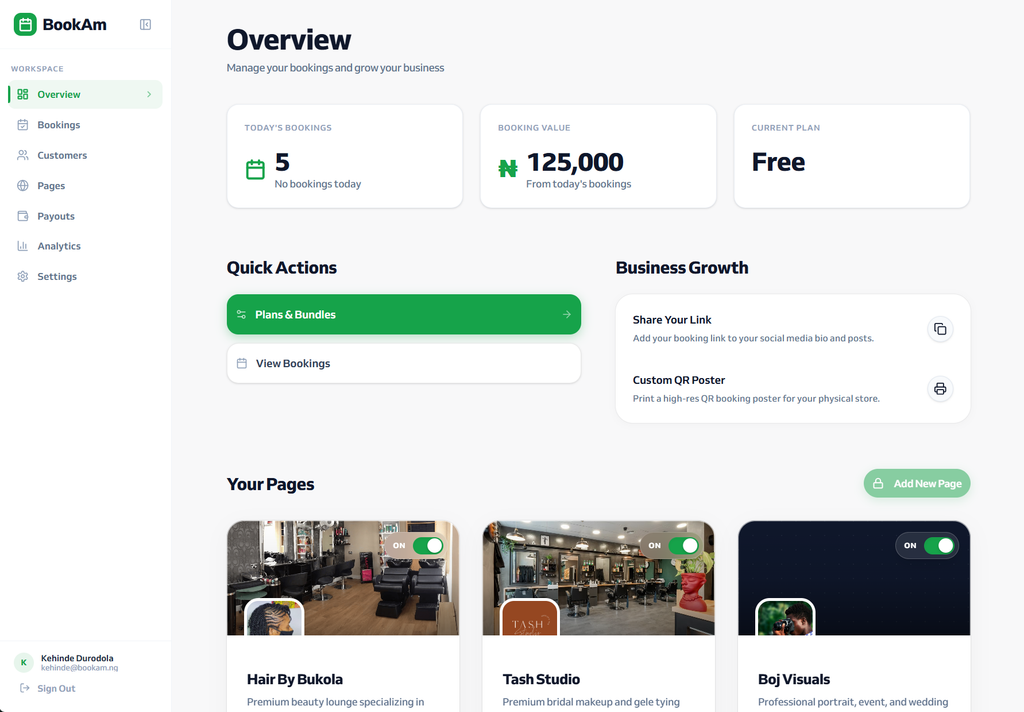
While the booking page is the part customers see, BookAm is designed to give business owners more control behind the scenes.
Businesses can manage bookings and customers from a central dashboard, track their booking activity, manage services and availability, and give staff members or branch managers their own access where needed.
The platform also includes features such as client management, analytics, QR-based booking, and automated notifications.
The idea is to give service businesses the operational structure they need without forcing them into a complicated enterprise system.
For a small business owner, the software should feel like something that removes work rather than something that creates more of it.
Why Kehinde Durodola built BookAm
BookAm was built by Kehinde Durodola, a software engineer who wanted to solve a problem he kept seeing among Nigerian service professionals.
For Kehinde, the opportunity was not simply to build another generic scheduling tool. The goal was to build something that understood the realities of the businesses it was serving.
That meant thinking about how Nigerian businesses communicate with customers, how they collect payments, how customers discover them, and how important upfront deposits can be for businesses whose income depends on appointments being kept.
It also meant building the product around the idea that the business owner should not need to become a technology expert to use it.
“BookAm” itself reflects that local approach. The name comes from the Nigerian expression “book am”, meaning “book it”. It is short, familiar, and intentionally local.
Starting free
BookAm is available for businesses to start using without a monthly subscription.
The platform operates on a model where businesses can create their booking pages and begin accepting appointments without committing to a recurring software subscription.
For an early-stage service business, the goal is to make the first step as easy as possible: create an account, set up services and availability, share the booking link, and start accepting bookings.
The company believes that the software should first prove its value to the business before asking the business to make a larger commitment.
Building with the businesses, not just for them
BookAm officially launched in 2026 and is now onboarding its first set of service businesses across Nigeria.
At this stage, the company is focused heavily on conversations with business owners and understanding how they currently manage bookings.
Those conversations are already influencing how the product evolves.
For Kehinde, launching the software is not the end of the development process. It is the beginning of a much more important phase: seeing how real businesses use it, where they struggle, and what needs to be improved.
The long-term ambition is bigger than simply providing another booking link.
BookAm wants to become the default appointment software for Nigeria’s service businesses, giving independent professionals and growing service teams the infrastructure to manage bookings, payments, customers, and appointments more professionally.
The market is still early.
But the problem is already familiar.
For thousands of service businesses, the next customer booking may still arrive as a WhatsApp message.
BookAm wants to make what happens after that message much simpler.