Category: Tech stories

  • Givr Wants to Give Volunteering in Nigeria the Infrastructure It Has Been Missing

    Givr Wants to Give Volunteering in Nigeria the Infrastructure It Has Been Missing

    For many young Nigerians, the desire to give back is not the problem. Finding where to start often is.

    A student may want to volunteer at an organisation, support a community project or contribute their time to a cause they care about, but opportunities are often discovered through WhatsApp groups, social media posts, friends or personal networks. There is rarely a central place to find verified opportunities, apply, participate and keep a record of the work done.

    That gap is what led to Givr.

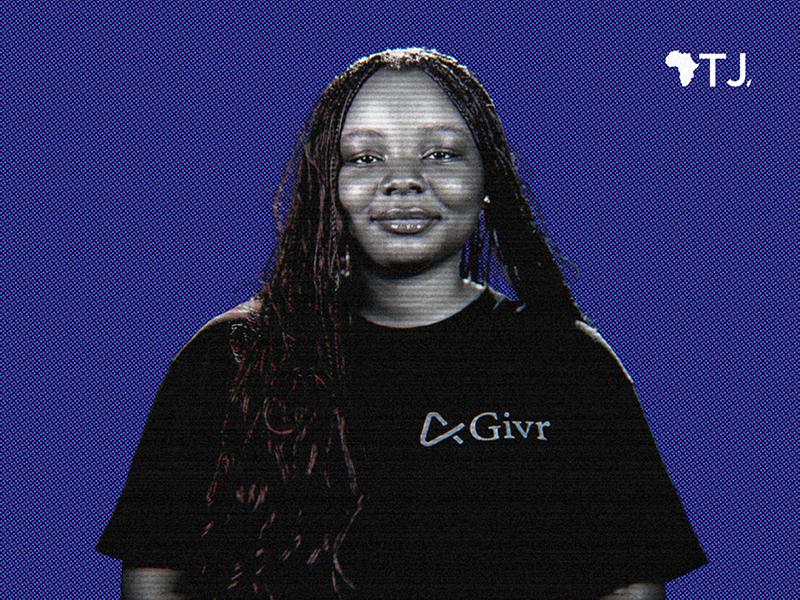
    The idea started from a personal experience with volunteering. Stephanie Lakpa had always wanted to give back, but as a student, money was not something she had much of. What she did have was time and the willingness to help. In her first year at university, a friend invited her to visit an orphanage with a small group of friends.

    It was a simple outing, but it stayed with her.

    Over time, she kept accepting opportunities to volunteer while wondering about the people who wanted to help but did not know where to find those opportunities. Conversations with volunteers and organisations later revealed that the problem extended beyond discovery.

    Organisations were also dealing with the administrative work behind volunteering: reviewing applications, confirming participants, communicating with volunteers, tracking attendance, issuing certificates and recognising contributions.

    Givr was created to bring those two sides together.

    Turning Volunteering Into a Structured Experience

    The platform allows organisations to publish volunteer opportunities, review applications, accept volunteers and confirm project completion. Volunteers can discover opportunities, apply and build a record of the projects they have completed.

    Givr also verifies organisations through VerifyMe, creating an additional layer of trust for people looking for opportunities.

    This matters because volunteering in Nigeria has largely remained informal. A person may find an opportunity through someone they know, show up and contribute, but have little formal evidence that the experience happened.

    Givr is attempting to change that by creating a digital record of participation.

    A volunteer can build a profile that reflects their contributions over time, while organisations can maintain records of the people who participated in their programmes.

    The company describes this as building infrastructure rather than simply running campaigns.

    Early Signs of Demand

    Givr launched with a focus on Abuja, but its early adoption has extended beyond the city.

    The platform now has more than 200 verified volunteers and about 30 registered organisations across 20 Nigerian states, with more than 10 verified opportunities listed. It has also facilitated projects including a six-week menstrual health initiative, outreach programmes and a conference.

    One of the milestones that stands out for the founder is seeing an organisation return to the platform.

    The Greener Basket for Nutrition and Agriculture Foundation was among the first organisations to list a project on Givr. After successfully recruiting volunteers and completing the project, the organisation returned to post another opportunity.

    For the team, the return was more meaningful than simply attracting another new user. It showed that the platform had become useful enough for an organisation to rely on again.

    The distribution of volunteers has also revealed something about the demand for structured volunteering in Nigeria. Although Givr launched in Abuja, people from 20 states signed up without the company physically expanding into those locations.

    A young person in Kaduna, for example, can discover an opportunity in Abuja, apply and build a record of their contribution without relying on an existing personal connection.

    Building Trust Around Volunteering

    For Givr, technology is not simply about making volunteering easier to find.

    It is also about creating trust.

    Organisations need confidence that volunteers will show up and participate. Volunteers need confidence that organisations and opportunities are legitimate. Givr is building toward a system where verification, applications, ratings and participation records can help establish that trust over time.

    The company has also learned that signing up is not the same as volunteering.

    Some people create accounts because they believe in the idea, but getting them to apply, show up and commit requires opportunities that genuinely align with their interests.

    That has pushed Givr to think less about the number of people on the platform and more about the quality of the experiences it creates.

    Building for a Culture That Already Exists

    Givr is not trying to introduce volunteering to Nigeria.

    Giving back has always existed within Nigerian communities. What the company sees as missing is the structure around it.

    The founder points to a culture where people show up for neighbours, communities and causes, but where those contributions can disappear without a record.

    Givr’s approach is to give that existing behaviour infrastructure.

    The team has also remained close to the work itself, with the founder participating in projects including an IDP camp outreach and the SHE Initiative’s menstrual health programme. That proximity has helped keep product decisions connected to the people the platform is intended to serve.

    What Comes Next for Givr

    For now, the priority is strengthening the platform in Abuja before expanding into other Nigerian states.

    The roadmap includes a deeper analytics and volunteer management system for organisations, including volunteer retention data, attendance history and downloadable impact reports. Givr also plans to allow individuals to create and lead their own volunteer initiatives on the platform.

    Longer term, the ambition is to become the infrastructure for volunteering across Nigeria.

    That could eventually mean a young person building a volunteering record from secondary school, carrying it through university and into their career.

    For Givr, the bigger opportunity is not simply helping people find volunteer opportunities.

    It is creating a system where showing up for others becomes easier to discover, easier to organise and easier to prove.

    As Nigeria’s civic and social impact ecosystem becomes increasingly digital, Givr is betting that volunteering can move from something people discover informally to something that has the same structure and visibility people now expect from other parts of their digital lives.

  • WorkKE Wants to Build the Digital Work Infrastructure Africa’s Talent Needs

    WorkKE Wants to Build the Digital Work Infrastructure Africa’s Talent Needs

    The Kenyan startup is moving beyond the traditional freelance marketplace to connect businesses with skilled professionals while addressing trust, payments, skills and access to digital work.

    There are many skilled people across Africa who can design, write, develop software, manage social media, analyse data and provide other digital services.

    There are also businesses that need those skills.

    The problem is that having the skill and having access to the internet does not always translate into reliable earning opportunities. For businesses, finding someone online can raise questions about quality, accountability, trust and payment.

    This gap became the starting point for WorkKE, a Kenyan digital work platform founded by Kennedy Mokaya Asiago in 2025.

    The initial idea was relatively straightforward. Businesses could find skilled professionals while freelancers could find work.

    But as people began using the platform, Kennedy and his team realised that connecting talent with businesses was only one part of the problem.

    Access to digital work also depends on payments, trust, relevant skills, productivity tools, connectivity and, for some people, access to suitable devices.

    That has gradually changed what WorkKE is trying to build.

    Rather than becoming another freelance marketplace, the company wants to build a broader digital work ecosystem designed around African realities.

    The problem is bigger than finding freelance work

    Kennedy’s background in technology, digital systems and project management shaped his thinking about the opportunity.

    He had seen talented young people using the internet while still struggling to convert their skills into sustainable income. At the same time, businesses often needed a graphic designer, developer, virtual assistant, marketer or data specialist for specific projects without necessarily needing to hire someone permanently.

    There was a clear opportunity to connect the two sides.

    But Kennedy was also interested in a broader question: what should digital work look like when the platform is designed around African users from the beginning rather than adapted from somewhere else?

    That question continues to influence WorkKE’s product decisions.

    The company started lean, relying on technology experience, knowledge of the local environment and the ability to build, test and learn from users.

    That approach also brought another part of the African digital economy into focus: cybercafés.

    There is often an assumption that participation in the digital economy requires a laptop, reliable broadband, strong digital skills and a comfortable place to work. That is not always the case.

    For some communities, cybercafés remain important access points.

    WorkKE is exploring whether these businesses can evolve beyond printing, internet access and government services into local gateways for digital work and commerce. More than 181 cybercafés are already part of the WorkKE ecosystem.

    Trust is part of the product

    One of the earliest challenges was trust.

    When a business meets a freelancer online for the first time, it wants to know whether the person will deliver.

    The freelancer has a similar concern: whether they will receive payment after completing the work.

    For WorkKE, solving this problem meant thinking about secured payments, verification, milestones, reputation and dispute handling.

    There was also the challenge of marketplace liquidity. A platform needs enough businesses and opportunities to attract professionals, while businesses need enough quality professionals to see value in using the platform.

    At the same time, much of hiring in Kenya still happens through referrals, WhatsApp groups, friends and existing networks.

    These channels are familiar and useful, so moving some of that behaviour onto a structured platform requires the platform to provide a clear reason for doing so.

    The company also had to consider the economics of smaller jobs.

    Not every business needs a large software project or a long-term consultant. Someone may need a poster designed, a document formatted, data entered or a short video edited.

    Individually, these jobs may appear small, but collectively they represent another layer of economic activity.

    That led WorkKE to think about micro-jobs and how smaller digital transactions could be made practical while maintaining quality, trust and fair value for the professional doing the work.

    From a freelance marketplace to digital work infrastructure

    WorkKE was digital from the beginning, but its understanding of what the technology needed to solve has changed.

    Initially, the focus was largely on connecting businesses with freelancers. The company later recognised that matching talent was not enough.

    A functioning digital work ecosystem also needs payments, reputation, trust, relevant skills and productivity tools.

    WorkKE has since expanded into micro-jobs, digital products and skills development through WorkKE Academy, while also incorporating AI-enabled tools.

    The company sees AI as potentially changing the economics of digital work, not only because of the possibility of automation, but because skilled professionals can use AI to become more productive.

    A designer can explore ideas faster. A developer can build and test faster. A marketer can analyse and create faster. A virtual assistant can automate repetitive tasks.

    That creates another opportunity for WorkKE: helping people become more productive and competitive as the nature of digital work changes.

    The company’s workflow is increasingly structured around a journey that moves from discovery to agreement, secured payment, delivery, reputation and repeat work.

    The numbers behind WorkKE’s first year

    Since launching in 2025, WorkKE has grown to more than 7,936 registered users, including over 7,436 freelancers and 181 cybercafés.

    The platform has also facilitated more than KES 5 million in freelancer payouts.

    For Kennedy, however, registrations are not the strongest measure of progress.

    A more meaningful outcome is when a business finds someone who can solve a real problem, the work is completed successfully and a professional earns money from their skill.

    That distinction is important for a marketplace business. A large number of registrations can indicate interest, but completed work and actual earnings provide a clearer indication that the platform is creating economic value.

    WorkKE’s growth is also not limited to Nairobi.

    The company believes technology can reduce the importance of geography when it comes to accessing work. A professional in Kisii, Kisumu or Bungoma should not necessarily have to relocate to Nairobi to work with a Nairobi-based business.

    Over time, the same principle could apply across African markets, allowing professionals to work with clients based elsewhere based primarily on capability rather than location.

    Why the cybercafé network matters

    One of the more unusual parts of WorkKE’s model is its relationship with cybercafés.

    Rather than seeing them as remnants of an earlier phase of the internet, the company sees an opportunity to turn some of them into local nodes of the digital economy.

    A cybercafé already has computers, connectivity, people with some digital skills and relationships within its community.

    WorkKE is exploring whether these spaces can become places where someone creates their first professional profile, learns a digital skill, accesses freelance opportunities, sells digital products or provides services to businesses elsewhere.

    With more than 181 cybercafés already represented in the ecosystem, the company sees the network as a possible bridge between physical access and digital opportunity.

    Building locally without limiting the ambition

    For Kennedy, building an African technology company does not mean simply taking a global business model and adding local features.

    It means allowing the realities of the market to influence product decisions.

    That includes local payment methods, affordability, smaller transactions, different devices and connectivity conditions, as well as the continued role of cybercafés in many communities.

    The goal is to build technology that can compete globally without losing the local understanding that made the product relevant in the first place.

    This also informs one of Kennedy’s central lessons from building WorkKE: start with the problem rather than the technology.

    Technology changes quickly, but many human and business problems change much more slowly.

    He also believes founders need to pay attention to what users actually do rather than relying only on what they say they want. Several WorkKE product decisions have come from observing how people interact with the platform.

    Another lesson is that African founders should not automatically assume that localisation means copying a successful global product and adding local payments. In some cases, the environment requires a fundamentally different product.

    What WorkKE wants to build next

    WorkKE’s ambition is now bigger than becoming another freelance marketplace.

    The company wants to become part of the infrastructure supporting digital work across Africa.

    That means improving how businesses discover talent, strengthening trust and payments, helping professionals develop relevant skills, using AI to increase individual productivity and expanding access to the digital economy.

    The cybercafé network will be an important part of that plan.

    If the model works, a cybercafé in a smaller Kenyan town could become a place where someone creates their first professional profile, learns to use AI, accesses their first freelance opportunity or provides digital services to a business hundreds of kilometres away.

    The company is also thinking about what happens as AI becomes more integrated into professional work.

    Rather than framing the future entirely as humans versus AI, Kennedy sees an opportunity for professionals who know how to work effectively with AI to become significantly more capable.

    The challenge will be ensuring that technology increases people’s ability to create value rather than simply driving prices down.

    If funding or strategic partnerships become available, WorkKE plans to prioritise four areas: trust infrastructure, demand, skills and AI-enabled productivity, and access and distribution.

    The objective is not simply to acquire more users. It is to increase the amount of real economic activity and opportunity created through the ecosystem.

    A wider opportunity for African talent

    The long-term opportunity WorkKE sees is not limited to Kenya.

    Across Africa, talent exists in places that are often disconnected from the companies and opportunities that could benefit from those skills.

    Technology can reduce some of that distance, but technology alone is not enough.

    Professionals need skills. Businesses need trust. Both sides need reliable payment systems. People need access to devices and connectivity. Businesses also need to become more comfortable hiring based on capability rather than proximity.

    That is why WorkKE’s ambition goes beyond creating another website where companies post jobs.

    For Kennedy, the larger possibility is an ecosystem where a skilled person in a smaller Kenyan town can create value for a company in Nairobi, Lagos, Johannesburg, London or somewhere else entirely.

    Kenya is the starting point, but the longer-term opportunity is African.

    If WorkKE can connect talent, businesses, technology, trust and local access infrastructure, it could become part of the infrastructure through which more African talent participates in the digital economy.

    WorkKE is still early in that journey. But its approach points to a broader question for Africa’s future of work: how do we build digital systems that do not only connect people to opportunities, but also give them the trust, skills, payments and access needed to actually participate?

    This article is based on an interview with Kennedy Mokaya Asiago, founder of WorkKE, conducted by African Tech Journal.

  • FinRik LOC Surpasses ₦500 Million in SME Loan Disbursements with 90%
Repayment Rate as FinRik Ecosystem Reaches 1,500+ Businesses

    FinRik LOC Surpasses ₦500 Million in SME Loan Disbursements with 90% Repayment Rate as FinRik Ecosystem Reaches 1,500+ Businesses


    Self-funded lending arm has disbursed over ₦500 million since 2022 at an average loan size of ₦250,000, supported by proprietary AI-powered financial analytics platform Ava Analytics

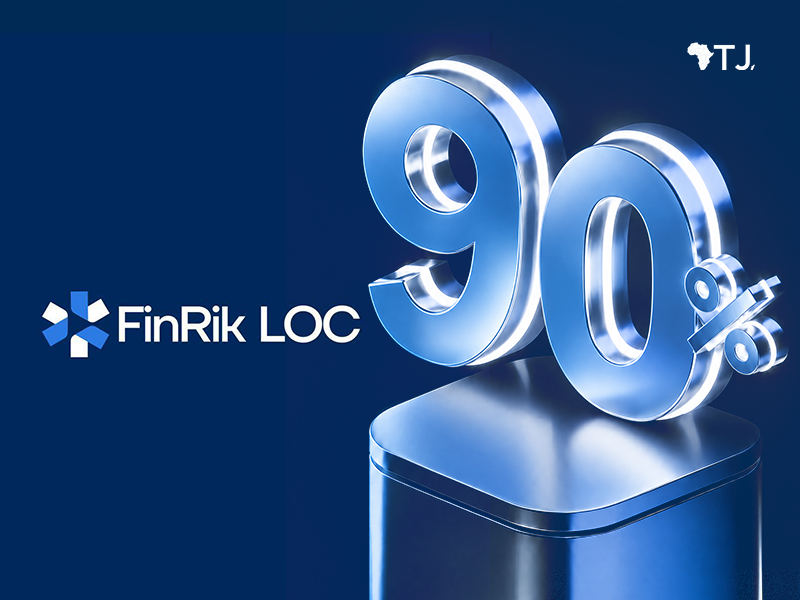
    FinRik LOC, the SME lending platform operated by FinRik Technologies, has surpassed ₦500 million in cumulative loan disbursements since its launch in 2022, maintaining a 90% repayment rate across its credit products.

    The majority of FinRik LOC’s lending has been funded from FinRik’s own balance sheet since inception, as the company has developed its lending infrastructure alongside its broader business technology ecosystem.

    FinRik LOC began as a credit offering for users of FinRik Shop, FinRik’s no-code e-commerce website builder, which later evolved into Ava Books, the company’s bookkeeping and financial management platform.

    The lending business crossed its first ₦10 million in disbursements in August 2022. As Ava Books expanded its financial management capabilities, FinRik LOC evolved alongside it, extending access to a broader base of small and growing businesses.

    In June 2026, FinRik launched V3 of FinRik LOC, expanding its credit infrastructure and product offering.

    Today, FinRik’s business technology ecosystem reaches more than 1,500 businesses across its products, including Ava Books, FinRik LOC and its newly launched procurement platform, Roadkit.

    FinRik LOC currently offers Business Term Loans, Founders Credit and Revolving Credit, with an average loan size of approximately ₦250,000, reflecting its focus on the working-capital needs of small and growing businesses.

    Building AI and Data Science Infrastructure for SMEs
    Alongside its lending infrastructure, FinRik has developed Ava Analytics, an internally built AI-powered financial analytics and data science platform designed to transform raw business and financial information into structured financial intelligence.

    At the core of Ava Analytics is Sophia, FinRik’s internally developed AI-powered data science system. Sophia coordinates a multi-stage analytical workflow that processes financial information, including bank statements, sales records and other business documents.
    The system is designed to identify data structures and quality issues, prepare and analyse datasets, perform exploratory analysis, develop and evaluate predictive models, and generate structured analytical outputs.

    Rather than relying on a single AI prompt, Sophia coordinates multiple analytical stages to transform complex financial datasets into structured and interpretable insights.

    From Business Records to Lending Intelligence

    One of the key applications of Ava Analytics is loan-readiness analysis.
    Sophia analyses historical financial performance, cash-flow stability, financial variance andother business indicators to generate insights that support underwriting, financial decision-making and recommended loan-size ranges.

    This infrastructure connects FinRik’s financial management, analytics and lending products, allowing the company to build a deeper understanding of how small businesses operate and
    develop financial products around their needs.

    Commenting on the milestone, Segun Awoniyi, CEO and Founder of FinRik Technologies, said: “Building FinRik LOC has always been about more than simply providing loans.

    Since we crossed our first ₦10 million in disbursements in August 2022, the majority of our lending growth has been powered by FinRik’s own balance sheet.

    “We have evolved from serving users of FinRik Shop to building technology that helps us understand businesses better and create financial products around the realities of how they
    operate.

    While Ava Books is an important part of our ecosystem, FinRik LOC is not limited to Ava Books users. Our ambition is to make our credit products available to as many viable SMEs as possible.


    “My background in data science has also shaped how we approach financial technology at FinRik. We are combining business data, AI and predictive modelling with lending to build more intelligent financial infrastructure for SMEs.

    Our 90% repayment rate is an encouraging indicator that this approach can support better financial decision-making and access to
    credit.”

    ₦500 Million in SME Financing

    The ₦500 million milestone represents cumulative disbursements through FinRik LOC across its credit products since 2022, at an average loan size of approximately ₦250,000.

    With more than 1,500 businesses reached across its ecosystem and a 90% repayment rate, FinRik plans to continue expanding its SME technology and financial products while investing in AI and data science capabilities that improve financial decision-making and
    access to credit.

    The company also plans to introduce additional financing products, including trade financing, leveraging its newly launched procurement platform, Roadkit, to connect SME procurement needs with access to financing.

  • BookAm wants to become the default appointment software for service businesses in Nigeria

    BookAm wants to become the default appointment software for service businesses in Nigeria

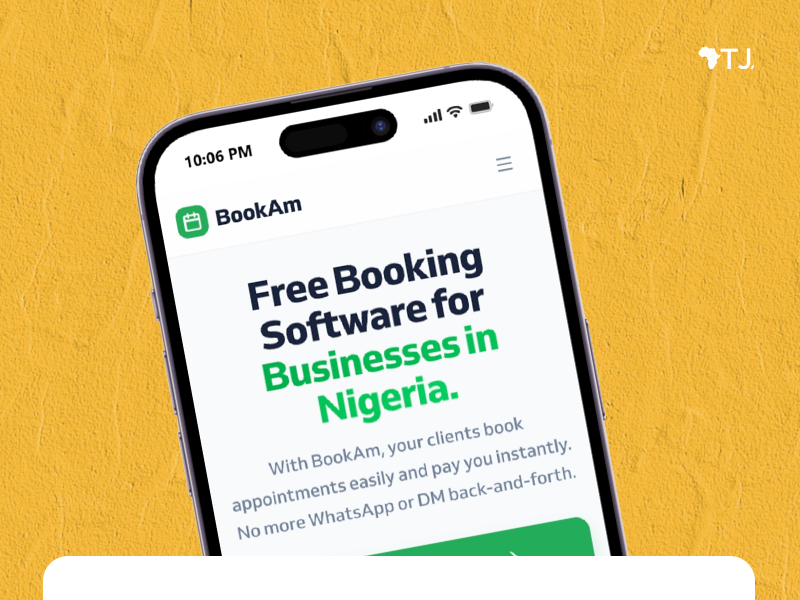
    The Nigerian-built booking platform is helping service professionals replace WhatsApp back-and-forth with a simpler way to manage appointments, collect deposits, and keep customers informed. 

    For many service businesses in Nigeria, a booking can begin with a simple WhatsApp message. 

    A customer asks for availability. The business owner checks their schedule, responds, confirms a time, sends payment details, waits for a transfer screenshot, and then manually records the appointment. 

    Then comes another message. 

    And another. 

    As the business grows, so does the number of conversations to manage. 

    For barbers, makeup artists, photographers, tutors, consultants, fitness trainers, salons, and other appointment-based businesses, WhatsApp has become an important part of how they communicate with customers. But it was never designed to be a booking management system. 

    That gap is what BookAm is building around. 

    From WhatsApp conversations to structured bookings BookAm is a booking and payment platform built specifically for Nigerian service businesses. 

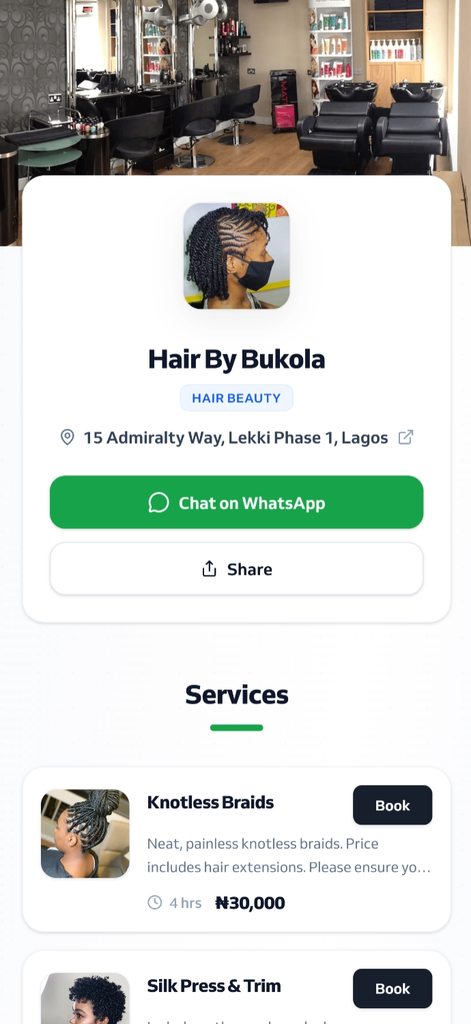
    The idea is straightforward: instead of asking customers to message a business every time they want to book, businesses can create a professional booking page that handles the process for them. 

    A business owner can add their services, prices, working hours, and availability. They can then share their personal BookAm booking link through WhatsApp, Instagram, TikTok, or anywhere else their customers already find them. 

    Customers open the link, choose a service, select an available time, and pay a deposit or the required amount to secure the appointment.

    The booking is then confirmed automatically. 

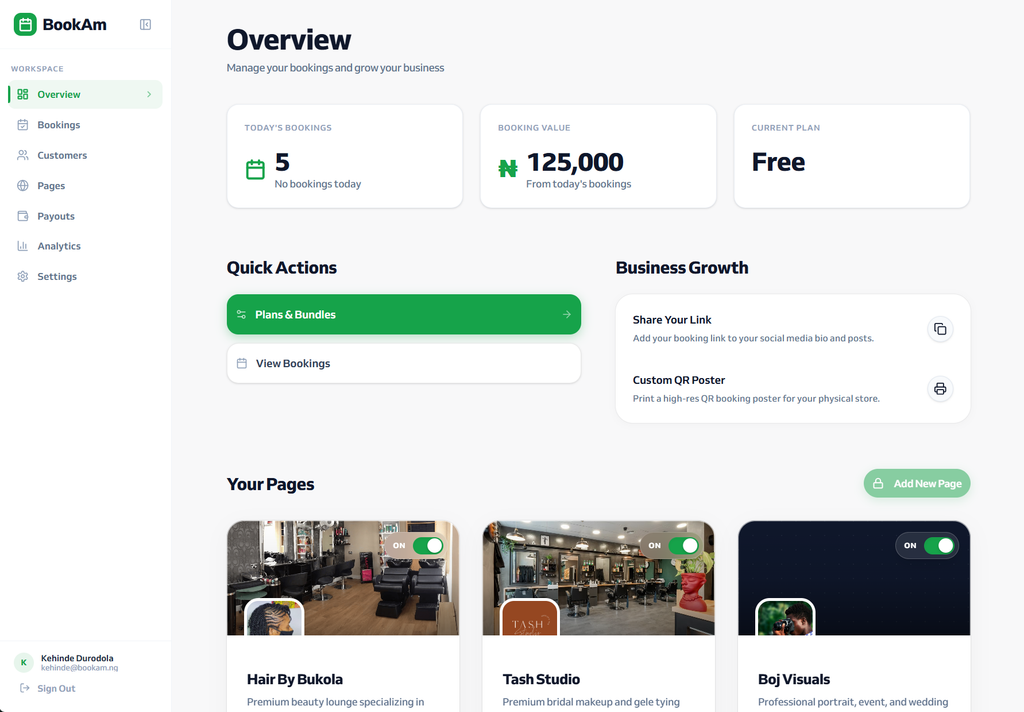
    For the business owner, the entire process is managed from a single dashboard. 

    The goal is not to replace the conversations businesses have with their customers. It is to remove the repetitive conversations that do not need to happen in the first place. 

    Why the problem matters 

    The problem with manual booking becomes more obvious as a service business gets busier. 

    A business owner may be working with a customer while another person is asking about availability. Someone else may be requesting a price. Another customer may have sent a payment screenshot that needs to be confirmed. 

    Then there are the customers who forget their appointments. 

    For businesses where every appointment represents a limited and valuable time slot, a missed appointment can mean lost revenue that cannot be recovered. 

    BookAm approaches these problems by turning the booking process into a structured workflow. 

    Customers can see the services available, choose a time based on the business’s availability, and make the required payment without waiting for the business owner to respond manually. 

    BookAm also sends automated booking confirmations and appointment reminders through WhatsApp and email, reducing the amount of manual follow-up required from the business. 

    Built around how Nigerian businesses already operate 

    One of BookAm’s biggest design decisions is to avoid forcing service professionals to completely change how they reach customers. 

    Many already have an audience on WhatsApp, Instagram, TikTok, or other social platforms. BookAm gives them a booking link they can place where their customers already are. 

    There is no mobile app that customers need to download before making an appointment. A customer can simply open the booking page in a browser, select a service and time, and complete the booking. 

    Payments are also designed around the Nigerian market, with customers able to pay through supported local payment methods.

    The platform is built to keep the experience familiar for both sides while making the underlying booking process more structured. 

    More than just a booking link 

    While the booking page is the part customers see, BookAm is designed to give business owners more control behind the scenes. 

    Businesses can manage bookings and customers from a central dashboard, track their booking activity, manage services and availability, and give staff members or branch managers their own access where needed. 

    The platform also includes features such as client management, analytics, QR-based booking, and automated notifications. 

    The idea is to give service businesses the operational structure they need without forcing them into a complicated enterprise system. 

    For a small business owner, the software should feel like something that removes work rather than something that creates more of it. 

    Why Kehinde Durodola built BookAm 

    BookAm was built by Kehinde Durodola, a software engineer who wanted to solve a problem he kept seeing among Nigerian service professionals. 

    For Kehinde, the opportunity was not simply to build another generic scheduling tool. The goal was to build something that understood the realities of the businesses it was serving. 

    That meant thinking about how Nigerian businesses communicate with customers, how they collect payments, how customers discover them, and how important upfront deposits can be for businesses whose income depends on appointments being kept. 

    It also meant building the product around the idea that the business owner should not need to become a technology expert to use it. 

    “BookAm” itself reflects that local approach. The name comes from the Nigerian expression “book am”, meaning “book it”. It is short, familiar, and intentionally local. 

    Starting free 

    BookAm is available for businesses to start using without a monthly subscription.

    The platform operates on a model where businesses can create their booking pages and begin accepting appointments without committing to a recurring software subscription. 

    For an early-stage service business, the goal is to make the first step as easy as possible: create an account, set up services and availability, share the booking link, and start accepting bookings. 

    The company believes that the software should first prove its value to the business before asking the business to make a larger commitment. 

    Building with the businesses, not just for them 

    BookAm officially launched in 2026 and is now onboarding its first set of service businesses across Nigeria. 

    At this stage, the company is focused heavily on conversations with business owners and understanding how they currently manage bookings. 

    Those conversations are already influencing how the product evolves. 

    For Kehinde, launching the software is not the end of the development process. It is the beginning of a much more important phase: seeing how real businesses use it, where they struggle, and what needs to be improved. 

    The long-term ambition is bigger than simply providing another booking link. 

    BookAm wants to become the default appointment software for Nigeria’s service businesses, giving independent professionals and growing service teams the infrastructure to manage bookings, payments, customers, and appointments more professionally. 

    The market is still early. 

    But the problem is already familiar. 

    For thousands of service businesses, the next customer booking may still arrive as a WhatsApp message. 

    BookAm wants to make what happens after that message much simpler.

  • He Once Called 112 Because He Needed Food. Now He’s Building openChow to Help Students Fight Hunger

    He Once Called 112 Because He Needed Food. Now He’s Building openChow to Help Students Fight Hunger

    There was a period during university when finding his next meal became more urgent than focusing on his studies.

    For the founder of openChow, the situation became so difficult that he once called 112 to see if he could get help getting food. He didn’t get the help he needed.

    At the time, it felt like a deeply personal problem. But as he began speaking to other students, he realised that his experience was far from unique. Many students had struggled with food insecurity while trying to navigate school, often without knowing where to turn for help.

    That experience eventually became the starting point for openChow.

    The platform was built around a simple idea: no student or vulnerable person should have to face hunger alone.

    Student hunger is often discussed as a financial problem, but the effects extend into education and everyday life. When a student is worried about where their next meal will come from, concentrating in class, studying for an exam, or simply getting through the day becomes considerably harder.

    The challenge is also not only about getting food to people who need it. There is another question that often comes with charitable giving: what happens after someone makes a donation?

    For openChow, building trust has become one of the most important parts of the product.

    Rather than directing donations into an anonymous pool, the platform allows donors to choose a specific MamaPut and fund meals online. Donated meals are then publicly tracked, giving contributors greater visibility into where their support is going.

    Technology, in this case, is not simply being used to make donations more convenient. It is being used to create a more transparent connection between the person giving and the person receiving.

    That approach has also helped openChow build an early community around its mission. After the founder shared his own experience publicly, thousands of people responded with stories of their own experiences with hunger during university.

    For the founder, that response became an important validation of the problem openChow was trying to solve. The platform was not simply addressing one person’s experience. It was responding to a wider issue affecting students and vulnerable people.

    One of the lessons the team has taken from this is that people respond to honesty. openChow has chosen to build in public, sharing its challenges, numbers, and progress with its community. That transparency has become part of how the platform approaches trust.

    The next stage is to expand beyond its current network of vendors into more cities across Nigeria. The team also wants to work with businesses, universities, and organisations that share its belief that people should not have to choose between learning and eating.

    If additional funding comes in, the priorities are straightforward: expand the vendor network, improve the technology, and strengthen the systems that keep the platform transparent and sustainable.

    What started with one university student’s struggle to find his next meal is now becoming an attempt to build a more organised way for communities to respond to hunger.

    For openChow, the ambition is not simply to make food donations easier. It is to make them more visible, accountable, and accessible to the people who need them.

  • LandSight Puts Nigerian Property Verification on the Blockchain, Aiming to Curb Land Title Fraud

    LandSight Puts Nigerian Property Verification on the Blockchain, Aiming to Curb Land Title Fraud

    Nigerian proptech platform goes live on Hedera mainnet with tamper-proof verification certificates and automated on-chain verifier payments

    LandSight, the Nigerian property verification platform helping buyers, including Nigerians in the diaspora, confirm that land is genuine before money changes hands, today announced that its blockchain verification layer is fully live on Hedera’s public mainnet. Every verification report approved on the platform is now anchored to a smart contract on a public blockchain, producing a tamper-proof certificate that any buyer, lawyer, or bank can independently confirm without having to take LandSight’s word for it.

    Land title fraud remains one of the most persistent and costly problems in Nigeria’s property market: the same plot sold to multiple buyers, forged documents, and verification reports that carry no independent proof of authenticity. Diaspora buyers are disproportionately targeted because they cannot inspect properties or supervise transactions in person. LandSight was built to close that trust gap, with a simple promise: “Don’t send money home blind.”

    “A PDF report can be edited. A WhatsApp forward can be faked. But a verification certificate anchored on a public blockchain cannot be quietly altered after the fact: not by a seller, not by an agent, and not even by us,” said Emmanuel Kolawole, Founder of LandSight. “That is what a lawyer in Lagos or a bank in London needs to see before real money moves.”

    How LandSight Works

    LandSight connects property buyers and owners with a network of independent, vetted verifiers who physically and documentarily assess a property, covering title authenticity, ownership history, and risk flags, and produce a verification report. Buyers pay for verification through standard Nigerian payment rails, and verifiers earn a commission on completed jobs.

    The Blockchain Layer: Augment, Don’t Replace

    Rather than replacing that existing infrastructure, LandSight has added a blockchain layer on top of it. Two things now happen automatically once a verification report is approved:

    1. A tamper-proof certificate. The verification result, including which approved verifier produced it, is written to a smart contract on Hedera’s public ledger. Because the record lives on a decentralized network rather than only in LandSight’s own database, anyone can independently confirm that a given report is authentic and unaltered. If even a single detail changes, the on-chain record no longer matches.
    2. Transparent on-chain verifier payments. When a buyer pays for a verification, the corresponding value moves into an on-chain escrow and is released to the verifier automatically the moment their report is approved. The result is a provable payment trail sitting alongside the provable verification record.

    Why Hedera

    LandSight initially built and tested its contracts on Ethereum-compatible test networks before consolidating on Hedera as its production chain, citing low, predictable transaction fees and Hedera’s native token service as the right fit for a payments-heavy product priced for the Nigerian market.

    Live Infrastructure, Real Value

    As of August 4, 2026, LandSight has completed its migration from test networks to Hedera’s production mainnet. The company has verified end-to-end that a property verification can move from report approval through to a completed on-chain payout to a verifier on live infrastructure.

    About LandSight

    Launched in March 2026, LandSight provides end-to-end property verification for buyers of land and property in Nigeria, with a particular focus on protecting diaspora buyers from fraud. The platform combines on-the-ground inspection, title and registry checks, and blockchain-anchored certificates. LandSight has been featured in The Guardian Nigeria.

    For more information, visit https://www.landsight.ng or contact:

    Media Contact Emmanuel Kolawole Founder, LandSight [email protected]

  • The IT Problem Nobody in Lagos Talks About (And the Company Built to Fix It — Krestkore Solutions

    The IT Problem Nobody in Lagos Talks About (And the Company Built to Fix It — Krestkore Solutions

    If your business has ever dealt with unreliable hardware, different vendors for every IT service, spiralling technology costs, or a team constantly struggling to keep up with tools that were supposed to make work easier, then you have already experienced the problem Krestkore Solutions was built to fix.

    These are not edge cases. They are the everyday reality for thousands of businesses across Lagos. And at the center of it all is a quiet but expensive issue: fragmented IT systems.

    One vendor handles hardware. Another handles software. A third manages networking. And when something breaks, responsibility becomes unclear. In many cases, businesses are left coordinating between multiple providers who were never designed to work together in the first place.

    Krestkore Solutions Limited was founded in response to this gap.

    The founding team observed a consistent pattern across Lagos businesses. Technology that was meant to improve efficiency was instead slowing operations down. The distance between technical systems and actual business outcomes was too wide, and very few providers were addressing it in a structured, end to end way.

    From that observation, Krestkore was built differently.

    Starting with a core team of engineers, developers, and analysts known internally as the Krestkore Tribe, the company launched with a focus on deep technical execution and a customer first design philosophy. The goal was not to add another IT service provider into the ecosystem, but to collapse the fragmentation entirely.

    Building IT as a Single System, Not Separate Services

    Most IT providers in Nigeria operate in silos. Krestkore’s approach was to eliminate those silos and design technology as a unified system under one accountable structure.

    That system includes hardware procurement, where enterprise grade equipment is sourced and deployed based on operational requirements rather than generic specifications. It includes custom software development, where tools are built around real workflows instead of forcing businesses to adapt to rigid templates.

    It also extends into network installation, ensuring stable, scalable infrastructure for multi location businesses, and corporate training programmes designed to make sure teams can actually use the systems being implemented.

    As the company puts it, the goal is to be “small enough to care about every detail, but skilled enough to handle enterprise level challenges.”

    What Changes When IT Stops Breaking Down

    For clients, the impact is often immediate. Faster response times, fewer operational disruptions, improved coordination across teams, and a general shift from reactive problem solving to stable, predictable systems.

    When technology is properly integrated, businesses stop spending time firefighting and start focusing on execution. The result is not just efficiency, but trust in the systems and in the teams using them.

    Internally, Krestkore applies the same structure to its own operations. The company uses advanced project management systems to coordinate engineering teams, manage supply chains, and track development workflows across multiple functions. In practice, it treats its own operations as a live demonstration of the systems it deploys for clients.

    As the team describes it, “Every time we build an unshakable digital foundation for a client, we are not just growing Krestkore — we are actively empowering tomorrow through innovation.”

    Beyond IT Support: Building for Africa’s Digital Future

    Krestkore’s roadmap is no longer limited to solving fragmented IT systems. The company is expanding into data intelligence, predictive analytics, and emerging technologies such as digital twin systems that help businesses simulate and optimise operations before execution.

    Corporate training programmes are also evolving alongside this expansion, with a stronger focus on preparing teams for more data driven and automated business environments.

    The long term ambition is clear. To become a defining force in Africa’s shift toward digital first operations, where businesses rely on integrated systems rather than disconnected tools and vendors.

    So, Is Your Technology Helping Your Business Grow?

    Krestkore Solutions works with SMEs, enterprises, and corporate teams across Lagos to design and implement end to end technology systems covering hardware, software, networking, and training under one structure.

    For many businesses, the question is no longer whether they have technology in place. It is whether that technology is actually working together or working against them.

    Because in today’s business environment, fragmented systems don’t just slow operations down. They define how far a business can go.

  • She Started With LinkedIn Profiles. Lenora Is Now Building a Career storytelling ecosystem for ambitious Africans

    She Started With LinkedIn Profiles. Lenora Is Now Building a Career storytelling ecosystem for ambitious Africans

    When Sharon Ariyo-Adeoye, popularly known as ‘Ronnie, The Founder’s Storyteller’ graduated in 2023, she did not have startup capital, investors, or a business plan.

    What she had was curiosity.

    Like many recent graduates, she was trying to figure out her own career path while spending time online learning new skills. Around that period, she stumbled upon LinkedIn optimization. Her best friend was already offering Instagram optimization services, and she became interested in understanding why certain professionals seemed to attract opportunities simply because of how they positioned themselves online.

    She began experimenting.

    Friends handed over their LinkedIn profiles. She tested ideas, documented her process, and shared her learning publicly. Slowly, people began reaching out.

    The requests kept coming.

    But something else happened.

    The people asking for LinkedIn optimization were often asking bigger questions.

    They wanted help with their CVs. They wanted career clarity. They wanted to understand personal branding, storytelling, positioning, visibility, and professional growth. What started as a LinkedIn service gradually became something much larger.

    That evolution eventually became Lenora Career Hub — a strategic career storytelling partner for ambitious Africans.

    Visibility Has Become Part of Career Growth

    Many of the most talented professionals are often the least visible.

    Across Africa, there are founders, professionals, creators, and builders doing exceptional work that rarely reaches the right audiences. Their work may be strong, but their online presence often tells a different story.

    At the same time, opportunities increasingly move through visibility.

    Jobs, partnerships, speaking engagements, clients, communities, and collaborations are often influenced by how people position themselves online. In many industries, competence alone is no longer enough. People also need discoverability.

    This was the gap Ronnie began noticing.

    Some of the smartest people she knew were almost invisible online because they had never intentionally built their professional identities. As she puts it, many say “ they do not have time for social media wahala.”

    That observation became the foundation of Lenora.

    Building Without Capital

    Lenora started with virtually no capital.

    The company is entirely bootstrapped. Every service the company offers today, from LinkedIn optimization to storytelling strategy and personal brand advisory, was developed through self-learning, experimentation, and practice.

    The company’s early support system came largely from Sharon’s LinkedIn and Twitter communities. They became the first clients, the first referrals, and the first people who consistently asked for additional services.

    Rather than building products in isolation, Lenora evolved by listening.

    Every new service at Lenora exists because a client identified a problem worth solving. For the past 672 days, Lenora has remained committed to solving the right problems, the right way.

    Technology Became an Amplifier

    As the business grew, technology became increasingly important.

    Lenora now uses collaborative platforms, AI tools, and workflow systems to support research, ideation, operations, and strategic work. Tools such as ChatGPT, Claude, and Google Workspace have helped improve research quality, accelerate content development, streamline team operations and create more scalable processes.

    For Sharon, technology is never the entire source of brilliance, but is a force multiplier for those who have taken the time to think well.

    The company continues balancing efficiency with personalization, particularly because many clients still want direct access to the founder. That balance between scale and intimacy remains one of the company’s ongoing challenges.

    Measuring Success Through Client Outcomes

    For Lenora, the strongest milestones are not revenue numbers.

    They are client stories.

    The company has supported professionals who secured international opportunities, global employment, relocation opportunities, and high-value partnerships. One client secured a role with NASA. Another a role with a U.S. company before relocating to Germany. Another developed a professional relationship that eventually led to a business partnership in Dubai.

    The company also launched The Fulfilled Ones, a campaign exploring how meaningful work, lived with intention, becomes work that is impossible to ignore.

    Building African Stories for African Professionals

    As Lenora grows, the company is becoming increasingly interested in Afrocentric storytelling.

    Sharon believes African professionals should not have to borrow narratives from elsewhere to understand their own ambitions or potential. The company hopes to build frameworks, stories, and resources that feel globally relevant while remaining rooted in African realities.

    Looking ahead, Lenora plans to build educational programs, launch career accelerators, and expand into new storytelling formats, including documentaries and short films.

    But beneath every service, every campaign, every project and every milestone lies a larger ambition.

    To build the kind of institution ambitious Africans instinctively turn to when they’re ready for what’s next.

    A place where founders, professionals, creators, and builders find belief, strategy, opportunity, and a community that refuses to let exceptional people remain invisible.

    Because the greatest loss is rarely untapped potential. It is potential that never gets the chance to be seen, Lenora exists to make that oversight less common.

  • From Conversations to Continental Intelligence: How Business Bee Africa Is Amplifying African Builders

    From Conversations to Continental Intelligence: How Business Bee Africa Is Amplifying African Builders

    Across Africa, thousands of founders are building solutions that address some of the continent’s most pressing challenges. Yet many of these stories remain untold, limiting their visibility to investors, policymakers, partners, and the global audience that could help accelerate their growth.

    Business Bee Africa was founded to change that.
    What began as a simple curiosity has evolved into a platform dedicated to documenting, amplifying, and understanding the African innovation ecosystem. Today, Business Bee Africa operates at the intersection of storytelling, ecosystem intelligence, and market research, helping founders, investors, and policymakers gain a clearer view of the opportunities shaping Africa.
    The journey began when founder Benedict Dayas was running a sneaker business that struggled to scale. Searching for answers, he started having conversations with entrepreneurs who had successfully built and grown their businesses. What started as a personal quest for knowledge soon became a podcast dedicated to uncovering the realities of entrepreneurship.

    Initially focused on Nigerian founders, the conversations quickly revealed a broader truth: many of the challenges faced by entrepreneurs were not unique to Nigeria. Founders across Africa were navigating similar obstacles, from access to capital and market expansion to policy limitations and infrastructure gaps.
    This realization transformed Business Bee Africa from a local platform into an Africa-focused platform.

    As conversations expanded to founders across multiple African countries, a deeper understanding emerged. While startup ecosystems often operate within similar industries, each market presents unique realities shaped by consumer purchasing power, regulatory environments, support systems, infrastructure, and culture. These differences create valuable lessons not only for founders but also for investors, corporations, and governments seeking to engage with Africa’s growing innovation economy.

    Recognizing the growing influence of video storytelling and the need for deeper ecosystem engagement, Business Bee Africa launched its first African Tech Tour.

    Over the course of one month, Benedict Dayas traveled across seven African countries: Benin, Togo, Ghana, Côte d’Ivoire, Liberia, Sierra Leone, and Guinea, meeting founders, documenting their work, and capturing the realities of building businesses across the continent.

    The tour provided firsthand insight into emerging startup ecosystems, uncovered untold stories of innovation, and helped establish relationships with founder communities across West Africa. More importantly, it reinforced the need for a platform dedicated to showcasing Africa’s builders and creating pathways for collaboration across borders.

    Beyond storytelling, Business Bee Africa has evolved into a data-gathering and ecosystem intelligence company. Through founder interviews, ecosystem mapping, market observations, and direct engagement with stakeholders, the organization collects valuable insights on startup growth, market readiness, expansion opportunities, policy environments, and investment trends across Africa.

    This intelligence serves a critical purpose: helping founders make better-informed decisions about growth and expansion. By understanding how markets differ, where opportunities exist, and what challenges are likely to arise, entrepreneurs can enter new regions with greater confidence and stronger strategies. The same insights also provide investors, corporations, and policymakers with a clearer understanding of emerging opportunities within Africa’s innovation economy.

    At its core, Business Bee Africa exists to ensure that startups solving real problems for Africans receive the visibility they deserve. By amplifying these stories and backing them with ecosystem intelligence, the platform helps founders attract investment, build strategic partnerships, and scale their impact.

    The organization also works to strengthen collaboration between startup ecosystems and policymakers, advocating for environments that make it easier for African founders to innovate, expand, and work across borders.

    Following the success of African Tech Tour 1.0, Business Bee Africa is preparing for African Tech Tour 2.0. The next phase will explore new markets, engage a new set of founders, collect deeper ecosystem data, and continue documenting the people and ideas shaping Africa’s future.


    As Africa’s innovation ecosystem continues to grow, Business Bee Africa remains committed to uncovering the insights that matter and helping founders make smarter decisions; one founder, one ecosystem, and one country at a time.

  • WiSolar’s Bigger Bet on Africa

    WiSolar’s Bigger Bet on Africa

    For years, Africa’s energy conversation has largely focused on one thing: access.

    How do millions of homes and businesses get stable electricity in markets where grid 

    infrastructure remains unreliable, diesel prices continue rising, and power interruptions affect everything from productivity to quality of life?

    But WiSolar founder Tonye Irims believes the next phase of the continent’s energy transition may no longer be about access alone. It may be about ecosystems.

    That distinction is shaping how WiSolar is expanding across Africa today.

    While many solar companies still operate around one time installations and hardware deployment, WiSolar has gradually positioned itself differently. The company’s broader strategy increasingly revolves around building the operational systems around energy itself, combining software, financing, partnerships, deployment networks, and customer management into a single coordinated platform.

    In many ways, WiSolar is approaching electricity less like a product and more like an everyday digital service.

    That shift becomes clearer when looking at how the company has evolved since launching in 2016. Founded by Tonye Irims, the company introduced a prepaid solar electricity model designed to function more like a digital utility platform than a traditional solar installer. Customers are able to monitor usage remotely, manage payments digitally, and access electricity through flexible recharge systems. (WiSolar)

    But perhaps the most important layer behind WiSolar’s growth is the ecosystem forming underneath the technology.

    The company now works with more than 500 accredited and vetted installer partners across Nigeria, creating a distributed operational network that allows deployments, maintenance, and after sales support to happen faster and at larger scale. Instead of relying entirely on a centralized installation structure, WiSolar has built around operational partnerships that improve customer experience while enabling the business to expand more efficiently across multiple markets.

    That model is also contributing to green job creation for electrical and solar engineers as renewable energy adoption accelerates across African cities.

    For Tonye Irims, this ecosystem approach appears central to WiSolar’s long term positioning.

    The company is no longer just installing solar systems. It is coordinating multiple layers of the energy experience, from financing and deployment to software management, maintenance coordination, customer support, and digital payments.

    Internally, the company’s ambitions appear to be growing alongside that recognition.

    Recent expansion efforts have included increasing financing access for homes and SMEs, growing battery deployment systems, strengthening developer partnerships, and scaling prepaid electricity models designed to reduce dependence on unstable national grids and diesel powered alternatives. WiSolar’s broader Power Purchase Agreement strategy also points toward a future where customers may consume electricity more flexibly without carrying the full burden of upfront installation costs. (WiSolar)

    That matters because affordability remains one of the biggest barriers to renewable energy adoption across many African markets.

    WiSolar’s model attempts to reduce that friction by combining financing flexibility, prepaid access, digital monitoring, and distributed operational support into one coordinated system. But underneath the technology itself is a much larger thesis.

    Tonye Irims appears to believe that the future of African energy will not be defined only by who manufactures solar hardware, but by who builds the strongest ecosystem around access, reliability, financing, software infrastructure, and operational scale.

    That distinction is becoming increasingly important across Africa’s technology landscape.

    Some of the continent’s fastest growing companies are no longer building simple standalone products. They are building systems that sit underneath how cities function every day through payments, connectivity, logistics, mobility, and increasingly, energy infrastructure. (Financial Times)

    WiSolar’s recent trajectory suggests the company wants to sit inside that category.

    The Financial Times recognition may validate the speed of its growth, but WiSolar’s larger story appears tied to something deeper. The company is positioning itself as part of the infrastructure layer shaping how electricity will be consumed, financed, distributed, and managed across African cities in the years ahead.

    And if its ecosystem strategy continues scaling successfully, WiSolar may end up building far more than a solar company. It may be building one of Africa’s next energy platforms.