Author: ATJ Super Admin

  • Over 3,000 Nigerian Innovators Compete for a Spot at the Red Bull Basement National Final

    Over 3,000 Nigerian Innovators Compete for a Spot at the Red Bull Basement National Final

    Five finalists will pitch their ideas to leading voices in Nigeria’s AI, innovation and tech ecosystem on Saturday, April 4, 2026 in Lagos Nigeria

    After attracting more than 3,000 applications from aspiring innovators across Nigeria, Red Bull Basement 2026 is set to host its Nigeria National Final on April 4, where five standout individual/teams will pitch their technology-driven ideas to a panel of influential leaders from the country’s AI, Innovation and tech ecosystem.

    The finalists represent the most promising ideas selected from thousands of submissions nationwide, reflecting the creativity and ambition of Nigeria’s growing community of student founders and early-stage entrepreneurs.

    Red Bull Basement is a global innovation programme that empowers student founders and first-time entrepreneurs to transform bold ideas into real-world solutions.

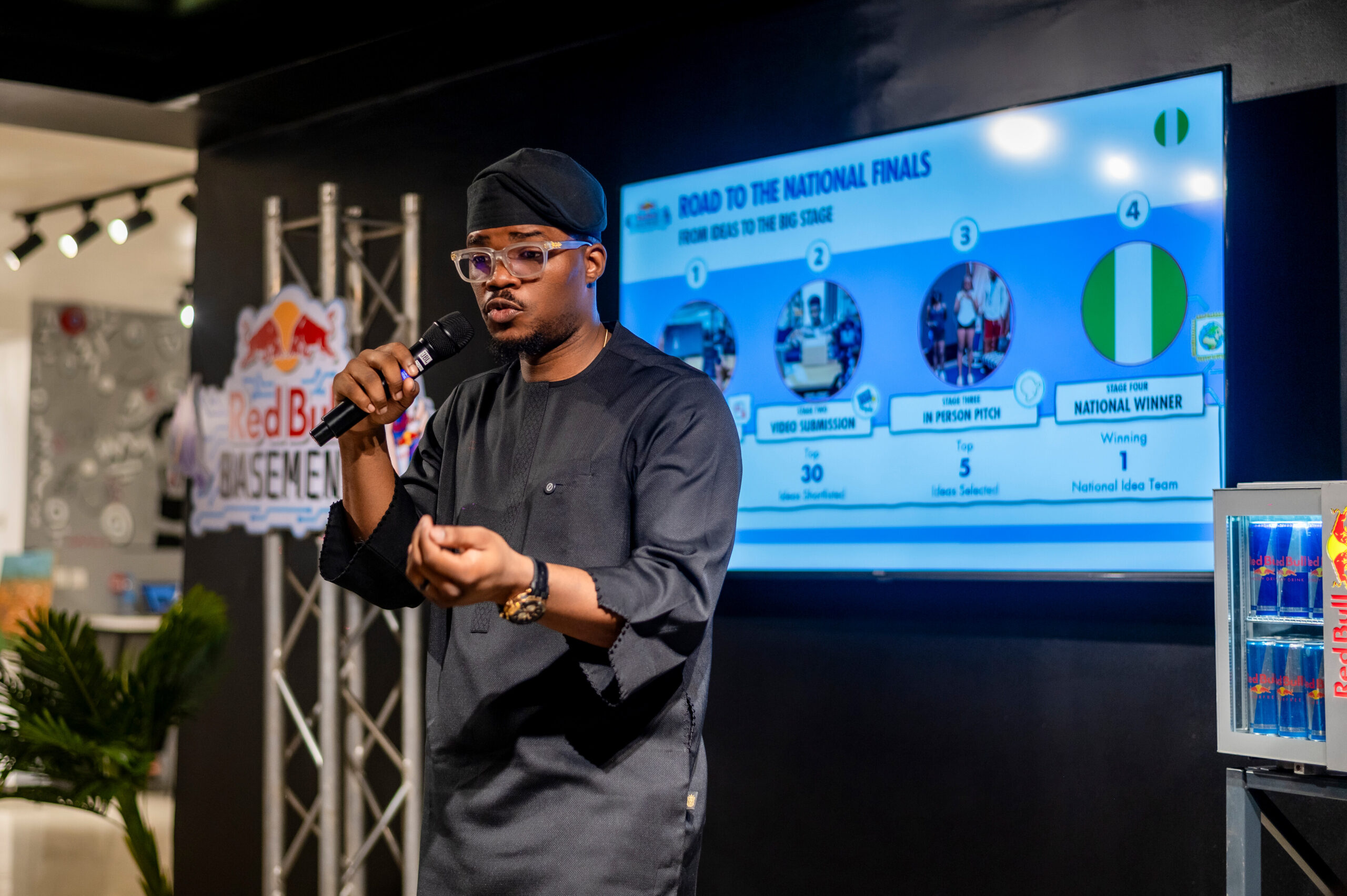
    Alexander Ehanire interacts with a participant during the Red Bull Basement Innovation Workshop at Cafe One in Abuja, Nigeria on February 28, 2026. // Adelugba Oluwapelumi / Red Bull Content Pool // SI202603160070 // Usage for editorial use only //

    By combining AI-powered technology, mentorship, and global exposure, the programme helps young innovators develop ideas that can positively impact industries and communities worldwide.

    From Thousands of Applications to Five Finalists

    This year’s edition saw an overwhelming response from young Nigerians, with more than 3,000 applications submitted from universities, tech communities, and startup hubs across the country.

    Applicants proposed solutions tackling a wide range of challenges, including:

    • Expanding access to education
    • Sustainable innovation
    • Health and wellness technology
    • Digital tools for creators and entrepreneurs
    • Community-driven tech platforms

    Following multiple rounds of evaluation, the strongest ideas were shortlisted, eventually narrowing the field to five finalist teams who will now present their prototypes live at the National Final.

    The National Final: Ideas Under the Spotlight

    At the Red Bull Basement Nigeria National Final, each team will deliver a two-minute pitch and prototype presentation before a panel of three respected figures from Nigeria’s technology and innovation space.

    The judges will assess each concept based on:

    • Innovation and originality
    • Potential impact on communities or industries
    • Scalability and feasibility
    • The strength of the founding team

    The winning team will be crowned Nigeria’s Red Bull Basement champion, earning the opportunity to represent the country as the programme continues globally later this year.

    Fueling Nigeria’s Next Generation of Builders

    Through Red Bull Basement, participants gain access to powerful tools that help turn ideas into working prototypes, even for those without traditional technical backgrounds.

    The programme is run in collaboration with Microsoft, AMD, and Red Bull Ventures, giving innovators access to AI-powered technology, development resources, and mentorship from experts in the tech ecosystem.

    For the five finalists, the National Final represents a chance to showcase the power of Nigerian innovation and the potential of young founders to create solutions that can scale beyond their communities.

    For more information check out @redbullng and go on www.redbullbasement.com to secure a spot to attend

  • The Creative Reset 2026: A First Edition Experience for Creatives Ready to Level Up

    The Creative Reset 2026: A First Edition Experience for Creatives Ready to Level Up

    The creative industry doesn’t slow down. Algorithms change, trends shift, client expectations evolve and most creators find themselves constantly producing, constantly adapting, but rarely stopping to ask the most important question: am I still building in the right direction?

    That’s exactly the gap The Creative Reset 2026 was designed to fill.

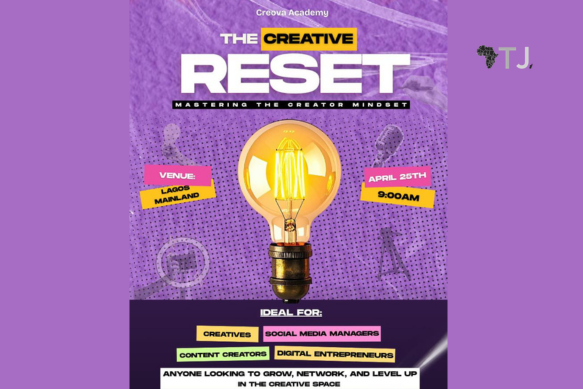
    On April 25th, 2026, Creova Academy is hosting its first-ever physical event on the Lagos Mainland ; a one-day educational and community experience built specifically for creatives who are ready to pause, reflect, and realign their creative direction with intention.

    What Is The Creative Reset?

    The Creative Reset isn’t a motivational event. It’s not about hype or surface-level inspiration. It’s a practical, structured day designed to help you master the internal game that drives everything you create externally.

    This year’s theme : Mastering the Creator Mindset which sets the tone for what attendees can expect: deep, honest conversations about the mental, strategic, and creative challenges that content creators, designers, writers, digital entrepreneurs, and social media managers face every single day.

    What to Expect

    Doors open at 9:00 AM and the day will be packed with value from start to finish. Attendees can look forward to keynote sessions from industry voices, a panel discussion covering real experiences from the creative community, a guided creative reset session to help you reconnect with your craft, and intentional networking with a room full of like-minded creatives.

    This isn’t a conference where you sit, listen, and leave unchanged. Every element of the day has been designed to create real, lasting impact on how you think, create, and grow.

    For Creova Academy, The Creative Reset 2026 marks the beginning of something much bigger , a long-term commitment to equipping Africa’s creative community with the tools, mindset, and connections needed to thrive in an industry that rewards those who show up with purpose.

    If you’re a creative in Lagos or willing to make the trip then this is the room you want to be in.

    April 25th, 2026 · 9:00 AM · Lagos Mainland

    Register now: rigitix.com/events/the-creative-reset-2026-P8p5Nd

  • Grace AI Labs: Building Autonomous Digital Workers for Enterprises that cannot afford to stop

    Grace AI Labs: Building Autonomous Digital Workers for Enterprises that cannot afford to stop

    Grace AI, a seed-stage company building intelligent agentic systems for enterprises, businesses, institutions, and defense organizations, is redefining what it means to build AI that works. Founded by Divine Matthew and a small team of co-founders with no external funding, the company has grown from a bold idea into a validated solution trusted by clients across multiple verticals.

    “We didn’t set out to build another AI demo. We set out to build infrastructure that actually deploys, actually works, and actually delivers ROI,” said Divine Matthew, Founder of Grace AI. “The market is flooded with hype. We chose a different path — start with real problems, earn trust through results, and let the work speak for itself.”

    The Problem

    Enterprises scale. Their operations don’t. More markets, more customers, more tickets , same bottlenecks. Hiring can’t keep up. Neither can margins. While the AI industry has exploded with promises, most solutions remain stuck in demo mode ; impressive on stage, useless in production.

    Grace AI was built to solve this gap. The company’s agentic systems are designed with a goal-oriented AGI-base architecture, enabling autonomous digital workers that don’t just answer questions ;they complete complex workflows, eliminate bottlenecks, and scale operations without scaling headcount.

    Built from the Ground Up

    Before Grace AI, Divine Matthew was running a different startup that achieved moderate success but eventually hit a ceiling. The experience was formative ; it revealed the opportunity to automate complex workflows at scale, and exposed a market gap: no one was building AI agents that actually work.

    Grace AI started with just co-founders, no funding, and a conviction that real AI companies are built on deployed solutions. Early believers included the co-founding team and a handful of early customers willing to take a chance on a new approach.

    Overcoming Early Challenges

    The path wasn’t easy. Getting enterprises to trust a new, small company proved difficult. Finding the right early customers who would pay; not just pilot required patience and persistence.

    Market conditions added friction: the Nigerian and African market wasn’t ready for AI pricing, enterprise sales cycles were painfully long, and the AI hype cycle made buyers skeptical of any solution claiming real results.

    The lowest point came when a sizable contract with one of the company’s first business prospects fell through a deal that would have been transformative at that stage. Rather than retreat, the team doubled down and found better customers. The setback became a filter: Grace AI learned to sell only to enterprises with real problems, to focus on deployment over demos, and to build relationships rather than just sales pipelines.

    The Turning Point

    Everything changed when Grace AI landed a major enterprise client that validated the model. The company secured its first case study with real ROI numbers, and word of mouth began generating inbound leads. Since then, the company has seen significant growth in clients across enterprises, businesses, and institutions, along with revenue and product capabilities.

    Results delivered to clients include: tasks automated that previously took humans hours or days, meaningful cost savings through reduced headcount needs, measurable accuracy improvements versus manual processes, and dramatic speed gains ; what took days now takes minutes.

    The Vision Ahead

    Grace AI’s ambitions extend far beyond enterprise automation. Over the next one to two years, the company plans to expand into more enterprise verticals, enter international markets across the US, Europe, and Middle East, and pursue opportunities in defense ; providing enhanced defensive capabilities as Nigeria faces rising security challenges — and agriculture, maximizing output in a country that urgently needs greater food production.

    “Companies without AI operations will fall behind. Agentic AI will become standard enterprise infrastructure. And emerging markets will leapfrog with AI adoption,” said Matthew. “We’re not just building a company. We’re proving that world-class AI infrastructure can be built from Africa, for the world.”

    If funding or partnerships come in, the priority is clear: AI research to tackle more complex problems, and infrastructure to handle extended, complex enterprise deployments at scale.

    About Grace AI

    Grace AI builds intelligent agentic systems that automate complex workflows, eliminate bottlenecks, and scale operations. The company’s goal-oriented AGI-base architecture delivers autonomous digital workers for enterprises, businesses, institutions, and defense organizations. Founded in Nigeria and built for the world, Grace AI represents a new playbook for AI companies in emerging markets — one where deployment beats demos, results beat hype, and trust is earned through delivery.

    About the Founder

    Divine Matthew is the Founder of Grace AI. A serial entrepreneur with previous startup experience, Matthew identified the opportunity to build AI agents that actually work after years of automating workflows and seeing the gap between AI hype and AI reality. He leads Grace AI with a philosophy rooted in deployment over demos, relationships over transactions, and letting results speak louder than pitches.

    LinkedIn: https://www.linkedin.com/company/grace-ai-

    X: lab/https://x.com/GraceAiLab

    Youtube: www.youtube.com/@GraceAilabs

    Email: [email protected]

  • Creators Workshop 2.0

    Creators Workshop 2.0

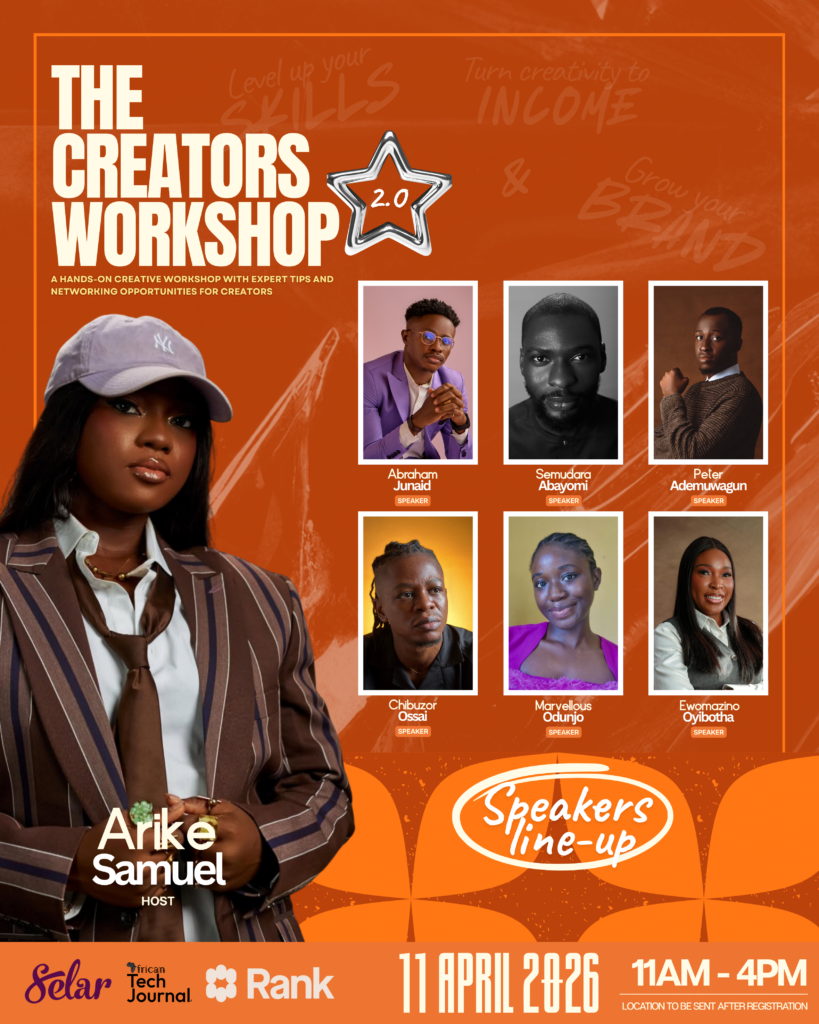
    Creators Workshop 2.0 is the third edition of a hands-on creative learning experience designed to help creators sharpen their skills, learn practical strategies for content creation, storytelling, branding and scaling their creative business. Participants will gain actionable insights and real-time hands-on experience to grow their creative careers.

    ORGANISER’S QUOTE

    “The Creators Workshop was born out of a simple but powerful belief, that whatever idea or dream you’re sitting on, you actually can do it. This is the room we wished we had when we were starting out.” — Arike, Founder, The Creators Workshop

    SPEAKERS & SESSIONS

    Marvellous OdunjoVideo Editing & Storytelling in the Creator Economy Marvellous

    Chibuzor Ossai  — Video Editing & Color Grading Chibuzor

    Peter AdemuwagunDesigning Compelling Content with Canva

    Abayomi SemudaraCreating Content That Cuts Through the Noise

    Abraham Junaid (AjayWhisper)Building a Creative Career & Scaling Opportunities

    EwomazinoProtecting Your Work A focused session on the legal framework every creator needs.

    PANEL SESSIONS

    SELAR — Monetisation strategies for creators

    RANK — Scaling your creative business

    KEY TAKEAWAYS FOR PARTICIPANT:  Practical skills in video editing, storytelling, design and branding; insights into growing a sustainable creative career and monetising content; understanding of IP rights and how to protect creative assets; and networking and collaboration opportunities with fellow creators.

    SOCIAL HANDLES & HASHTAG Organiser: @workwitharike

    Event: @_thecreatorsworkshop Hashtag: #Thecreatorsworkshop

    CONTACT For additional information, assets or enquiries:

     Arike — 09053681039

    Email: [email protected]

  • Peerless Launches SeaBaas Lite to Transform Core Banking for Nigerian Microfinance Institutions

    Peerless Launches SeaBaas Lite to Transform Core Banking for Nigerian Microfinance Institutions

    Peerless, a modern enterprise technology company, has officially announced the launch of SeaBaas Lite. This core banking solution is built to support the digital transformation of microfinance institutions (MFIs) and fintechs across Africa.

    The product represents a standardized version of the company’s flagship SeaBaas core, designed for rapid deployment and operational efficiency.

    The Nigerian financial sector currently faces significant infrastructure hurdles. High capital expenditure on hardware, foreign exchange volatility affecting software maintenance, and the complexity of local regulatory compliance have created barriers for many institutions.

    SeaBaas Lite addresses these challenges by offering a cloud-native platform hosted on Huawei Cloud with local data residency. This ensures that Nigerian financial data stays within the country, meeting the requirements of the Central Bank of Nigeria (CBN) and the Nigeria Data Protection Regulation (NDPR).

    SeaBaas Lite is built on an API-first modern core. This technical foundation allows for seamless integration with external channels, facilitating automatic verifications and faster customer onboarding. By removing the need for manual data entry and disjointed verification processes, institutions can reduce their transaction processing time by 60%.

    The platform also solves a major pain point for compliance officers through built-in regulatory reporting templates. These templates are pre-mapped to local requirements, allowing banks to generate reports for regulators with a single click. This automation reduces the risk of manual errors and the potential for regulatory fines.

    Data is a central component of the new offering. SeaBaas Lite provides robust analytics that give banks rich insights into customer behavior. These data-driven tools help institutions move beyond simple record-keeping to identify new revenue opportunities and improve credit scoring models.

    “Peerless is on a mission to remove the high barriers of entry that have historically held back African financial institutions,” says Dr. Joachim Adenusi, Co-Founder and CEO of Peerless. “SeaBaas Lite gives MFBs and regional banks access to world-class infrastructure without the heavy price tag of legacy systems. We believe every institution deserves a core that supports growth instead of hindering it.”

    Support remains a key differentiator for Peerless. Unlike global competitors that often manage support from different time zones, Peerless maintains a top-quality technical and customer support team based in Lagos. This proximity allows for one-hour response times and a deeper understanding of local integration rails and network conditions.

    The track record of the SeaBaas infrastructure is substantial. The platform has served over 12 million end users and processed more than 4 billion transactions. These operations have led to over $30 million in operational savings for Peerless customers. The system maintains a 99.99% availability rate, providing stability even during peak transaction periods.

    Olumide Odeyemi, Marketing & Growth Manager at Peerless, notes that the transition from traditional hardware ownership to cloud access is a necessity in the current economic climate. “The cost of maintaining rigid legacy systems consumes budgets that should go toward innovation. SeaBaas Lite moves these costs from a heavy upfront investment to a predictable operational expense.”

    SeaBaas Lite is now open for subscription. Interested institutions can visit https://bepeerless.co/product/seabaaslite to learn more about the platform’s capabilities and the 30-day deployment promise.


    About Peerless

    Peerless is a modern enterprise technology company purpose-built to support the digital transformation of institutions in emerging markets. With offices in Nigeria and the UAE, Peerless provides core digital infrastructure including core banking software, business process automation, and customer relationship management tools.

  • Inside KeepAm: The Product Turning Tax Confusion Into Clarity for Millions of Nigerians

    Inside KeepAm: The Product Turning Tax Confusion Into Clarity for Millions of Nigerians

    In early 2026, a quiet panic started spreading across Nigeria’s informal economy.

    Freelancers, creators, and small business owners were all asking the same question:

    “How does this new tax law actually affect me?”

    No one had a clear answer.

    That confusion is what led Emmanuel Olorunshola to build KeepAm.


    Where It Started

    The Nigeria Tax Act 2025 didn’t just introduce new rules. It exposed something deeper.

    Millions of Nigerians were earning, but very few understood what they owed or how to stay compliant without overpaying. Some turned to accountants and paid heavily for guidance. Others ignored the system entirely and hoped for the best.

    Neither option worked.

    Emmanuel had seen this pattern before while building compliance tools in a different market. The insight carried over:

    People don’t avoid compliance because they want to break the law. They avoid it because they don’t understand it.

    KeepAm was built to solve that.


    A Different Kind of Tax Product

    From the beginning, KeepAm was not designed like traditional accounting software.

    It wasn’t built for finance teams or enterprises. It was built for the everyday Nigerian earning online or running a small business without formal structures.

    The idea was simple. Show people what they earn, what they owe, and how to reduce it legally. No complexity. No jargon. Just clarity.

    That simplicity became the product.


    The Real Challenge Was Trust

    Building a tax product in Nigeria comes with a unique problem: trust.

    Tax is already sensitive, and many people approach it with skepticism. Add that to the broader distrust of digital financial tools, and the barrier becomes even higher.

    KeepAm had to position itself carefully.

    Not as a system helping the government collect more money, but as a tool helping users keep more of theirs legally. The tone, messaging, and even certifications were intentional. Everything had to signal credibility without overpromising.

    Because in this category, trust is not a feature. It is the product.


    Why Technology Was Non-Negotiable

    Serving millions of users meant one thing: this had to be a technology-first business.

    KeepAm was built as a Progressive Web App, designed to work instantly from a browser without forcing downloads. In a market where data costs matter and phone storage is limited, that decision removed a major barrier to adoption.

    The experience is simple, but the infrastructure behind it is deliberate. From payments to AI-assisted tax guidance, everything is built to scale access without increasing complexity.

    The goal is not just functionality. It is accessibility.


    Early Growth Came From the Problem, Not Marketing

    KeepAm launched in January 2026.

    Within seven weeks, over 1,000 users had signed up.

    There was no heavy advertising push. Growth came from people sharing their experiences. Someone calculates their tax, reacts to the result, and sends it to a friend. Conversations move from WhatsApp to Twitter to real-life discussions.

    The product spread because the problem was already there.

    When people finally understood their numbers, it triggered something immediate. Sometimes shock. Often relief.

    But most importantly, clarity.


    Building With Users, Not Assumptions

    One of the most important product decisions didn’t come from strategy. It came from a user.

    The initial roadmap prioritized bank integrations. But users hesitated. Many didn’t want to link their accounts to a new platform.

    Instead, they asked for something simpler: the ability to upload their bank statements manually.

    That request shifted priorities.

    It reinforced a key lesson about building in Nigeria. Adoption is not just about what is possible. It is about what people are comfortable with.


    Keeping It Local

    Even the name “KeepAm” reflects the thinking behind the product.

    It is simple. Familiar. Nigerian.

    The brand doesn’t sound like a financial institution. It sounds like someone explaining money to you in a way that makes sense.

    That choice is not cosmetic. It is strategic.

    Because in markets like Nigeria, products that feel local travel faster than those that feel imported.


    What Comes Next

    KeepAm is still early, but the direction is clear.

    The immediate focus is on deeper integrations, better automation, and eventually making tax filing seamless. The long-term vision is a system where users track their income throughout the year and complete their filings in a single flow.

    No friction. No confusion.

    Just completion.


    The Bigger Picture

    KeepAm is solving for tax, but the real story is about access.

    Access to understanding.
    Access to compliance.
    Access to keeping more of what you earn.

    In a country where millions operate outside structured systems, that kind of access is powerful.

    Because sometimes, the most important innovation is not creating something entirely new.

    It is making something complicated finally make sense.

  • AI Agents Aren’t Magic: They’re Computer Architecture Reapplied

    AI Agents Aren’t Magic: They’re Computer Architecture Reapplied

    Because I just got admitted to study Computer Science at Miva Open University, I’ve had to study the basics of computer science again. In a lecture, we were taught something we’ve all heard before:

    “The CPU is the brain of the computer.”

    Of course, this isn’t new. We learned it in primary school. We repeated it in secondary school. It almost feels too basic to think about seriously.

    But because I’ve also been reading deeply about AI agents, that simple statement started to feel different.

    It just wouldn’t leave my mind.

    What if AI agents are not revolutionary in structure, but evolutionary in abstraction?

    What if we’re simply rebuilding the computer — at a higher cognitive layer?

    The CPU Is Not “Smart.” It Coordinates.

    When we say the CPU is the brain, we don’t mean it is intelligent in the human sense.

    What it actually does is:

    • Fetches instructions
    • Decodes them
    • Decide what needs to run
    • Schedules execution
    • Coordinate between memory and storage
    • Call the appropriate operations

    It is simply a control system.

    The CPU’s power lies not in performing every operation, but in deciding which operation runs, when, and in what order.

    It is an orchestrator.

    And this is where something clicked for me.

    Now Look at Modern AI Agents

    An AI agent built around an LLM behaves similarly.

    At runtime, the system:

    1. Receives input
    2. Interprets intent
    3. Determines whether reasoning alone is sufficient
    4. Decides whether to call a tool
    5. Selects which tool to call
    6. Incorporates external retrieval (RAG) if necessary
    7. Integrates results
    8. Produces output

    The LLM is not doing everything by itself either.

    It is coordinating execution across external capabilities.

    Sound familiar?

    Yes, just like the CPU.

    Skills Feel Like Installing New Software

    In another lecture, we were told there are two types of software on a computer: the system software and the application software.

    An application software is installed by the user to perform a specific task or solve a specific problem, e.g. Microsoft Word, Spreadsheet, Design Tools, etc.

    Most importantly, we were told that without application software, a computer would have just been an ordinary electronic device that can only do basic operations.

    In some AI agent frameworks, you can extend capabilities by defining new skills, sometimes as simple as a structured markdown file.

    When I saw that, I couldn’t help but think:

    Isn’t this similar to installing new software on a computer?

    A computer becomes more powerful when you install applications.

    An AI agent becomes more capable when you add skills.

    Same pattern, but just a different abstraction layer.

    RAG Looks Like External Memory

    Then there’s RAG, Retrieval-Augmented Generation, which adds another layer to this parallel.

    Instead of relying only on what’s inside the model’s parameters, the RAG system:

    1. Searches external knowledge bases (long-term memory?)
    2. Retrieves relevant information
    3. Inject it into the context window (working memory?)
    4. Uses it to reason

    That feels a lot like what we’re used to in a traditional computer:

    • Fetching from disk
    • Loading into memory (RAM)
    • Then executing

    Again, the same architectural principle.

    Tool-Calling Feels Like System Calls

    In classical operating systems:

    • User applications do not directly control hardware.
    • They invoke system calls.
    • The OS mediates execution.

    In agent architectures:

    • The model does not directly execute code.
    • It emits a structured tool call.
    • The orchestration layer executes the function.
    • The result is fed back into context.

    This means we have recreated system calls, but now the caller is a probabilistic model instead of a deterministic user application.

    So, this isn’t magic?

    Is the LLM Becoming a Software-Level CPU?

    Now, this is the thought that keeps forming in my mind:

    Within an agent system, the LLM functions like a software-level CPU.

    Not hardware, but a high-level control plane; because:

    1. It does not execute arithmetic directly.
    2. It does not access memory directly.
    3. It does not perform input/output operations directly.

    Instead:

    1. It decides.
    2. It sequences.
    3. It orchestrates.

    That sounds familiar.

    And, in that sense, we are witnessing the emergence of a new abstraction layer:

    From:

    • Hardware CPU controlling instructions

    To:

    • Software model controlling capabilities

    The locus of control has shifted upward, from silicon to probability distributions.

    Why This Matters (At Least To Me)

    Revisiting foundational Computer Science concepts while watching AI evolve has been humbling for me.

    It reminds me that every technological leap feels magical at first. But when you understand the foundations deeply, new technologies stop looking magical.

    You start seeing patterns. And once you see patterns, you can build better systems.

    I don’t have this fully formed yet. But I know this much:

    The more I study first principles, the more AI makes sense.

    And that’s a good place to be.

    References

    1. Patterson, D. A., & Hennessy, J. L. Computer Organization and Design: The Hardware/Software Interface.

    2. Lewis, P., et al. (2020). Retrieval-Augmented Generation for Knowledge-Intensive NLP Tasks.
  • Embedding AI into Everyday Products Without Losing the Human Touch

    Embedding AI into Everyday Products Without Losing the Human Touch

    You’ve probably used AI more than 10 times today without realizing it. It has suggested the fastest route to work, music you might like on Spotify,  completed your email text on Gmail, or even flagged a suspicious transaction on your Opay app. No press release. No dramatic “Powered by AI” banner. Just quiet, helpful intelligence working in the background.

    That’s the sweet spot.

    As artificial intelligence becomes more embedded in everyday products and lives, the real competitive advantage is no longer whether you use AI, rather  it’s how you use it. The products that will win are not the ones shouting about automation. They are the ones that make life easier while preserving clarity, empathy, and user control.

    Intelligence Should Feel Invisible, Not Intimidating

    The most successful AI integrations don’t overwhelm users with complexity. They remove friction.

    When a music streaming app like Spotify curates a playlist that feels eerily accurate, of course the users don’t think about machine learning models. They think, “Oh wow, this app gets me, I just love my spotify’s playlist.” 

    When a fintech product like Opay detects fraud in seconds, users feel protected, not processed, “Wow, Opay is top tier with detecting fraud before I sent money to this account”

    AI works best when it behaves like a thoughtful assistant, not an overbearing decision-maker.

    The moment users feel replaced, judged, or confused by automation, trust begins to erode.

    Automation Should Enhance Human Agency

    One of the biggest mistakes companies make is designing AI systems that override users instead of empowering them.

    Human-centered AI gives recommendations  but preserves choice. It automates repetitive tasks but makes sure to leave critical decisions to the user. It predicts behavior  but explains its reasoning when it matters.

    A good example, smart email platforms suggest responses but don’t send them automatically. Financial apps categorize expenses but allow edits.

    These small design decisions signal respect and in turn respect builds loyalty.

    Empathy Is a Strategic Differentiator

    As more products adopt AI, intelligence alone won’t differentiate brands. Emotional experience will.

    Users don’t remember algorithms. They remember how a product made them feel.

    Did it reduce anxiety?
    Did it simplify a stressful process for them?
    Did it communicate clearly when something went wrong?

    Embedding AI without losing the human touch means designing systems that anticipate not just actions, but emotions. Clear microcopy, transparent data usage, graceful error handling, and accessible design all contribute to an experience that feels human  even when powered by complex technology.

    Trust Is the Real Currency

    In an AI-driven ecosystem, trust becomes the defining growth lever.

    Users need to understand:

    • What data is being used
    • Why certain recommendations appear
    • How to adjust preferences
    • When they are interacting with automation

    Products that prioritize transparency and give users control will outperform those that treat AI as a black box. When intelligence is done with clarity, it definitely creates Adoption

    The Future Belongs to Quiet Intelligence

    The next wave of successful products won’t feel robotic. They’ll feel intuitive.

    AI is now being embedded in scheduling tools, payment systems, healthcare platforms, education apps, and everyday workflows. But the brands that stand out will be the ones that design with empathy first and algorithms second.

    Because ultimately, users don’t want more automation.

    They want less effort, less friction, and more confidence.

    And the best AI is the kind that helps them achieve that without ever making them feel less human.

  • Why Chowdeck is the Unsung Hero of Lagos Hustle Culture

    Why Chowdeck is the Unsung Hero of Lagos Hustle Culture

    Before Chowdeck showed up, ordering food without bleeding money on delivery fees or waiting two hours felt like a fairy tale.

    Bike men would quote you 5k to cross two neighbourhoods, Jumia Food, and the others slapped ridiculous charges on every order, and most times your jollof still arrived cold.

    Then Chowdeck landed in Lagos and quietly changed the game.

    Chowdeck isn’t just another delivery app, it’s a community of riders, restaurants, and everyday hustlers who finally made “quick and cheap” mean something real.

    In a city where traffic can swallow three hours of your life without warning, being able to get a full plate of egusi and pounded yam (or shawarma, or indomie deluxe) delivered for as low as ₦600 is revolutionary.

    That’s cheaper than the okada you’d take to the buka and back, and you can get free deliveries and a couple other freebies with a members subscription starting at just ₦3,500 a month.

    I’m the typical Lagos creative: 14-hour workdays, back-to-back Zoom calls, deadlines breathing down my neck.

    The moment hunger hits, my brain wants to shut down. Stepping out isn’t an option. Lagos traffic doesn’t care about your client presentation at 4 pm.


    Cooking? I love my kitchen, but not when I’m in the zone. Chowdeck became my lifeline.

    I’ve ordered from Chicken Republic in Ikorodu to my house in Federal Low Cost Housing Estate at 7:47 pm and had hot food in my hands by 8:09 pm. Two thousand five hundred naira total, including delivery. Try doing that with any other platform in 2019–2021.

    But it’s bigger than my personal convenience. Chowdeck created real jobs for thousands of young riders who now earn daily without needing a “connection” or university degree.

    Restaurants that were barely surviving now get orders from customers 30 minutes away, they would never have reached. Small businesses think that a woman making killer asun in Surulere or the guy doing moi-moi and akara in Ajah can now list on Chowdeck and blow up overnight.

    In a continent where logistics remains one of the biggest barriers to everything (e-commerce, healthcare, you name it), Chowdeck proved you can build hyper-efficient last-mile delivery that actually works for African wallets and African chaos.

    They’re in Morocco, Kenya, Uganda, Ghana, Côte d’Ivoire, and still flying under the radar while the spotlight stays on fintech unicorns.

    Chowdeck deserves way more flowers. In the middle of Lagos madness, they made it possible for us to stay locked in, eat well, and keep creating without breaking the bank or wasting half the day. If that’s not proper African innovation, I don’t know what is.

  • Africa’s Next Tech Boom Will Come From Infrastructure, Not Startups

    Africa’s Next Tech Boom Will Come From Infrastructure, Not Startups

    For more than a decade, the story of African technology has been told through startups. Venture funding rounds, new fintech apps, and fast growing companies have shaped how the world views the continent’s digital future. These companies have solved real problems and opened access to services that were once difficult to reach. But focusing only on startups can give a narrow picture of how technology ecosystems actually grow.

    The next phase of Africa’s technology development will likely depend on something less visible but far more foundational. It will depend on infrastructure.

    Not just internet connectivity or mobile coverage, but the deeper systems that make digital economies work at scale. Payments, identity, cloud platforms, cybersecurity, and data infrastructure are the foundations that allow thousands of companies to build services without starting from scratch. Across much of Africa, these foundations remain fragmented or controlled outside the continent. This has created a structural imbalance that shapes how African technology grows.

    The rise of the application economy

    The first wave of African technology growth was built on what can be described as the application economy. Founders focused on building products that solved immediate problems for users. Mobile payments, logistics platforms, e-commerce services, and digital financial tools emerged quickly as smartphone adoption increased and internet access improved.

    This wave of innovation produced many impressive companies and brought millions of people into the digital economy. Yet most of these startups were able to move quickly because they relied on infrastructure that had already been built somewhere else. Cloud platforms hosted their systems. Global payment networks moved funds behind the scenes. Software development frameworks provided tools that allowed teams to build products faster.

    This model allowed African founders to innovate rapidly, but it also meant that much of the value chain remained uneven. African companies built the applications, while the deeper infrastructure that powered those applications often remained outside the continent.

    The infrastructure ownership gap

    This pattern has created what can be described as an infrastructure ownership gap. African engineers contribute talent and innovation to the global digital economy, yet many of the systems that support that economy remain concentrated within a small number of global platforms.

    Cloud computing is largely dominated by a handful of international providers. Payment settlement networks often rely on infrastructure located outside Africa. Many cybersecurity and identity systems used by African organisations are developed and operated abroad.

    This situation does not simply reflect technological dependence. It represents a concentration of control within the digital economy. When the core infrastructure that powers businesses is owned elsewhere, decisions about pricing, data governance, and technological direction are often made far from the markets where those systems are used.

    For startups, these limitations are not always visible in the early stages of growth. But they often become clear when companies attempt to scale across multiple markets or when operating costs become tied to infrastructure they do not control.

    Why infrastructure shapes innovation

    Applications solve visible problems, but infrastructure determines what is possible within an ecosystem.

    A fintech startup can design a payment app that users find convenient, yet scaling that product across multiple countries becomes difficult if reliable payment rails do not exist across borders. An e-commerce platform can attract customers quickly, but without strong identity verification systems and fraud protection networks, trust in the platform can become fragile. A digital service can gain popularity, but if cloud infrastructure remains expensive or unreliable, the company’s ability to grow becomes constrained.

    Infrastructure reduces these barriers by creating shared systems that many companies can build upon. Instead of solving the same foundational problems repeatedly, innovators can focus their energy on building services that deliver value to users.

    This is one of the reasons why mature technology ecosystems often revolve around platforms rather than individual applications.

    From the application economy to the infrastructure economy

    Africa’s technology sector may now be approaching a transition from an application economy to what could be described as an infrastructure economy. In an application economy, companies compete by building services on top of existing platforms. In an infrastructure economy, companies create the platforms themselves and enable others to build on them.

    This shift is already beginning to appear in several parts of the continent. Payment infrastructure companies are building systems that allow businesses to move money across multiple African markets. Data center investments are expanding as demand for reliable cloud services grows. Digital identity and verification platforms are emerging to support online commerce, financial services, and government programs.

    These companies often receive less attention than consumer facing startups, but their impact is different in scale. Instead of serving individual markets or industries, infrastructure platforms can support thousands of businesses at once.

    The platform multiplier effect

    Infrastructure platforms create what might be called a platform multiplier effect. When a reliable infrastructure platform exists, it allows many other companies to innovate more quickly.

    A strong payment infrastructure platform enables thousands of merchants to accept digital payments. A reliable cloud platform allows thousands of developers to launch applications without purchasing hardware. A trusted identity system makes it easier for businesses to verify customers and reduce fraud across multiple industries.

    The impact of infrastructure is therefore not linear. A single successful application may serve millions of users, but a successful infrastructure platform can enable thousands of other companies to build services that reach millions more.

    This multiplier effect is often what transforms early stage technology ecosystems into mature digital economies.

    What needs to change

    For Africa to move toward an infrastructure driven technology ecosystem, several shifts will likely be necessary.

    Infrastructure projects require patient capital. Building payment networks, cloud platforms, or identity systems takes time and investment before financial returns become clear. Investors who focus only on rapid growth cycles may overlook these opportunities, even though their long term economic value can be significant.

    Infrastructure also requires regional thinking. Many digital systems become most useful when they operate across borders. Payment rails, identity frameworks, and digital security platforms gain strength as they connect larger markets and reduce fragmentation across the continent.

    Finally, infrastructure development requires deep technical expertise and operational reliability. Platforms that support thousands of companies must be secure, stable, and scalable. Fortunately, Africa already has a growing pool of engineers who have gained experience working on global systems and large scale platforms.

    A different kind of technology leadership

    Africa’s technology ecosystem has already proven that it can produce creative founders and ambitious startups. That entrepreneurial energy will remain essential to the continent’s digital future.

    But the next generation of technology leaders may focus on building something slightly different. Instead of only launching consumer apps, some will focus on building the infrastructure that those apps depend on.

    Payment rails that move money across the continent. Identity systems that allow citizens to access services securely. Cloud platforms that host businesses locally. Cybersecurity systems that protect growing digital economies. These platforms may not always attract the same headlines as fast growing startups, but they form the foundations on which entire ecosystems can grow.

    The next phase of African technology

    Africa’s technology sector has already shown that it can produce innovative companies and talented engineers. That was the first phase of growth.

    The next phase may be defined by the development of infrastructure platforms that allow those innovators to scale more effectively across markets.

    When those foundations become stronger, startups will find it easier to grow, digital services will become more reliable, and the continent’s technology ecosystem will gain greater independence and resilience.

    The next African tech boom may not begin with a new app. It may begin with the systems that make thousands, or maybe even millions, of new apps possible.