When I think about the African tech brand that has quietly made life easier for thousands of creatives, small business owners, and dreamers like me, Paystack is the first name that comes to mind. It’s funny because I didn’t start out paying attention to fintech at all.
I just wanted to understand why so many business pages on Instagram were suddenly taking payments smoothly without all the usual back-and-forth. Somewhere along the line, the answer kept pointing back to one company: Paystack.
My first real interaction with the brand wasn’t even as a business owner. It was as a customer. I remember trying to pay for a virtual class and expecting the usual stress-failed transactions, double debits, or the “network not available” message.
But the payment went through instantly, and the receipt hit my email before I could even refresh the page.
It was such a small moment, but it made me pause. In this country, where simple things often become complicated, that small moment of ease meant something.
The more I paid attention, the more I realized how deeply Paystack is woven into the daily hustle across Africa.
The vendors who rely on payment links. The creators who send invoices. The startups that feel “official” because they have a proper checkout page. Even NGOs and schools use it now.
Paystack somehow manages to be present but not loud , almost like a quiet backbone that keeps so many ideas alive.
What I love most is how simple they make things feel. You don’t need to be tech-savvy to use it. You don’t need a big business. You don’t even need a website.
There’s something empowering about that the idea that anyone with a skill or a passion can start collecting payments and building something real.
And of course, the global recognition they’ve gotten, especially after their acquisition by Stripe, made me genuinely proud. It felt like a win for everyone who believes Africa can build world-class technology.
But beyond the headlines and the milestones, Paystack represents something personal to me: possibility.
The possibility that African problems can be solved by African innovators. The possibility that a simple idea can transform how we work and create.
Paystack may be a fintech company, but to me, it’s a reminder that progress doesn’t always have to be loud. Sometimes, it’s the quiet systems running in the background that change the most lives.
An average child born in London, can scroll through platforms and instantly stories that resonate or books he wants to read.
He reads about autumn leaves piling up on the pavements or children building snowmen in winter, and it feels natural because those details reflect his environment.
The Lagos child, on the other hand, opens the same platforms and is bombarded by the same kinds of books. But, for him, the context might be difficult to understand.
Not because they are difficult words, but because they do not reflect his reality. His imaginations are limited to the environment around him, the dry chill of harmattan mornings, the excitement of suwe and ten-ten in the compound, or the ritual of Saturday morning Akara and Pap.
When the books accessible rarely reflect the realities of people, it doesn’t just create distance, it makes it harder to see their own stories as worthy of being told.
While the London child grows up affirmed by the stories around him, the Lagos child is left trying to measure his reality against tales that were never written with him in mind.
The challenge isn’t about having no books at all, it’s about visibility and access to their own stories.
Digitalisation promised to democratise storytelling. But when African books are hidden or hard to find, it blocks children from hearing their own voices. Instead, they grow up consuming their identity secondhand, through stories told by outsiders.
This lack of access makes them more vulnerable to stereotypes and incomplete narratives. As Chimamanda Adichie puts it in The Danger of a Single Story: “The single story creates stereotypes, and the problem with stereotypes is not that they are untrue, but that they are incomplete. They make one story become the only story.”
And this isn’t happening in isolation. The global book market is dominated by Western platforms that decide which stories rise to the top.
These platforms shape distribution, pricing, and discoverability.
For African readers, paying in dollars, navigating limited payment options, and fighting visibility algorithms makes access even harder. What starts as a visibility challenge quickly becomes both an economic and cultural one.
That’s why Chapter One is different.
Their pricing model is designed around local realities, so affordability doesn’t mean exclusion. At the same time, they’re amplifying African authors in ways that make their books as easy to discover as their global peers.
Fair value for the writer, fair access for the reader. Because the goal isn’t just “more books.”
It is ensuring the African child grows up with the same right to dream, imagine, and discover through stories rooted in their own world ; not just borrowed from someone else’s.
A few months ago, I was in a call with a company that had just been hit by a ransomware incident. They were not small. They were not careless. They had a security team, modern tools, and a Managed Detection and Response service watching their environment around the clock.
Managed Detection and Response, or MDR, is meant to do exactly what it sounds like. A specialist provider monitors your systems for suspicious activity and helps investigate and respond to threats. In many cases, they can isolate an infected machine, stop malicious processes, and then inform the organisation about what they have done and what needs to happen next. It is one of the most sensible ways for organisations that cannot staff a full security operations centre to get serious protection.
And yet, in this case, when the attack started, nothing important happened for almost two hours.
No critical system was isolated. No high-risk accounts were shut down. People were still debating whether the activity was “really an incident” or just a false alarm. By the time action was taken, the attackers had already moved through the environment and encrypted far more than they should have been able to.
After the call, someone said something I hear a lot. “We need to improve our security maturity.”
That was not the real problem. The problem was that, in spite of all the tooling and services in place, the organisation was not actually defensible.
Most organisations think about security in terms of what they have bought and what framework they follow. They talk about maturity levels, roadmaps, and coverage. But none of that answers a simpler question.
If something goes wrong tonight, can you stop it from turning into a business crisis?
Very often, the honest answer is no.
This is why I think we need a different way to think about security. Not in terms of how advanced it looks, but in terms of whether it clears a basic survival threshold. I call this threshold the security poverty line.
It is not a moral judgement. It is a practical one. In economics, being below the poverty line does not mean you have nothing. It means you do not have enough of the right things to absorb shocks. One unexpected expense can push you into crisis. In security, one ordinary attack can do the same.
Above the line, incidents still happen. Systems still get compromised. But the organisation has a chance to contain the damage and keep operating. Below the line, every serious incident becomes a gamble.
This problem shows up everywhere, but it is especially visible in Africa and other emerging markets.
Many organisations there are growing fast, adopting cloud services quickly, and digitising core processes under real economic pressure. They do not have the luxury of large in-house security teams. So they do what makes sense. They buy tools. They buy MDR. They buy insurance. They try to borrow “global best practice” and make it work locally.
And still, they get hit. Sometimes badly.
The easy explanation is to say the attackers are getting better. The more honest explanation is that many organisations are still structurally fragile. They are operating below a minimum level of security that makes real defence possible.
In the current geopolitical climate, this fragility is becoming harder to ignore. Modern conflicts are no longer fought only on physical battlefields. They increasingly extend into digital infrastructure. The ongoing tensions and conflicts in the Middle East have been accompanied by waves of cyber activity targeting energy companies, financial systems, government networks, and logistics platforms.
These incidents rarely begin with sophisticated zero-day exploits. More often they begin with the same weaknesses organisations struggle with everywhere else: exposed identities, poorly monitored systems, and slow decision-making when an incident begins to unfold.
In other words, geopolitical cyber operations frequently succeed not because the attackers are extraordinary, but because the target organisations are operating below their own security poverty line.
When nation-state aligned groups begin probing infrastructure, the difference between a minor incident and a systemic disruption often comes down to the same basic question: how quickly can the organisation detect what is happening, make decisions, and contain the damage before it spreads.
What does “defensible” actually mean?
It does not mean being hard to break into. That is a comforting idea, but it is not realistic. It means something more practical. It means you can spot trouble early enough, that someone can make a decision quickly, that someone can act without waiting for a committee, and that the business can find its way back to a stable state without weeks of chaos.
When any of those are missing, security turns into a form of organised hope. This is where the conversation about MDR often becomes confused.
Most modern MDR services can and do take action. They will isolate a compromised device. They will kill malicious processes. They will raise the alarm and explain what they have done. But in most environments, response is still a shared responsibility. The provider can contain part of the problem, but the customer still needs to reset accounts, check for lateral movement, decide whether systems should be taken offline, and deal with the business consequences.
This is exactly where many incidents go wrong.
If identity systems are weak, attackers can simply come back using another account. If nobody is quite sure who is allowed to shut down a critical server, action gets delayed. If logs are scattered and incomplete, nobody can see the full picture. If recovery has not been tested, restoring systems takes far longer than expected.
In other words, you can have good detection and even some level of response, and still be below the security poverty line.
I see this pattern in the UK and Europe. I see it even more often in African and other emerging markets, where environments are usually more mixed, budgets are tighter, and systems have grown in less tidy ways. Old servers sit next to new cloud services. Shared admin accounts exist because “that’s how it’s always been.” Internet links are less stable. Support contracts are more complicated. All of this makes fast, clean response harder.
And attackers do not need perfection. They just need enough friction in your response to buy themselves time.
The uncomfortable truth is that many organisations are not failing because they lack tools. They are failing because they lack coherent control over their own environments.
They cannot reliably say what they own. They cannot reliably say who can do what. And they cannot reliably act fast when something starts to burn.
This is what it means to be below the security poverty line.
It also explains why so much security spending feels disappointing. Money goes into things that sit above the line, while the foundations remain weak. More alerts. More dashboards. More reports. But when something serious happens, the same delays and confusions appear.
The shift in thinking is simple, but not easy.
Instead of asking, “How mature are we?” organisations should ask, “Can we actually survive the most likely incidents?”
For many, the fastest improvement will not come from buying something new. It will come from fixing identity properly. From reducing the number of powerful accounts. From making it clear who can isolate systems and disable access. From practicing recovery in conditions that feel uncomfortable. From deciding in advance who is in charge when things happen at the worst possible time.
These are not glamorous projects. But they move you from below the line to above it.
And once you are above the line, services like MDR start to deliver far more value. Detection becomes meaningful because response can follow. Containment sticks because attackers cannot simply walk back in. Recovery becomes a business process, not a crisis experiment.
The final, slightly uncomfortable conclusion is this.
A lot of organisations are not being defeated by brilliant attackers. They are being defeated by their own fragility.
The idea of a security poverty line gives leaders a more honest way to look at their situation. Not through the lens of how modern their stack looks, but through the lens of whether they can take a hit and stay standing.
In fast-growing markets, in emerging economies, and in fact everywhere, that question is starting to matter more than any maturity score.
Because in the end, security that only looks good on paper is not really security at all.
In the digital economy, brands, communities, and movements are built on social media every day. Behind those posts, campaigns, and conversations are professionals who manage communities, shape narratives, and drive engagement online.
Yet, despite their impact, social media managers, community builders, and digital professionals rarely have spaces designed specifically for them.
That is what ENGAGE 2026 aims to change.
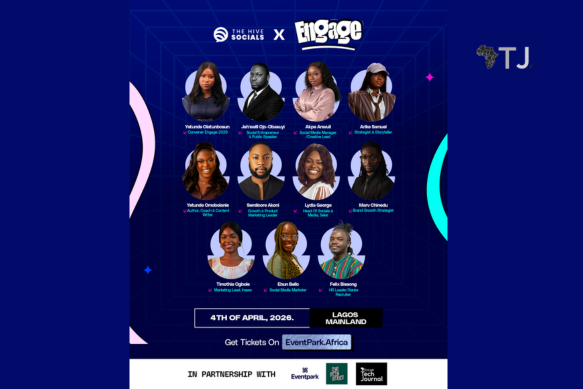
Organised by The Hive Socials community, ENGAGE 2026 is a community-driven event designed to bring together the people who build digital communities for others. Rather than being a traditional conference, the event focuses on learning, honest conversations, and meaningful connections among professionals navigating the fast-evolving world of social media and digital marketing.
The event is scheduled to take place on April 4, 2026, on the Lagos Mainland, bringing together creators, social media managers, brand strategists, and digital professionals for a day of shared insights and collaboration.
At its core, ENGAGE 2026 is about creating a room where the people responsible for building online communities can finally build one for themselves.
Convener Yetunde Olatunbosun, founder of The Hive Socials, is bringing together a lineup of speakers who work at the intersection of content, growth, marketing, and digital storytelling.
Speakers at ENGAGE 2026
The event will feature conversations and insights from professionals actively shaping the digital ecosystem:
Yetunde Olatunbosun — Convener, ENGAGE 2026
Jah’swill Ojo-Obasuyi — Social Entrepreneur & Public Speaker
Akpe Anwuli — Social Media Manager / Creative Lead
Together, they will explore topics around social media strategy, content creation, community building, growth marketing, and the evolving role of digital professionals in today’s economy.
As more businesses and creators rely on digital platforms to reach audiences, events like ENGAGE 2026 highlight the importance of the professionals who keep those communities active and thriving.
By creating an intentional space for these conversations, ENGAGE 2026 is positioning itself as a gathering point for the people shaping online culture and digital engagement.
For creators, social media managers, and digital professionals looking to connect with peers and gain practical insights, the event promises a room full of conversations that matter.
I still remember the first time someone mentioned Chamsmobile to me. It was during a casual conversation about digital payments and identity systems in Nigeria, and a friend said, “Have you checked what Chamsmobile is doing?
They are not loud, but they’re doing real work.” Out of curiosity, I went online to see for myself, and honestly, that small search opened my eyes to a brand that deserves far more attention than it gets.
What I love about Chamsmobile is that they are building solutions for realities we face every day in this country, not fantasies.
Many tech companies chase hype; Chamsmobile builds quietly for people who need technology the most: market women, transport workers, SMEs, civil servants, and communities usually left out of the main conversation.
One thing that really stood out to me is their focus on digital identity and financial inclusion. In a country where a simple thing like verifying someone’s identity can delay jobs, stop access to credit, or complicate business transactions,
Chamsmobile found a way to simplify it with their Kegow platform. It’s not just about transferring money. It’s about helping people prove who they are, opening accounts easily, and accessing financial services without stress.
I also respect how they operate. They don’t try to be everywhere at once; instead, they focus on solving real administrative and financial gaps in Nigeria.
For example, the way they’ve built partnerships with government agencies and private organizations shows that they understand the Nigerian system deeply. They’ve also created room for agents and small business owners to earn through their digital services, and for me, that’s one of the most practical ways a tech brand can empower ordinary people.
Another thing I admire is the trust they’ve built over the years. In a space where many fintechs rise fast and crash even faster, Chamsmobile is consistent.
They don’t make noise, but they deliver. They’ve been part of Nigeria’s digital identity journey long before it became trendy, with the help of their parents’ company, Chams Hold Co, and they’ve stayed committed to it through every challenge.
Chamsmobile makes me proud because they represent what African tech should be: innovation rooted in real problems, solutions created with Nigerians in mind, and a quiet confidence that speaks louder than hype. They may not always trend on social media, but they are impacting lives in a way that truly matters.
For me, that’s the kind of tech brand worth celebrating.
The idea for Trackiose did not start in a boardroom. It started at the front desk of a hotel.
I was working in hospitality at the time, and I saw the same pattern every day. Guests would leave negative reviews about issues that could have been fixed. Slow check-in. Staff not knowing basic room details. Inconsistent service.
One experience stayed with me.
As a guest, I stayed at a supposed five-star hotel that did not have a walk-in shower or a working telephone. These were not complex problems. They were operational gaps.
The frustrating part was not that feedback did not exist. It did. Hotels collected reviews, surveys, and mystery shopping reports. The problem was what happened after.
Most of that feedback never translated into real improvement.
Management would review reports, discuss them, and sometimes plan training. But by the time anything changed, weeks had passed. The issues had already repeated themselves.
At the same time, I had spent years in HR and talent development, working with enterprise systems that large organizations used to improve performance. The contrast was clear.
Large companies had structured systems. Most small and mid-sized hospitality businesses did not.
That gap is what became Trackiose.
A Fragmented System That Does Not Scale
The traditional approach to customer experience in hospitality is fragmented.
A business might use a mystery shopping agency, spend hours manually checking online reviews, and occasionally run surveys. Training, when it happens, is often reactive and generic.
These systems do not connect.
Insights from reviews are not linked to training. – Feedback is delayed. – Decisions are based on incomplete information.
In a fast-moving environment like Lagos or Abuja, this delay has consequences. Poor reviews accumulate. Revenue is lost. Staff disengagement increases.
More importantly, managers cannot answer simple questions like:
What is our biggest service issue right now? Is our training actually working?
The problem is not a lack of data. It is the lack of structure.
From Feedback to Action
The turning point came when I tried to solve the problem manually.
I analysed reviews for a restaurant and noticed a recurring issue. Staff could not confidently answer questions about food allergies. I created a short training video and shared it with the team.
Within days, a customer specifically praised a staff member for their knowledge. That feedback turned into a top review for the restaurant.
That was the insight.
The value is not just in collecting feedback. The value is in turning it into action quickly.
Trackiose was built around that idea.
Building an Integrated System
Trackiose combines three core functions into one system:
Feedback collection from online and on-site sources
Sentiment analysis to identify patterns
Automated training delivered to staff
Instead of waiting weeks, insights can be converted into training within a short time frame.
Staff can access these learning modules on their phones, making it easier to apply knowledge in real time.
The goal is simple. Reduce the gap between feedback and improvement.
Early Traction and Impact
Trackiose is still in its early stage, but the results from pilot customers are encouraging.
The platform currently works with hospitality businesses and financial institutions across Nigeria and Ghana. It has generated hundreds of personalised training modules and built a growing network of mystery shoppers.
One of the most meaningful outcomes came from a restaurant group in Lagos.
After implementing Trackiose:
Their review rankings improved significantly
Customer ratings increased
Service quality scores rose across locations
Time spent managing customer experience dropped from hours to minutes
But the more important change was internal.
Staff reported feeling more supported, and some progressed into leadership roles. That shift reflected something deeper than metrics.
It showed that structured feedback can improve both customer experience and employee development.
Lessons From the Journey
One of the most important lessons has been to build from lived experience.
Understanding the problem at an operational level makes a difference. It shapes how solutions are designed and how they are adopted.
Another lesson is that speed matters.
In many businesses, the gap between feedback and action is too wide. Closing that gap creates immediate value.
Finally, in emerging markets, context matters.
The challenges, behaviours, and constraints are different. Building with that understanding is not a limitation. It is an advantage.
Looking Ahead
Trackiose is focused on scaling its platform across Nigeria and expanding into new markets.
The goal is to improve automation, reduce manual intervention, and build a system that can operate at scale.
Beyond growth, the broader vision is clear.
To create a system where customer feedback does not just exist, but leads to meaningful change. Where staff are supported with the right information at the right time.
And where small and mid-sized businesses can access tools that were previously limited to large organizations.
Because when feedback turns into action, performance improves.
Right now, that object is AI. Every startup pitch deck mentions it. Every product roadmap promises it. Every conference panel dissects it. And yet, for all the noise about artificial intelligence revolutionizing product development, most organizations are building AI features that nobody asked for, solving problems that don’t exist, and wondering why adoption rates are dismal.
Here’s what they’re missing: technology has never been the bottleneck in product innovation. Understanding human behavior is.
I’ve spent nearly two decades building digital products across Nigerian fintech, capital markets, and UK healthcare, markets where the stakes are high, the margins are thin, and users have zero tolerance for products that waste their time. What I’ve learned is that the most transformative products aren’t the ones with the most sophisticated technology. They’re the ones that deeply understand what people actually need and remove every barrier standing between them and that need.
AI doesn’t change that equation. It amplifies it.
The Empathy Deficit in Product Development
Let me tell you what I see when I look at most “AI-powered” products hitting the market: solutions in search of problems.
A chatbot that forces users through ten questions when they just want a phone number. An AI recommendation engine that suggests things nobody wants because it’s optimized for engagement metrics, not actual usefulness. A “smart” interface that’s so clever it confuses the humans who need to use it.
The problem isn’t the AI. The problem is that the teams building these products never stopped to ask the most important question: What is the actual human problem we’re solving, and is AI the right tool to solve it?
I learned this lesson early, not in a boardroom, but on contact center floors managing customer complaints. You hear what people are actually frustrated about. You see where systems fail them. You understand the gap between what executives think customers want and what customers are actually experiencing.
That ground-level empathy, the ability to see your product through the eyes of someone who doesn’t care about your technology stack, who just wants to accomplish a task and move on with their life, is the foundation of good product development. Always has been. Always will be.
AI should enhance that empathy, not replace it.
What AI Actually Does Well (And What It Doesn’t)
Here’s the uncomfortable truth about AI in product innovation: it’s exceptionally good at scale, pattern recognition, and automation. It’s terrible at understanding context, nuance, and what people actually care about.
AI is able to analyze millions of data points and reveal patterns that no human would ever know existed. That’s a powerful thing. I’ve had experience with big data and predictive analytics to understand that if you have the right data infrastructure in place, AI will deliver insights that change the way you interact with customers.
But this is what AI cannot do: it cannot tell you why the customer is agitated. It cannot understand that because a customer fell off in the middle of your product is not because the interface was confusing, it’s because they got a call from their kid’s school and had to handle an emergency. It can’t differentiate between a user that is struggling seriously and a user who is browsing your product out of curiosity.
Context is everything. And context requires empathy.
The best product teams I’ve worked with use AI to handle the things humans are bad at, processing massive datasets, identifying patterns at scale, automating repetitive tasks, so that humans can focus on the things AI is bad at: understanding what people actually need, designing experiences that feel intuitive, making judgment calls when the data is ambiguous.
Designing for Humans, Not Algorithms
One of the most dangerous trends I see in product design is groups coding for their algorithms instead of for their people.
I’ve seen this play out in financial services, where banks build loan approval systems optimized for risk models that are technically sound but produce outcomes that feel arbitrary and unfair to customers. I’ve seen it in healthcare, where digital platforms optimize for operational efficiency but create experiences that leave patients feeling like case numbers instead of humans.
The technology works. The algorithms are accurate. But the products fail because nobody stopped to ask: What does this feel like from the other side?
Enterprise Design Thinking, which I’m certified in, teaches you to start with the user’s needs and work backward to the technology. Not the other way around. It’s a simple principle, but it’s surprising how often organizations ignore it when they’re excited about new tech like AI.
Here is the test that I use: Can you tell me what your product does and why it matters without talking about the tech? If you can’t, then you are building a feature, not solving a problem.
When I led transformation projects, whether it was optimizing customer engagement strategies at scale or redesigning digital health experiences, the question was never “What can the technology do?” It was “What do people need, and what’s getting in their way?”
Once you answer that, the technology choices become obvious.
The Products That Win: Invisible Intelligence
The best AI-powered products are the ones where users don’t even realize AI is involved.
Take the things you’re using day-to-day that seem effortless. That anticipate what you need before you ask for it. That removes friction without making you think about how they’re doing it. That’s not magic, that’s intelligent design backed by smart technology.
I saw this principle at work during a digital transformation project I led that drove over 400% subscription growth during the pandemic. The product wasn’t technically complex in terms of AI, but it succeeded because we obsessed over the user journey.
We identified every point where someone might drop off, get confused, or lose trust. We eliminated those points one by one. The technology served the experience, not the other way around.
Contrast that with products where the AI is front and center, “Look at our machine learning! Look at our algorithm!”, and users are left confused about what they’re supposed to do with it. That’s a product intended for a tech conference demo, not real humans trying to solve real problems.
The magic of excellent product design is making complex things simple. AI should be the engine in the under-the-hood, not the dashboard that you get users to drive.
Where Empathy and AI Actually Intersect
So, where does AI genuinely enhance empathy-driven product innovation? Three places:
1. Personalization at Scale
Empathy in product design used to mean “understand your customer segment.” Now it means “understand each customer individually.” AI makes that possible.
I’ve worked on customer engagement data models that used analytics to identify patterns in behavior, who’s about to churn, who’s ready for an upsell, who needs support before they even ask for it. When done right, this doesn’t feel creepy or invasive. It feels like the product gets you.
But here’s the critical part: the AI identifies the pattern; humans design the response. You don’t automate empathy. You use intelligence to know when empathy is needed and empower humans, or very carefully designed experiences, to deliver it.
2. Reducing Cognitive Load
Good AI removes decisions users shouldn’t have to make.
When I was streamlining customer onboarding, the goal was always to remove unnecessary steps. AI can do that quicker by pre-filling data, offering next actions, or taking users to where they need to go without asking them to wade through complex menus.
But you must be intelligent. The wrong kind of automation is frustrating, like chatbots that trap you in loops when all you want to do is talk to a human being. The right kind of automation is when the product appears to be doing things for you instead of pushing you down a scripted journey.
3. Surfacing Insights That Drive Better Decisions
One of the most powerful uses of AI in product development is helping teams see what they’re missing.
I’ve led discovery initiatives where data analysis revealed gaps in processes that were costing organizations millions, problems that were invisible because systems weren’t designed to surface them. AI can process massive amounts of operational data and flag anomalies, trends, or opportunities that human analysts would never catch.
But again: AI surfaces the insight. Humans decide what to do about it. The combination is powerful. AI alone is just interesting data. Human judgment alone misses patterns. Together, they drive transformation.
What This Means for Product Leaders
If you’re leading product development in 2025, here’s what you need to internalize:
Stop asking “How can we use AI?” Start asking “What problems are our users actually facing, and would AI help solve them better than other approaches?”
Invest in understanding human behaviour before you invest in algorithms. Customer journey mapping, user research, data flow analysis, voice of customer programs, these aren’t nice-to-haves. They’re the foundation. If you don’t understand what people need, your AI will optimize for the wrong things.
Design for outcomes, not features. Folks don’t care that you’re doing machine learning. They care if your product makes them get what they want faster, easier, or better than someone else can. If your AI isn’t moving those needles, it’s decoration.
Remember, empathy does not scale through automation. AI can help you observe patterns and make experiences more intimate, but you cannot replace human judgment, creativity, or the ability to perceive context. The best products use AI to augment human capabilities and not replace them.
Be willing to say no to AI if it’s not the right solution. In certain situations, the best solution is fewer complexity points of infrastructure, better process design, or simply removing unneeded complexity. Don’t add AI features just because they’re cool. Add them because they produce more authentic solutions, better than simpler solutions.
The Next Generation of Product Innovation
The products that will win in the next decade won’t be the ones with the most sophisticated AI. They’ll be the ones that use technology, (AI included) to genuinely understand and serve human needs at scale.
That requires empathy: the ability to see your product through your users’ eyes, to understand their frustrations and goals, to remove barriers instead of adding features.
And it requires intelligence: the ability to process complex data, identify patterns, personalize experiences, and make smart predictions about what people need before they articulate it.
The intersection of empathy and AI isn’t about making technology more human. It’s about making human-centered design more powerful.
I’ve seen transformation happen when organizations get this right, when they stop chasing technology trends and start obsessing over user outcomes. When they use data and analytics to understand behavior, not just measure it. When they design experiences that feel effortless because the complexity is handled invisibly.
That’s the future of product innovation. Not AI for AI’s sake. Not empathy as a buzzword in your mission statement.
Real empathy. Real intelligence. Real products that solve real problems.
Everything else is just noise.
Kehinde Ejukorlem is a digital transformation and product innovation leader with over 15 years of experience delivering technology-enabled solutions across financial services, healthcare, and emerging digital ecosystems. She has led digital innovation initiatives at organisations including AXA Health UK, Crowdyvest, Avon HMO, InvestNaija, and Diamond Bank (now Access Bank), where she has driven the adoption of digital platforms, data-driven decision-making, and customer-centric product design.
She played a key role in delivering the MTN Nigeria Public Offer digital investment platform, a landmark initiative that enabled millions of retail investors to participate in capital markets through a fully digital channel, advancing financial inclusion across Africa.
Currently contributing to digital innovation within the UK technology ecosystem, Kehinde specialises in digital strategy, product development, artificial intelligence, and enterprise design thinking. She also mentors emerging professionals and advises startups on product-led growth and digital transformation, while advocating for increased female representation in technology leadership.
In the African tech ecosystem, the greatest barrier to scale isn’t always capital or talent: it’s the “Knowledge Gap.”
For a decade, the “how-to” of African fintech has existed in silos. Valuable lessons on navigating the Central Bank of Nigeria (CBN), managing cross-border liquidity in the EAC, or scaling credit in South Africa are often trapped in private WhatsApp groups or lost when an operator switches roles.
Today,Builders in Fintech are changing that. With the launch of the African Fintech Library (AFL), the ecosystem finally has a structured, durable archive for the hard-won lessons of its builders.
Beyond the Informal: Why Structure Matters
The AFL didn’t emerge from a vacuum. It was born from a recurring observation: Africa’s fintech sector is projected to grow 5x by 2028, yet its “institutional memory” is scattered.
“Valuable operational and regulatory lessons are being generated every day,” the AFL team notes. “But they are rarely captured in a format that outlives the moment.”
The Library is the intentional answer to this problem. It is designed to preserve knowledge before it disappears, making it accessible to a founder in Senegal who needs to understand the compliance mistakes made by a predecessor in Ghana.
One Archive. 10,000 Practical Insights.
The vision for the AFL is as bold as the sector it serves. It isn’t just a blog; it is a Structured Knowledge Infrastructure.
Think of it as the “Reference Manual” for the African context. The Library covers the critical, often unglamorous, pillars of the industry:
Payments & Infrastructure: The “plumbing” of how money actually moves across borders.
Regulation & Governance: Navigating the shifting sands of continental policy.
Risk & Credit: Managing the math behind Africa’s lending boom.
Built by Practitioners, for Builders
The most distinctive feature of the AFL is its authorship. Every guide is written by real world practitioners, the people who have sat in the rooms where the decisions were made.
By moving from “theory” to “hands-on experience,” the AFL levels the playing field. Emerging talent and first-time founders no longer need to rely solely on “private circles” to understand the nuances of the market. They now have a central publication that offers expert knowledge backed by thorough research and lived experience.
A Call to the Ecosystem: Contribute Your Story
The AFL is a living asset. As the ecosystem evolves, so must the Library. The team is calling on builders across the continent to share their practical knowledge.
The process is rigorous but rewarding:
Write: Draft a publication ready guide based on a topic you know in theory and practice.
Submit: Your work undergoes a 2–4 week review by the Builders in Fintech editorial team.
Preserve: Once live, your insights become a permanent part of the continent’s fintech history.
The ATJ Perspective: Why We Are Amplifying This
At African Tech Journal, we believe that Structured Knowledge = Faster Innovation. The launch of the African Fintech Library marks a new dispensation. It is the moment the African fintech sector stops “reinventing the wheel” and starts building on a foundation of collective intelligence. Whether you are an operator looking to build faster or a student looking to understand the mechanics of money, the AFL is now your primary reference.
Start Exploring the Archive Today
Don’t build in the dark. Access the collective memory of the continent’s best builders.
Reevar was born from a simple but powerful question:
What if expertise didn’t depend on physical presence?
In a world increasingly driven by artificial intelligence and digital connectivity, knowledge still faces an old constraint, time. The most brilliant professionals can only be available for so many meetings, consultations, classrooms, or advisory sessions. Their thinking has depth.
Their insights have value. But their availability limits their impact.
Behind Reevar is a forward-thinking team of technologists, strategists, and product builders who saw this limitation not as inevitable, but as solvable.
The Gap They Chose to Solve
Before building Reevar, the team observed a critical paradox in the digital economy:
Professionals were building massive audiences. They were creating content libraries, hosting webinars and publishing thought leadership. Yet their true value, how they think, remains locked behind one-to-one access.
Content scales visibility. But thinking does not scale easily.
The team realized that what makes an expert valuable is not just information, it’s reasoning patterns, frameworks, decision-making logic, and contextual judgment. And none of that had been truly operationalized. So they built Reevar.
Turning Expertise into Deployable Intelligence
Reevar enables professionals to create AI-powered Digital Minds, structured, interactive representations of how they think, reason, and communicate within their domain.
These are not generic AI assistants. They are domain-specific, personality-aligned, reasoning-informed digital extensions of professional expertise.
Digital Minds on Reevar can:
Be discovered by individuals and organizations
Engage users in real-time conversations
Be embedded into websites, dashboards, and platforms
Function as scalable advisory or knowledge systems
In effect, Reevar transforms expertise into an employable, deployable, and scalable digital asset.
This introduces a new category of professional presence, one that is persistent, interactive, and not limited by geography or schedule.
The Team’s Philosophy
At its core, Reevar is built on a clear belief:
AI should not replace human intelligence. It should amplify it.
The team approached the platform not from a place of automation, but from augmentation. Their goal was not to create another tool for content generation, but to design infrastructure that multiplies professional impact.
With strong foundations in:
Artificial intelligence
Product architecture
Digital systems design
Human-centered experience
Strategic thinking
The team engineered Reevar to sit at the intersection of technology and human cognition.
Every feature reflects that philosophy, preserving authenticity while enabling scalability.
More Than a Product: A New Professional Layer
Reevar is not positioning itself as just another AI startup. It is building what could become a new layer of the internet, where expertise is interactive, deployable, and accessible in real time.
If social media scaled voice, and cloud computing scaled software, Reevar aims to scale human reasoning. The team understands that the future of work will be defined not just by automation but by cognitive productivity. By how effectively expertise can be accessed, distributed, and embedded into digital systems.
Reevar represents the beginning of that shift. And the team behind it is not simply launching a product. They are building the infrastructure for scalable human intelligence.
A Conversation with Oluwasanya Taiwo Ruth on Building Products That Resonate with Users
A form of innovation driven by empathy rather than dashboard metrics alone is a distinctive and remarkable perspective that she had brought to the field of product marketing. Her methodology combines technical discipline with genuine human concern, this is shaped by her journey from Nigeria to the UK and across FMCG, streaming services, and financial services.
I sat down with Oluwasanya Taiwo Ruth to understand how she balances security requirements with emotional engagement, captures user sentiment in real-time, and why she believes the most impactful products fuse engineering prowess with emotional involvement.
What are some of the product design lessons you have learned in designing consumer goods and streaming as well as financial services that you have applied to fintech to make sure offerings truly resonate with users?
One of the biggest lessons I’ve taken from consumer goods and streaming is that people gravitate toward products that reduce friction and make decisions feel effortless. In consumer goods, simplicity drives adoption; in streaming, it’s about instant clarity, users expect to understand what they can do within seconds. I bring that same mindset to fintech by making sure the core value of a feature is immediately visible, and that the path to taking action is as short as possible.
Another key lesson is that emotional trust is just as important as functional value. With streaming, users trust that when they hit play, the content will be there. With financial services, that trust takes on added weight because it involves people’s money. So I’ve learned to design for reassurance: clear language, predictable behaviors, and contextual signals that reinforce security and transparency. This has proven essential in helping fintech users feel confident enough to try new tools or shift financial behaviors.
From consumer goods, I also learned the importance of leaning into real-life use cases rather than abstract features. People don’t buy products; they buy outcomes. In fintech, that means illustrating how a feature helps someone save time, avoid fees, build habits, or reduce anxiety. Translating benefits into everyday scenarios ensures the experience feels practical, not technical.
How can you balance incompatible technical requirements of security, scalability, and compliance against emotional engagement that drives loyalty?
Since day one, our security, UX, and development teams adopted security-by-design, incorporating interconnected end-to-end encryption and robust data protection into every release pipeline, and UX design workstreams created micro-moments to provide moments of reassurance. You know, like that subtle success animation after a bill payment or budget milestone. Are you aware that a company that is a leader in customer experience can achieve more revenue growth than its peers, and I have seen that when users feel safe and appreciated, they can experiment with more advanced features instead of leaving the app.
Real-time feedback loops have been said to be essential. Can you tell me about your processes of capturing and utilizing user sentiment throughout the early product life cycles?
We’re working on a rollout where users are asked to submit a one-tap satisfaction rating with an optional text field after initial usage or after key interactions. Those inputs would feed a live dashboard tracked by product and engineering leads, allowing us to identify friction points quickly. In a previous project, this approach helped us spot a confusing button label that was driving a spike in errors within two days. We corrected it and watched error rates revert to baseline, an agility that reassured users we were listening and acting.
Digital socialization can strengthen the process of community building. What have offline brand communities taught you that applies to fintech platforms?
In many cases FMCG brands have ambassadors to sell products in the markets. What this means is that we can do this by providing a virtual product council of power users who would have early access to new features and video workshops each month. A community-driven development can also increase the adoption rates of our products, and our council members would become our most credible spokespeople, telling genuine experiences that attracted more referrals than any paid cycle.
So as a final question, I want to go back to your frontline experience and ask, what is the guiding principle that you could provide to fintech teams developing products to fit in our digital world?
The guiding principle is simple: pair strong technical discipline with genuine concern for real users. Fintech products must be designed with the practical financial challenges of target users in mind. When performance is seamless and communication feels human, users quickly become loyal advocates.
This was clear during Spendify’s virtual unveiling across Nigeria, Ghana, Kenya, South Africa, and the diaspora, where we showed how the platform helps people move from manual records to organised, digital financial management. In that balance of engineering clarity and human insight lies the core of products that truly make a difference.
About Oluwasanya Taiwo Ruth
Oluwasanya Taiwo Ruth is a product marketing strategist and author with over a decade of experience across FMCG, streaming, and fintech. Currently at Spendify, she’s a CIM member and graduate of the Forward programme. She’s the author of The Ad Man Guide and holds an MSc in Advertising and Marketing from The University of Hull, UK.