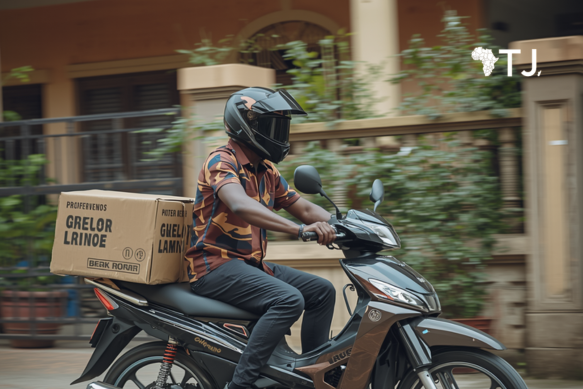
The food delivery darling just made its boldest move yet – and it has nothing to do with jollof rice.
There is a peculiar ritual Nigerians know well. You order something from a vendor on Instagram. They quote you a delivery fee. You haggle. You balance the rider “small something”. The package arrives two hours late, slightly roughed up, with no way to track where it’s been. You swear you’ll never do it again. You do it again next week.
This is the informal courier economy that has propped up millions of small businesses and frustrated millions more customers. It is disorganised by design, personal by necessity, and ripe for disruption by anyone with a large enough rider network.
Chowdeck has that network, and now, it is coming for that market.
This May, the Lagos-based food delivery company pushed its Relay courier service into the spotlight with a flat ₦1,000 intra-city delivery offer. Same-day. Tracked. Backed by the same logistics infrastructure that has made Chowdeck one of Nigeria’s most reliable delivery brands.
It is a quiet pivot. But the ambitions behind it are anything but.
The Company That Outlasted Everyone
Founded in October 2021 by Femi Aluko, Olumide Ojo, and Lanre Yusuf, all veterans of Paystack, the fintech acquired by Stripe, Chowdeck launched as a simple idea: get food from Lagos restaurants to customers in under 30 minutes.
The timing looked naïve. The graveyard of food delivery in Nigeria was already crowded. Jumia Food had burnt through capital and retreated. Bolt Food had exited Nigeria altogether. Glovo was hedging its bets. Every major player had tried and failed to crack what was obviously a huge market, and just as obviously, a brutal one.
Chowdeck survived by doing the boring things well. Its geotagging system matched orders to the nearest rider with precision that competitors couldn’t match. Its incentive structure kept couriers loyal in a market notorious for rider churn. And it kept delivery fees honest enough to build trust with price-sensitive Nigerian consumers.
By October 2023, the platform crossed ₦1 billion ($830,000) in monthly order value for the first time. By March 2024, that figure had more than doubled to ₦2.4 billion ($2 million). That same year, Chowdeck closed a $9 million Series A, one of the largest fundraises ever for a local African food delivery player, with investors betting on the company’s ability to scale beyond meals.
Today, Chowdeck operates across eight cities in Nigeria, processes over 30,000 daily deliveries, runs a fleet of roughly 20,000 riders, and has facilitated over $19 million in vendor deliveries on its platform alone. In August 2025, it launched in Accra, Ghana, hitting 1,000 daily orders in just three months, a milestone that took nearly a year to reach in Lagos.
The company is not just surviving. It is compounding.
The Courier Gap Is Worth $230 Million
Here is what makes the Relay push strategically sensible: the infrastructure Chowdeck has already built is overkill for food delivery alone.
Twenty thousand vetted, geotagged, app-enabled riders across major Nigerian cities, that is an asset most logistics companies would spend hundreds of millions of dollars to assemble. Chowdeck assembled it to deliver jollof rice. The marginal cost of routing some of those riders to deliver packages instead is nearly zero.
Meanwhile, the market they are entering is enormous and deeply underserved.
Nigeria’s last-mile delivery market is currently valued at $230 million, with urbanisation, e-commerce growth, and smartphone penetration driving steady expansion. The broader African last-mile delivery market stood at $1.45 billion in 2024 and is projected to reach $3.02 billion by 2033, growing at a compound annual rate of 8.45%.
In Nigeria specifically, e-commerce orders grew 22% year-on-year in Q1 2025, with 58% of total orders now originating from secondary cities, an indicator that demand for reliable delivery is spreading beyond Lagos and Abuja. Yet the courier experience for most consumers and small businesses remains chaotic, unreliable, and opaque.
Existing players like GIG Logistics, Kwik Delivery, and Sendbox have carved out niches. But none of them holds the brand trust that Chowdeck has built through millions of successful food deliveries. Trust, in a market defined by theft, delays, and accountability gaps, is a moat.
₦1,000 Is Not a Price. It’s a Statement.
The flat ₦1,000 rate for intra-city delivery is not just a promotional offer. It is a market signal, Chowdeck telling competitors, small business owners, and individual senders that it intends to compete aggressively on price.
For context, most Lagos courier services charge between ₦1,500 and ₦4,000 for same-day intra-city delivery depending on distance, package size, and the rider’s mood. Kwik, one of the better-organised options, raised $4.7 million to build its two-hour delivery promise in Lagos and Abuja. GIG Logistics operates 100+ service centres across Nigeria using a hub-and-spoke model, but its pricing reflects that infrastructure overhead.
Chowdeck has no such overhead problem. Its riders are already on the road. Its app already handles live tracking, payments, and customer support. All it needs is to redirect existing capacity to a new category.
The ₦1,000 flat rate is designed to make the switching cost for a first-time Relay user essentially zero and to make the comparison with informal bike-rider delivery unmistakably favourable.
Beyond Delivery: The Superapp That Won’t Say It Is One
What is really happening here is a quiet superapp strategy.
Chowdeck has spent three years building the hard parts: a reliable rider network, a geolocation stack competitors couldn’t replicate, and consumer trust earned meal by meal. Now it is running those assets across multiple revenue lines.
The product map tells the story clearly:
- Food delivery, the core, is still growing
- Grocery & pharmacy delivery, launched alongside 1,500+ vendors across multiple verticals
- Chowpass, a subscription product that drives retention and revenue predictability
- Relay, intra-city courier for packages
- Mira, a restaurant POS and operations tool acquired in June 2025, is extending Chowdeck’s footprint into vendor-side infrastructure
Each of these is independently useful. Together, they form a logistics and commerce operating system, one that makes Chowdeck increasingly difficult to displace from the lives of its users.
This is the same playbook Grab executed in Southeast Asia: start with the thing people need every day (food, rides), earn their trust, then expand the surface area of the relationship. The difference is that Chowdeck is doing it in a market where the baseline infrastructure is far less mature, which means both the challenge and the ceiling are considerably higher.
Chowdeck’s CEO, Femi Aluko, has been careful not to use the “superapp” label. But the feature releases suggest a company that has figured out what it wants to be when it grows up.
What This Means for Nigerian Small Businesses
For Instagram vendors, WhatsApp merchants, and small shop owners across Lagos, Port Harcourt, and Abuja, Relay could represent something genuinely transformative: a named, trackable, accountable courier service at a price that doesn’t eat their margin.
The informal delivery economy that currently serves these businesses is large but unreliable. Theft is common. Accountability is rare. When a customer does not receive a package, the business owner absorbs the cost of the goods, the refund, and the reputational damage. Organised logistics apps have helped, but at price points that make per-order economics painful for low-ticket items.
A ₦1,000 flat delivery rate changes the calculus. For a vendor selling a ₦5,000 product, with a 20% logistics overhead, it is still meaningful but workable. For a vendor who previously lost packages or paid ₦3,000 for unreliable delivery, it is a revelation.
And because Relay rides on Chowdeck’s existing app infrastructure, it comes with live delivery tracking and vetted riders, the two features small business owners most need and have historically been unable to afford.
The Road Ahead
Relay is not yet a fully realised product. Its rollout is still limited in scope, and the ₦1,000 rate appears to be an introductory offer rather than a permanent pricing floor. The long-term unit economics will need to hold up as volume grows and the promotional period fades.
There are also structural challenges that no app can fully resolve. Lagos traffic is a logistics problem with no software solution. Fuel prices remain volatile and represent a significant cost pressure on rider margins. And the informal courier culture, built on personal relationships and flexible arrangements, will not simply dissolve because a better-priced alternative exists.
But Chowdeck has already demonstrated that it can build trust in a market that did not believe trust was possible. It cracked food delivery in Nigeria, which was supposed to be uncrackable. It is now applying the same model to a courier market that is larger, more fragmented, and arguably even more broken.
The food was just the beginning. Chowdeck wants to deliver everything else, too.
Data sourced from TechCrunch, Rest of World, Afridigest, Ken Research, Straits Research, Mordor Intelligence, and Chowdeck’s official communications.