In 2020, millions of businesses across Africa were forced to close their doors.
For weeks and, in some cases, months, shops that had relied almost entirely on walk-in customers suddenly had no customers to serve. Sales disappeared overnight. Businesses that had operated successfully for years realised how dependent they had become on physical locations.
The pandemic exposed a weakness many entrepreneurs had never seriously considered.
A business could have loyal customers, quality products, and a strong reputation, but if people couldn’t physically visit the store, the business struggled to survive.
While schools moved online, churches began livestreaming services, and companies embraced virtual meetings, many small businesses were still searching for an affordable way to continue selling.
That observation became the foundation for TLG Trade.
The company was founded during the COVID-19 lockdown with a simple idea: physical stores should no longer be the only place where businesses exist. Instead of replacing traditional commerce, TLG Trade wanted to help businesses build digital storefronts that could continue serving customers regardless of physical disruptions.
African Businesses Are Becoming More Discoverable Before They Become Visitable
Consumer behaviour has changed significantly over the past few years.
Today, many buying journeys begin long before someone enters a store. Customers search online, compare prices, read reviews, browse product catalogues, and evaluate sellers before making purchasing decisions.
For businesses without an online presence, this shift creates a new challenge.
The problem is no longer just selling products.
It is being discovered in the first place.
Many small businesses still rely heavily on physical locations and word-of-mouth referrals, even as consumers increasingly expect to find products through search engines, social media, and digital marketplaces.
TLG Trade believes every business should have an online storefront that complements its physical location rather than replacing it.
Building More Than an Online Shop
One of the earliest lessons the company learned was that creating an online store alone does not guarantee sales.
Many businesses expected customers to appear immediately after launching their websites. When that didn’t happen, some concluded that eCommerce simply didn’t work.
The team realised that digital commerce required more than storefronts.
Businesses also needed visibility.
That insight shaped the evolution of TLG Trade into a broader eCommerce ecosystem.
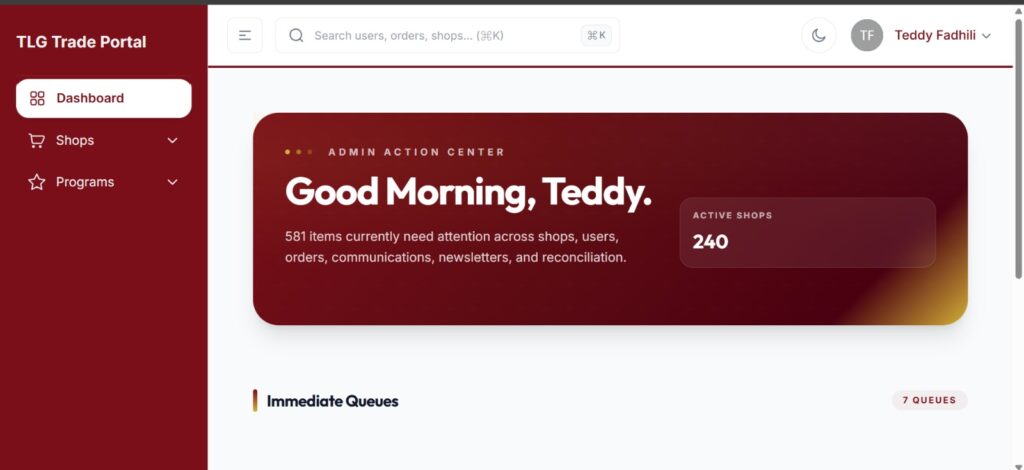
Today, the platform combines custom online storefronts with digital marketing tools, AI-assisted product listing, secure escrow payments, Google Search Console integration, Google Merchant Centre integration, Meta Merchant Centre integration, SEO-friendly infrastructure, and shareable product links that help businesses reach customers beyond their physical locations.
Rather than functioning as a standalone online shop, the platform is designed to help businesses become easier to discover, market, and trust.
Learning From Early Users
Before its public relaunch, TLG Trade onboarded 150 sellers from different African countries during its pilot programme.
The pilot became more than a product test.
It became a learning exercise.
Feedback from early users helped shape product improvements, refine the platform, and strengthen features before wider expansion. For the team, listening to businesses proved just as important as building technology.
Today, the company’s initial focus remains Nairobi while preparing for broader expansion across the continent through partnerships and ecosystem collaborations.
The Future of African Commerce
For decades, many African businesses measured growth by opening additional physical locations.
Digital commerce is beginning to change that equation.
Growth increasingly depends not only on where a business is located, but also on how easily customers can discover it online.
TLG Trade believes the future belongs to businesses that combine physical presence with digital accessibility.
Looking ahead, the company plans to expand across Africa while strengthening its platform with additional AI capabilities, strategic partnerships, and integrated digital commerce tools.
The ambition is larger than building another eCommerce platform.
It is to help millions of African businesses become visible, discoverable, and competitive in a digital economy where the customer often arrives online before walking through the door.