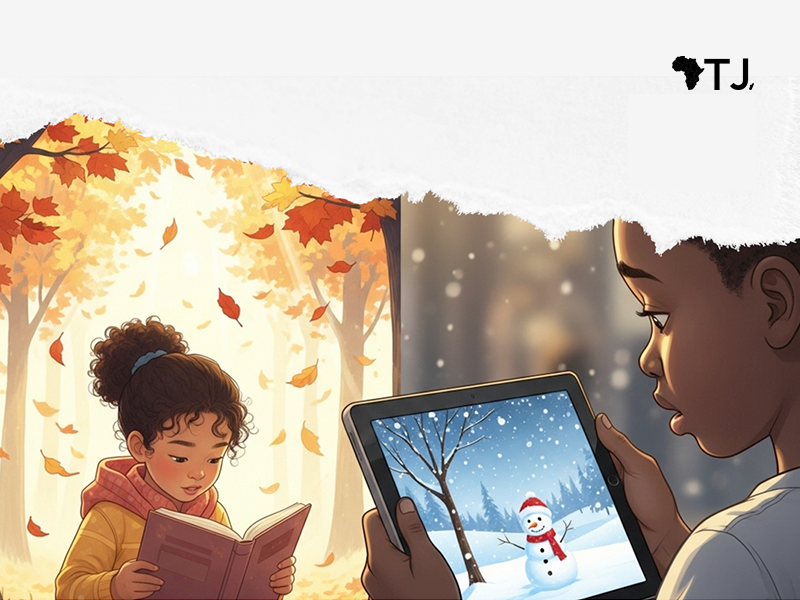
An average child born in London, can scroll through platforms and instantly stories that resonate or books he wants to read.
He reads about autumn leaves piling up on the pavements or children building snowmen in winter, and it feels natural because those details reflect his environment.
The Lagos child, on the other hand, opens the same platforms and is bombarded by the same kinds of books. But, for him, the context might be difficult to understand.
Not because they are difficult words, but because they do not reflect his reality. His imaginations are limited to the environment around him, the dry chill of harmattan mornings, the excitement of suwe and ten-ten in the compound, or the ritual of Saturday morning Akara and Pap.
When the books accessible rarely reflect the realities of people, it doesn’t just create distance, it makes it harder to see their own stories as worthy of being told.
While the London child grows up affirmed by the stories around him, the Lagos child is left trying to measure his reality against tales that were never written with him in mind.
The challenge isn’t about having no books at all, it’s about visibility and access to their own stories.
Digitalisation promised to democratise storytelling. But when African books are hidden or hard to find, it blocks children from hearing their own voices. Instead, they grow up consuming their identity secondhand, through stories told by outsiders.
This lack of access makes them more vulnerable to stereotypes and incomplete narratives. As Chimamanda Adichie puts it in The Danger of a Single Story: “The single story creates stereotypes, and the problem with stereotypes is not that they are untrue, but that they are incomplete. They make one story become the only story.”
And this isn’t happening in isolation. The global book market is dominated by Western platforms that decide which stories rise to the top.
These platforms shape distribution, pricing, and discoverability.
For African readers, paying in dollars, navigating limited payment options, and fighting visibility algorithms makes access even harder. What starts as a visibility challenge quickly becomes both an economic and cultural one.
That’s why Chapter One is different.
Their pricing model is designed around local realities, so affordability doesn’t mean exclusion. At the same time, they’re amplifying African authors in ways that make their books as easy to discover as their global peers.
Fair value for the writer, fair access for the reader.
Because the goal isn’t just “more books.”
It is ensuring the African child grows up with the same right to dream, imagine, and discover through stories rooted in their own world ; not just borrowed from someone else’s.