Author: African Tech Journal

  • Digital at Scale: Inside the DevOps Strategies Fueling Nigeria’s Financial Services Boom

    Digital at Scale: Inside the DevOps Strategies Fueling Nigeria’s Financial Services Boom

    Infrastructure as a growth lever

    Nigeria’s financial services sector is experiencing unprecedented digital transformation, with traditional banks racing to match fintech innovation while maintaining regulatory compliance and operational stability.

    To understand the infrastructure strategies driving this evolution, Fabunmi Raphael spoke with Olaitan Falolu, Head DevOps of the leading financial institute in Nigeria, whose seven-year career spans platform engineering at multiple tier-1 financial institutions.

    Falolu has led teams that achieved 99.9% uptime for critical banking systems while reducing cloud costs by 35% and cutting deployment times by 40%. metrics that have become benchmarks for financial services infrastructure in Nigeria.

    Nigeria’s financial sector is undergoing massive digital transformation.

    From your perspective leading DevOps at one of the leading commercial banks in Nigeria, what infrastructure challenges are banks facing that most people don’t see?

    The biggest challenge is that Nigerian banks are essentially running two businesses simultaneously. We have traditional banking operations that require absolute stability and regulatory compliance, while also building fintech-style digital services that need to deploy features daily and scale instantly.

    Most people see the mobile app or web interface, but behind that is infrastructure that must handle millions of transactions during peak periods like salary payment days when transaction volumes can spike 300% in a few hours. Our systems need to auto-scale seamlessly while maintaining the security and compliance standards that banking regulations demand.

    The complexity isn’t just technical. We’re managing infrastructure that serves customers across Nigeria with varying network conditions, device capabilities, and usage patterns. A deployment strategy that works for Lagos connectivity doesn’t necessarily work for rural areas, so our platform architecture has to be resilient across these different operating environments.

    What specific DevOps strategies have you implemented to address these scaling challenges?

    The game changer is focusing on what I call “intelligent automation”—not just automating manual processes, but building systems that make smart decisions about resource allocation and deployment strategies.

    – We implemented Azure DevOps pipelines with intelligent staging that automatically provisions testing environments that mirror production configurations exactly. This eliminated the configuration drift issues that were causing 30% of our deployment failures.

    – The game-changer was integrating our monitoring stack—Dynatrace, Prometheus, and Grafana—directly into the CI/CD pipeline. Now our deployment system automatically validates performance metrics before promoting releases to production. If a deployment causes any degradation in response times or error rates, it automatically rolls back without human intervention.

    – We also implemented what we call “feature flagging infrastructure” that allows us to deploy code to production but control feature availability at the infrastructure level. This means we can push updates during low-traffic periods and then enable features instantly when market conditions are optimal.

    You’ve helped tier-1 financial institutions achieve 99.9% uptime across their digital banking platforms. In the Nigerian operating environment, that’s incredibly difficult.

    What’s your approach to reliability?

    Reliability in Nigerian banking infrastructure requires anticipating failure modes that don’t exist in other markets. Power infrastructure variability, network connectivity challenges, and the fact that digital banking services are essential infrastructure for millions of people create unique reliability requirements.

    Our approach is built on redundancy at every layer. We run multi-region deployments across Azure availability zones, but we also maintain on-premises backup systems for critical functions. If cloud connectivity fails, customers can still access core banking services through alternative pathways.

    The monitoring strategy is predictive rather than reactive. We’ve configured Dynatrace to identify performance patterns that typically precede system failures. When we see database query times increasing or memory utilization following specific patterns, our systems automatically scale resources and alert engineers before customers experience any impact.

    We also implemented what I call “graceful degradation architecture.” During high-load periods or partial system failures, the platform automatically disables non-essential features while maintaining core banking functions. Customers might not be able to view detailed transaction histories during peak periods, but they can always check balances and make payments.

    Security is obviously critical in banking. How do you integrate security into DevOps processes without slowing down deployment velocity?

    Security integration has to be invisible to development teams, or they’ll find ways around it. We embedded security scanning using SNYK directly into Azure DevOps pipelines, so vulnerability assessment happens automatically during the build process. Developers never have to think about running security scans—they just get alerts if issues are detected.

    The key insight was treating security as infrastructure code rather than a separate process. Our Terraform modules include security policy enforcement, network segmentation rules, and access control configurations. When engineers provision new resources, they automatically inherit security standards rather than having to implement them separately.

    We also implemented automated compliance validation. Every deployment automatically checks configurations against CBN [Central Bank of Nigeria] requirements and international banking standards. If a deployment would create compliance issues, it fails automatically with specific guidance on what needs to be fixed.

    This approach actually accelerated deployment velocity because engineers no longer have to wait for security reviews. They get immediate feedback during development, and they know that anything that passes pipeline validation will meet security and compliance requirements.

    Cost optimization is crucial for Nigerian banks. How do you balance performance requirements with cost efficiency?

    Cost optimization in banking infrastructure isn’t just about spending less money—it’s about spending money more intelligently to support business growth. We reduced cloud costs by 35%, but transaction processing capacity actually increased during the same period.

    The strategy focuses on dynamic resource allocation based on actual usage patterns rather than peak capacity provisioning. Nigerian banking has very predictable transaction patterns—salary days, month-end processing, holiday periods—so we designed autoscaling policies that anticipate these patterns rather than just reacting to them.

    We implemented intelligent caching layers that reduce database load during high-traffic periods. Instead of scaling database resources to handle peak loads, we cache frequently accessed data and serve it from high-performance Redis clusters. This provides better customer experience at lower infrastructure costs.

    The biggest cost optimization came from eliminating unused resources. We implemented automated resource lifecycle management that provisions development and testing resources when needed and destroys them when projects complete.

    This eliminated the “forgotten infrastructure” that was consuming significant budget without providing business value.

    How do you see fintech competition affecting infrastructure strategies for traditional banks?

    Fintech companies have forced traditional banks to adopt startup-style infrastructure thinking, but banks have advantages that fintechs don’t fully appreciate yet. Fintechs can build greenfield infrastructure optimized for specific use cases, but banks need infrastructure that supports both legacy systems and modern digital services.

    The opportunity for banks is building platform foundations that enable fintech-style innovation velocity while maintaining the operational stability that regulatory compliance requires. This means investing in platform engineering capabilities rather than just application development teams.

    We’re building what I call “fintech-ready infrastructure”—platform foundations that can support rapid feature development, A/B testing, and real-time personalization while maintaining the security and compliance standards that banking requires.

    The banks that will succeed are those that recognize infrastructure as a competitive advantage rather than just operational overhead. When you can deploy features in hours instead of weeks, you can respond to customer feedback and market opportunities faster than competitors—even fintech startups.

    What advice would you give to other financial institutions looking to optimize their DevOps capabilities?

    Start with monitoring and observability before you optimize anything else. You can’t improve what you can’t measure accurately. Many banks are trying to optimize deployment processes without understanding their current performance baselines or failure patterns.

    Invest in platform engineering teams as business enablers, not just technical support. The engineers who understand both infrastructure optimization and business requirements are the ones who deliver transformational results rather than just technical improvements.

    Don’t try to implement everything simultaneously. We achieved our 40% deployment improvement through systematic optimization over six months, not a single massive change. Focus on eliminating the biggest bottlenecks first, then build additional capabilities on stable foundations.

    Most importantly, treat security and compliance as infrastructure requirements rather than external constraints. When security is built into your platform architecture, it enables faster development rather than slowing it down.

    Looking ahead, how do you see DevOps evolving in Nigerian financial services?

    The next phase will be about intelligent infrastructure that makes decisions automatically based on business context, not just technical metrics.

    We’re already implementing systems that automatically optimize resource allocation based on transaction patterns, customer behavior, and market conditions.

    Cross-border expansion is driving demand for platform architectures that can adapt to different regulatory environments automatically. Nigerian banks expanding across Africa need infrastructure that can deploy the same applications while meeting different compliance requirements in each market.

    The bigger opportunity is positioning Nigerian platform engineering expertise globally. The engineers who can maintain 99.9% uptime while optimizing costs in challenging operating environments bring capabilities that financial institutions worldwide need. Nigerian DevOps expertise isn’t just supporting local digital transformation—it’s creating competitive advantages that transcend geographic boundaries.

    Olaitan Falolu is the Head DevOps of the leading financial institute in Nigeria, where he leads platform engineering initiatives supporting Nigeria’s digital banking transformation.

    His expertise in Azure cloud optimization, security integration, and DevOps team leadership spans seven years of financial services infrastructure experience across Nigeria’s banking sector.

    Connect with him on LinkedIn

  • How Vendyz Is Powering Africa’s Surging Social Commerce Infrastructure

    How Vendyz Is Powering Africa’s Surging Social Commerce Infrastructure

    The Beginning: Born from a Painful Loss

    Most startups begin with market research, pitch decks, and investor meetings. Vendyz started with a gut punch: a significant loss to an online scammer.

    For the average online entrepreneur in Nigeria, that’s not just money—it’s months of hustle, saved income, and deferred dreams. But instead of accepting it as “the cost of doing business” in Nigeria’s Wild West online marketplace, the Vendyz team asked a different question:

    What if trust didn’t have to be a gamble?

    That question sparked what would become one of Africa’s most authentic social commerce stories—a journey defined not by Silicon Valley playbooks, but by the messy, beautiful reality of building for Africans who trade on WhatsApp, Instagram, and Facebook every single day.

    The Hard Truth: When Your Co-Founder Walks and the Market Doesn’t Care

    Let’s get real about what “building from scratch” actually means.

    Just as Vendyz started gaining momentum, their CTO and co-founder exited. Not after Series A. Not after product-market fit. Right when the foundation was being laid.

    For a bootstrapped team funding operations personally, this wasn’t a minor setback—it was an existential crisis. There was no budget to hire senior engineers. No safety net of investor capital. Just a mission and a decision: fold or find another way.

    They chose the latter. They found people willing to learn, trained them, and kept building.

    But the market had other lessons waiting.

    The Escrow Paradox

    Here’s what nobody tells you about building in Nigeria: sometimes the problem you’re solving is real, but the market isn’t ready for your solution.

    Vendyz launched as an escrow platform—a logical answer to the trust crisis in online transactions. The research made sense. The pain point was validated. Users agreed they needed protection.

    But behavior told a different story.

    People wanted safety, but they didn’t want process. They wanted protection, but they didn’t want to explain escrow to every buyer. They wanted trust, but they wanted it to feel as seamless as a regular bank transfer.

    And quietly, competitors who started in escrow were pivoting away. No press releases. No public admissions. Just silent repositioning into other fintech verticals.

    Vendyz could have followed them out the door. Instead, they did something harder: they stayed and adapted.

    The Pivot: Meeting Africans Where They Already Trade

    The breakthrough came from watching how Africans actually buy and sell online.

    While some trade through e-commerce platforms and Shopify stores, the overwhelming majority operate in WhatsApp groups, Instagram DMs, Facebook Marketplace, and TikTok comments.

    Social commerce wasn’t a buzzword for Vendyz’s users—it was reality. Vendors were already building businesses in chat threads, managing inventory through phone galleries, and coordinating deliveries via voice notes.

    So Vendyz made a critical decision: **instead of changing user behavior, build around it.**

    They evolved from a standalone escrow platform into a social commerce infrastructure company—one that integrated direct payments, escrow for those who wanted it, and access to over 50 logistics providers, all while vendors continued trading exactly where they were comfortable.

    The market validated the shift immediately. Africa’s social commerce market is projected to explode from $3.51 billion in 2024 to $9.43 billion by 2030 (16.2% CAGR). In Nigeria alone, it’s expected to nearly double from $2.04 billion in 2025 to $3.96 billion by 2030.

    Vendyz wasn’t chasing a trend. They were building infrastructure for a revolution already happening in millions of DMs across the continent.

    The Tech Stack: From Manual Chaos to Automated Trust

    The turning point came after the first few dozen transactions.

    Manual coordination between buyers and sellers might work for 10 deals. Maybe 50. But at scale? Impossible.

    That’s when Vendyz became a technology company, not just a payment facilitator.

    The Build

    They constructed an automated escrow system that held funds securely and released them only when both parties confirmed satisfaction—no human intervention required for happy paths, full support available for disputes.

    Then they integrated the tools that turned them from early-stage startup to serious infrastructure:

    – Korapay and Palmpay for payment processing

    – Google Cloud for hosting and security  

    – Shipbubble for 50+ logistics provider integrations

    – Tawk.to for live customer support

    – GA4 and GTM for behavioral analytics

    – Custom dashboards for real-time transaction monitoring

    On the operations side, they built structured workflows through Google Sheets and Slack Workspace, ensuring product, design, operations, and marketing stayed aligned without expensive project management tools.

    The Impact

    The change was immediate and measurable:

    – Transactions became faster

    – Error handling improved dramatically  

    – Internal communication became seamless

    – Customer trust skyrocketed

    Users started describing Vendyz as “simple, safe, and easy to use”—the three words every fintech founder dreams of hearing in a market saturated with complexity.

    The Cultural Secret: Building for Behavior, Not Ideals

    Here’s what separates Vendyz from most African tech startups: they never tried to “educate the market” out of its habits.

    They didn’t build a fancy app and then wonder why adoption was low. They didn’t create workflows that required users to change how they already did business.

    Instead, they met Africans exactly where they were:

    The WhatsApp Marketplace

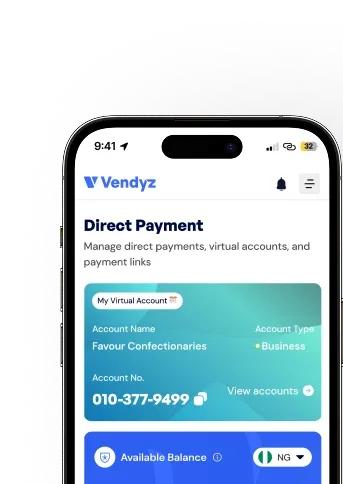
    Recognizing that WhatsApp is Africa’s primary commerce platform, Vendyz built a verified vendor marketplace directly within WhatsApp. Sellers could list products, buyers could discover them, and transactions could happen without anyone leaving the app they were already in.

    The Language

    They kept communication simple, human, and personal. No corporate jargon. No fintech buzzwords. Just clear language that made sense to someone selling shoes from their apartment or a university student flipping tech gadgets.

    The Process

    Instead of forcing escrow on everyone, they offered direct pay for those who wanted speed and escrow for those who wanted protection. User choice, not company preference.

    This cultural authenticity is why Vendyz has been able to grow organically in a market where most fintech startups burn millions on user acquisition.

    The Numbers: What Organic Growth Actually Looks Like

    Since launching their MVP in mid-March 2025, Vendyz has achieved metrics that most funded startups would envy:

    – 600+ verified buyers and sellers in active marketplace

    – 500+ active users engaging regularly with the platform

    – 50+ integrated logistics providers enabling nationwide delivery

    – Strategic partnerships with Anchor, Korapay, PalmPay, and other fintech infrastructure players

    But here’s what matters more than the numbers: Vendyz deliberately chose quality over vanity metrics.

    They started with over 1,000 onboarded users. Then they refined their verification process and cleaned the database down to 600 verified, trustworthy participants.

    Why? Because in a trust-based business, credibility > scale.

    One scammer in your marketplace destroys more value than 100 legitimate users create. Vendyz understood this from Day 1.

    The Milestones That Matter

    Every milestone at Vendyz tells a story of resilience over resources:

    1. The WhatsApp Marketplace Launch

    Creating a free, verified vendor marketplace inside WhatsApp wasn’t just product innovation—it was cultural adaptation. It proved that African vendors didn’t need to learn new platforms; platforms needed to meet them where they already were.

    2. The ₦3M Transaction Milestone

    Processing over ₦3 million organically within months of launch validated the core hypothesis: Africans want trust-based payments when executed with simplicity.

    3. The Verification System

    Choosing to reduce their user count from 1,000 to 600 verified participants was a defining moment. It signaled to the market that Vendyz prioritized safety over growth theater.

    4. The Community Trust Signal

    The most meaningful milestone? Organic referrals.

    Users started recommending Vendyz without prompting. Vendors shared testimonials unpaid. Buyers referred friends naturally. That’s when Vendyz knew they’d built something real.

    The Lessons: What Vendyz Teaches African Founders

    1. Start with Empathy, Not Features

    Vendyz didn’t begin with “let’s build fintech.” They began with “we got scammed, and that needs to stop.” Real innovation starts with real pain.

    2. Don’t Scale Noise; Scale Trust

    It’s better to have 600 verified, engaged users than 6,000 inactive ones. Growth without trust eventually collapses.

    3. Build Lean, But Build Consistently

    Every milestone was achieved without external capital by focusing ruthlessly on user value and operational discipline.

    4. Adapt Fast, But Stay True

    The market shifted from escrow to direct pay, from app to WhatsApp, from standalone payments to full commerce infrastructure. But Vendyz’s mission—enabling safe online trade—never changed. That clarity created resilience.

    5. Culture Drives Success

    Building a team culture rooted in accountability, empathy, and clarity will always outperform even the best strategies. Vendyz’s team evolution from small founding group to full-function operation proves this.

    The Future: Building Africa’s Social Commerce Backbone

    Vendyz isn’t done. In fact, they’re just warming up.

    The Next 3 Years: Three Growth Pillars

    1. Product Expansion

    Launching Vendyz Storefronts—allowing any vendor to create a professional mini-store in minutes that integrates payments, delivery, and reviews. Think Shopify simplicity meets WhatsApp ubiquity.

    2. Geographical Growth

    Expanding to Ghana and Kenya first, where informal trade and social selling mirror Nigeria’s dynamics. The playbook is proven; now it’s about regional adaptation.

    3. Financial Enablement

    Deepening access to business tools like Virtual Business Accounts (VBA), enabling small sellers to transact with the credibility of structured businesses.

    The Technology Vision

    Vendyz is investing heavily in:

    – Automation of vendor verification, payouts, and analytics

    – Data systems that help vendors understand their customers

    – AI-driven insights for inventory management and pricing

    – Reputation scoring to build trust at scale

    If Funding Comes

    Vendyz has been approached by investors, but they’ve been selective. If capital arrives, priorities are clear:

    1. Technology infrastructure (strengthen escrow/direct pay, expand logistics integrations)

    2. Marketing and growth (vendor education, university ambassador programs)

    3. Talent development (ensuring the team grows with the company)

    Why This Story Matters

    Vendyz represents something bigger than a fintech startup.

    They’re proof that:

    ✅ You can build trust-first technology without external funding 

    ✅ Cultural adaptation beats market education

    ✅ Organic growth is possible when mission > hype  

    ✅ African innovation often comes from lived experience, not imported playbooks

    In a tech ecosystem obsessed with fundraising announcements and unicorn valuations, Vendyz is building the unsexy, essential infrastructure that enables thousands of everyday Africans to trade safely online.

    They’re not chasing headlines. They’re opening doors.

    The Vendyz Playbook: Questions for Reflection

    For every African entrepreneur reading this, ask yourself:

    1. Are you building for the market you wish existed, or the one that actually does?

    2. Have you truly met your users where they are, or are you asking them to meet you? 

    3. Are you measuring vanity metrics or building real trust?

    4. Can you articulate your mission in one sentence that a street vendor would understand?

    Vendyz can. Their mission is simple: Make online trade safe for everyday Africans.

    Everything else—the tech, the partnerships, the pivots—flows from that clarity.

    Join the Movement

    Vendyz isn’t just building a platform. They’re building the infrastructure for Africa’s next generation of digital vendors.

    If you’re a vendor tired of trust issues, a buyer tired of scams, or an entrepreneur inspired by resilient building—Vendyz’s story is your invitation.

    The future of African commerce isn’t happening in boardrooms alone. It’s happening in WhatsApp chats, Instagram DMs, Shopify stores, and communities of builders who refuse to accept “that’s just how things are.”

    Vendyz is proof that another way is possible.

    Want to be part of Africa’s social commerce revolution? Follow Vendyz’s journey and join their verified marketplace. Because trust shouldn’t be a luxury—it should be infrastructure.

    🚪 Welcome to the new wave of African tech.

  • How Amoke Oge Turned Lagos Food Business Into A ₦2.3 Billion Success With Technology

    How Amoke Oge Turned Lagos Food Business Into A ₦2.3 Billion Success With Technology

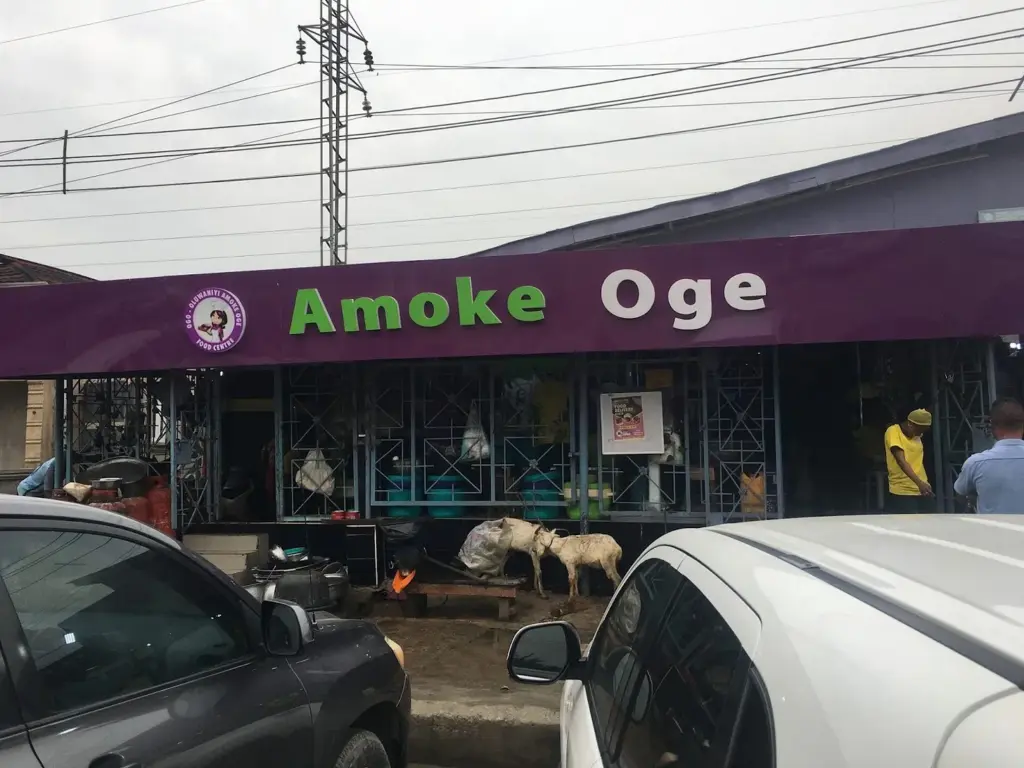
    There’s something inspiring about watching someone turn passion into serious money. Hajia Amoke Odukoya, better known as Amoke Oge, did exactly that with her Amala food business. Today, it’s a ₦2.3 billion success story.

    Her journey isn’t just about cooking great food. Although her amala is legendary in Lagos, it’s also about how she used food technology and delivery platforms to solve real problems. As a result, she scaled beyond the walls of a single kitchen and built one of the most inspiring food businesses in Lagos.

    Starting Small, Dreaming Big

    In the early 2010s, Amoke Oge started with less than ₦200,000. She learned to cook from her sister, Alhaja Saudi (known locally as Iya Amoke), who was already making waves with food in Lagos. With her husband, Ishola Ade, supporting the vision, they began grinding yam and cassava the traditional way, feeding their community from a single kitchen.

    However, success brought its own problems. As inflation hit 28.9% in 2023, running a physical restaurant became brutal. Stores were packed. Customers grew frustrated while waiting for tables. Seating was limited. The traditional model was hitting its limits. After all, you can only serve so many people at once when they must physically show up.

    The Platform Play

    Photo from Refined.ng
    The Platform Play Image Caption

    Two to three years ago, Amoke Oge made a move that changed everything. She joined Chowdeck, one of Nigeria’s fastest-growing food delivery platforms.

    This wasn’t just about adding delivery as a side option. Instead, she went all-in on the platform model, letting Chowdeck handle logistics while she focused entirely on cooking. Consequently, this strategic embrace of food technology turned a beloved local kitchen into a scalable food business in Lagos.

    The results speak for themselves. Over 500,000 deliveries have been completed, making her the first woman-led business to hit that milestone on the platform.

    The numbers are striking. Amoke Oge is now averaging ₦4,600 per order. Yes, that’s higher than what you’d pay eating in a traditional bukka. Yet it’s also what people are willing to pay for convenience and quality delivered to their door.

    Just by leveraging food delivery technology in Lagos, Amoke Oge moved from a single kitchen to multiple outlets. In addition, she built a repeatable system for growth.

    Scale and Strategy

    Today, Amoke Oge operates seven locations across Lagos — Oshodi, Surulere, and others — with plans to expand to ten branches soon. That expansion is directly enabled by the delivery model.

    It’s a technology-based food delivery platform where Chowdeck manages the connection between vendors, delivery riders, and customers. Therefore, vendors like Amoke Oge can focus on cooking while leveraging the platform’s infrastructure for order fulfillment and delivery.

    Instead of worrying about foot traffic and prime real estate for each new location, she can focus on kitchen efficiency and meeting delivery demand.

    The ₦2.3 billion in revenue isn’t just impressive. It’s also proof of concept for how traditional food businesses in Lagos can use food technology to reach entirely new markets and price points.

    Why This Matters

    Amoke Oge’s story resonates because it’s not about replacing tradition with technology. She’s preserved the authenticity of Yoruba cuisine while using modern tools to reach more people. Amala isn’t just food. It’s a cultural heritage. Yet she’s found a way to scale that without losing what makes it special.

    For entrepreneurs watching from the sidelines, there are clear lessons here. She identified a real constraint (physical space limiting customers), found a technology solution that addressed it (delivery platforms), and executed consistently enough to become a category leader.

    Meanwhile, the timing worked in her favor too. Chowdeck just raised $9 million in Series A funding, which suggests investors believe in the model she’s been proving works.

    Lessons for Food Entrepreneurs in Lagos

    • Start with authenticity. Whether it’s amala, suya, or small chops, build your food business around something real.
    • Also, use food technology as leverage. Platforms like Chowdeck or Glovo can handle logistics while you focus on quality.
    • Think beyond your kitchen. Delivery means your reach isn’t limited by foot traffic or seating space.
    • Consistency matters. High quality and prompt delivery build trust and repeat customers.
    • Finally, track your numbers. Knowing your order averages and growth patterns helps you plan expansion intelligently.
    • For small food businesses in Lagos, these lessons are a practical blueprint you should follow. The sky is wide enough for everyone to fly if you do it strategically.

    What’s Next for Amoke Oge

    Photo from Businesspost

    Amoke Oge represents something bigger than one successful food business. She’s part of a generation of African entrepreneurs who are figuring out how to use food technology platforms to scale traditional businesses without losing their essence.

    Her success creates a template. Start with something you’re genuinely good at. Identify where technology can remove constraints. Execute consistently. Not revolutionary advice, but clearly effective when done right.

    The real question now is who follows her playbook next, and in which industries. Because if you can scale amala to ₦2.3 billion, what else becomes possible?

  • Tosin Ojo launches the Global Analytics Challenge for aspiring Data analysts.

    Tosin Ojo launches the Global Analytics Challenge for aspiring Data analysts.

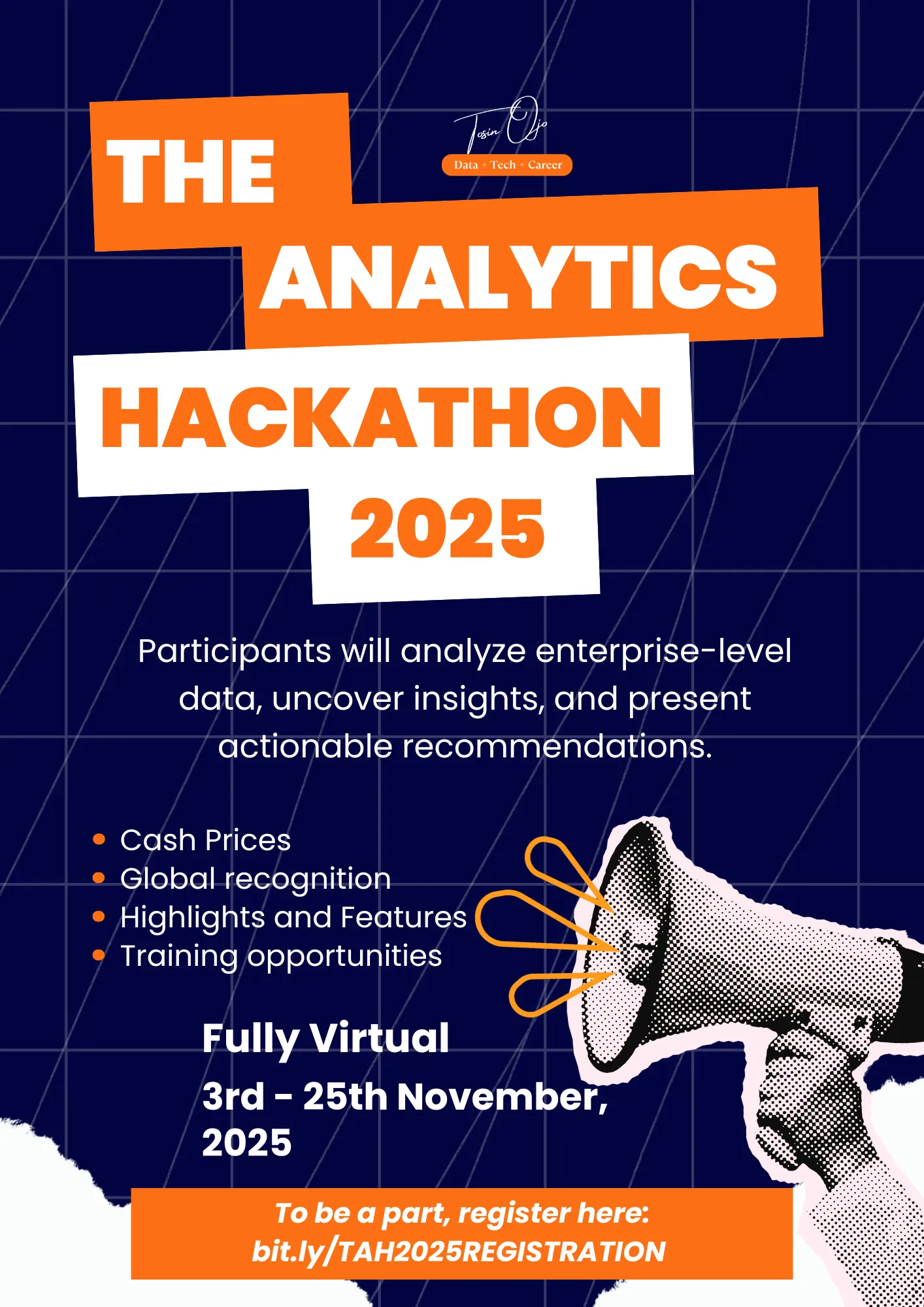
    The Global Analytics Challenge 2025 is a 5-week data analytics competition designed to spotlight and empower beginner data analysts across Africa and the diaspora. The challenge gives emerging analysts the opportunity to engage with real-world datasets, uncover insights, and creatively present their findings—bridging the gap between learning and real-life application.

    At its core, the challenge aims to transform data skills into meaningful impact by exposing participants to practical problem-solving, industry-aligned evaluation criteria, and visibility within the growing African data ecosystem.

    Register here

  • Loveworld Trade and Investment Forum (LTIF) 2025

    Loveworld Trade and Investment Forum (LTIF) 2025

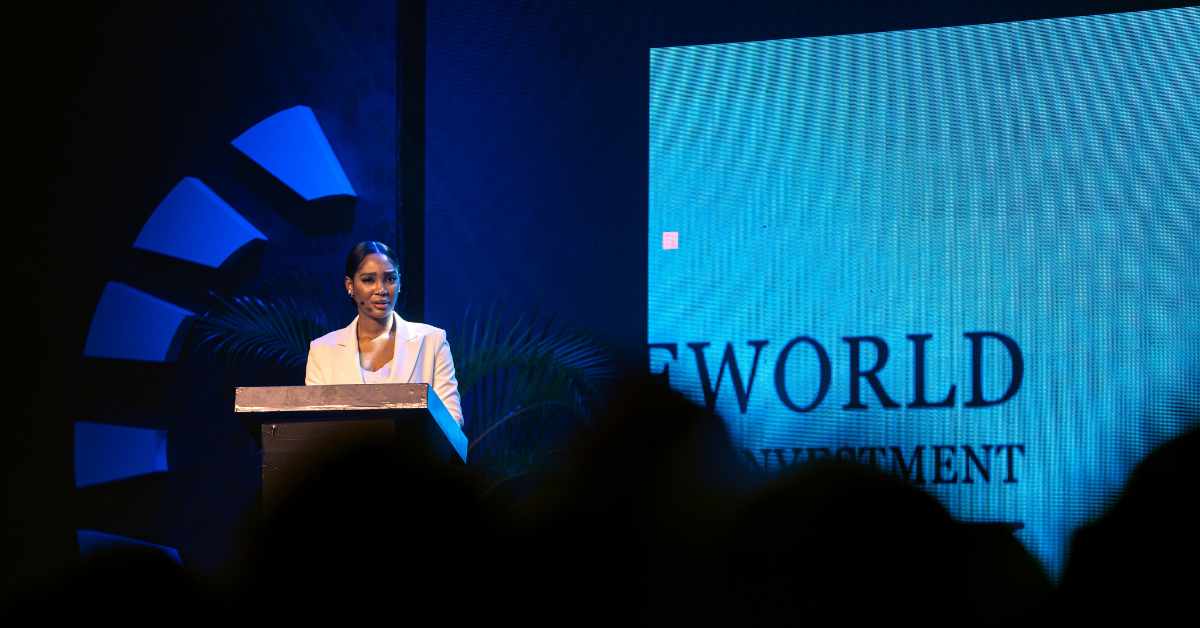
    The Loveworld Trade & Investment Forum (LTIF) 2025, a two-day gathering designed to strengthen trade, investment, and enterprise growth across Africa’s emerging markets.

    The inaugural edition, themed “Trust, Trade & Transformation,” brings together entrepreneurs, investors, policymakers, innovators, and business leaders to explore practical pathways for building resilient, scalable ventures in today’s evolving economic landscape.

    Event Details
    – Date: November 19–20, 2025
    – Time: 10:00 AM – 4:00 PM daily
    – Venue: Balmoral Convention Center, Ikeja, Lagos
    – Registration: Click Here

    The Forum is structured as both a conference and a business exhibition, creating space for real dialogue, real deal flow, and real market access.

    Over two days, attendees will engage across keynote conversations, high-level business panels, pitch sessions, investment roundtables, and industry masterclasses.

    The exhibition floor will showcase solutions, brands, and ventures positioning themselves for scale in African and global markets.

    For African Tech Journal, this aligns with our mission to document the work, the builders, and the systems shaping Africa’s innovation economy.

    Events like LTIF provide more than networking value; they reveal how organizations, founders, and investors are actively redesigning growth models and cross-border collaboration in real time.

    What To Expect Inside the Forum
    • Keynotes and strategic dialogues on trade, financing, and enterprise development
    • Investor roundtables on capital access and market expansion
    • Startup and SBO pitch blocks (early-stage and scale-ready)
    • Panels on technology, innovation, and operational resilience
    • Exhibition showcase featuring solution-driven African ventures

    This is a platform for decision-makers, implementers, and emerging operators who are committed to building businesses that last.

    If you are building, expanding, or looking to partner across African markets, LTIF is a space you should be in.

    Join the conversation.
    Register:
    https://ltif.lwcommerce.org

  • Building Sustainable Innovation Ecosystems

    Building Sustainable Innovation Ecosystems

    10Alytics Global Hackathon 2025

    The 10Alytics Global Hackathon is an annual innovation platform mobilizing data professionals to solve the world’s most pressing development challenges. Now in its 7th edition, the 2025 Hackathon is co-created with BudgIT Nigeria and sponsored by Mainstack, reflecting a shift toward cross-sector partnerships connecting civic actors, private sector innovators, and global knowledge networks.

    The idea is simple but urgent: Africa cannot wait.

    With a young population, rapid digital adoption, and an expanding knowledge workforce, the continent is positioned to architect new models for social development and economic growth. Data and AI present an unprecedented leapfrog opportunity—but without intentional ecosystem design and talent cultivation, that opportunity remains unrealized.

    The Hackathon aligns directly with the United Nations Sustainable Development Goals (SDGs), challenging participants to interrogate real global problems—inequality, unemployment, governance deficits, health challenges—while equipping them with data-centric problem-solving frameworks.

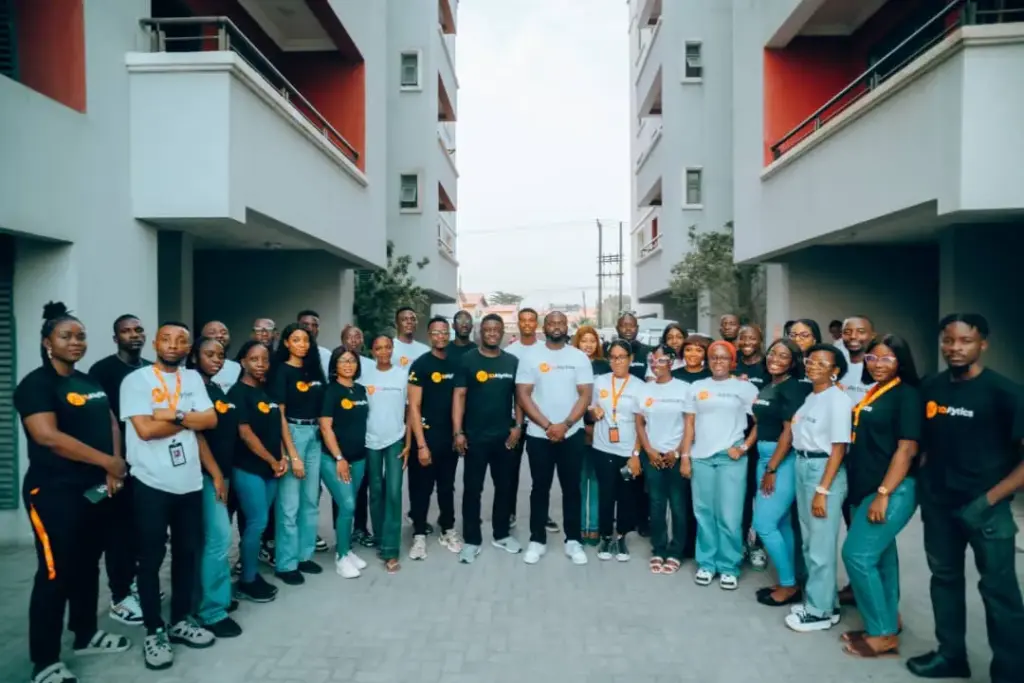
    The 10Alytics team.

    Historical Context

    Since inception, the hackathon has grounded each edition in real-world development challenges tied to continental data realities:

    December 2022: Tackling the Health Crises in Africa

    May 2023: Poverty, Life Expectancy and GDP Crises

    December 2023: Unravelling the Challenge of Unemployment in Africa

    December 2024: Child and Infant Mortality

    This continuity demonstrates the Hackathon’s sustainability logic: it’s not an isolated competition—it’s a data-driven inquiry into systemic SDG-linked challenges. Each edition builds knowledge that can shape policy conversations and interventions across sectors.

    Judges & Evaluation

    A diverse panel of global judges—senior Data, AI, and Product leaders from multiple countries—will evaluate solutions based on four equally weighted pillars:

    | Criteria | Focus |

    1. Understandability Framing & clarity of the problem
    2. Innovativeness Uniqueness & quality of insights
    3. Impactfulness Strength & relevance of the solution
    4. Applicability Practicality, feasibility & presentation

    Their scoring determines the Top 5 winners.

    What Participants Should Expect

    • Real-world problem statement linked to an SDG challenge
    • 100% virtual hackathon (Zoom + YouTube Live)
    • 2 days of collaboration and solution building
    • Top 10–20 finalists pitching live before global judges
    • Cash prizes, global visibility, and post-hackathon support

    Why This Matters

    The SDGs are urgent. Africa is young. Data is powerful.

    This Hackathon accelerates Africa’s transition into an innovation economy—where data decisions shape institutions, markets, and social outcomes. It proves that African data talent can shape policy, influence global markets, and build technologies responding to real human needs.

    Innovation isn’t just capital—it’s curiosity, community, structured knowledge, and access to opportunity.

    With thousands of participants across 20+ countries, the 10Alytics Global Hackathon is an evolving experiment in collective intelligence, democratizing innovation pathways and building sustainable tech talent pipelines across the continent.


    Get Involved

    Register: [10Alytics Global Hackathon Registration]

    Partnership/Sponsorship: [email protected] | [email protected]

    About 10Alytics

    10Alytics is an African-founded EdTech organization advancing data and emerging technology skills. We lower entry barriers by enabling Africans to leverage their professional experience while transitioning into Data Analytics, Data Science, Business Analysis, Agile Project Management, Financial Analytics, HR Analytics, and Data Engineering roles.

    Over five years, we’ve supported thousands of learners across Nigeria, Ghana, UAE, Canada, USA, UK, Germany, France, and Sweden—building competencies to secure jobs in top global organizations.

    Founded by Adeiza Suleman and Efemena Ikpro, 10Alytics also offers consulting focused on shaping organizational data culture—from data warehouses to live dashboards enabling real-time decision-making.

    More information: www.10alytics.io

  • How Contemeleon Built a Powerful System Connecting Africa to The $250B Creator Economy

    How Contemeleon Built a Powerful System Connecting Africa to The $250B Creator Economy

    How Contemelon started

    Sometimes a company doesn’t start the day you print a CAC certificate or open a fresh Google Doc for a pitch deck. Sometimes it starts years earlier, when life keeps throwing you into situations that don’t make sense yet. You collect the lessons and survive the chaos. You build muscles you didn’t plan for. And one day, everything snaps into focus.

    That’s how Contemeleon happened. On paper, it launched last year. In reality, it has been growing quietly for ten years.

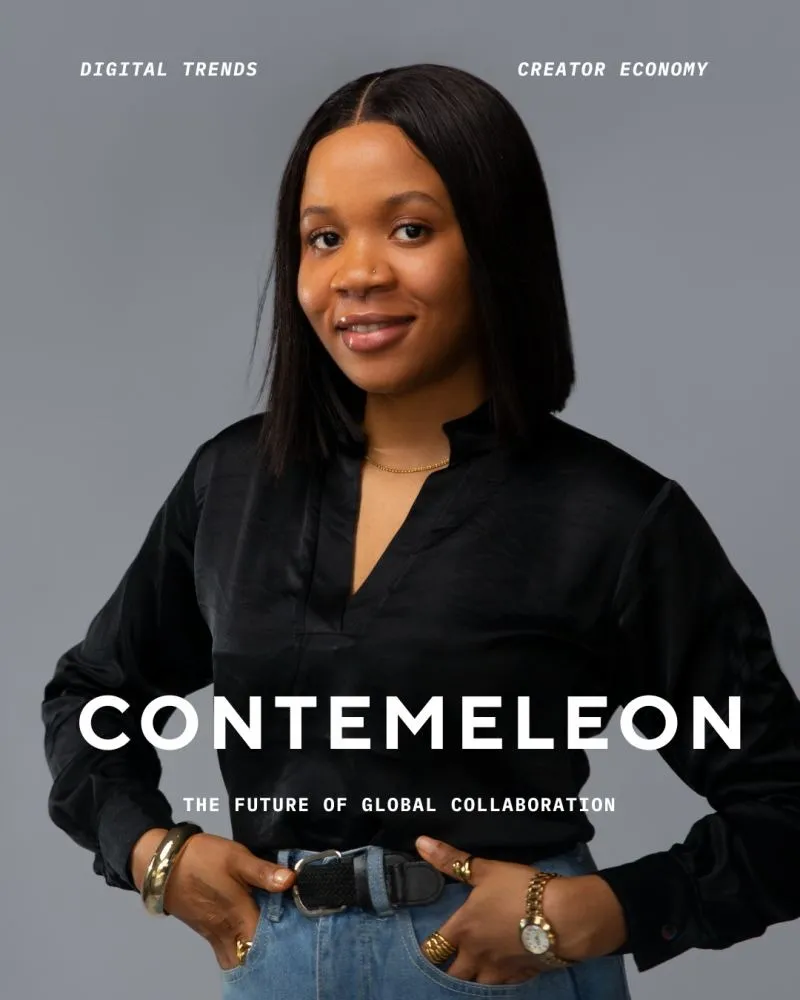
    And the funny thing is, the vision didn’t come from someone who sat down to “disrupt creator monetization” or “unlock Africa’s influence potential.” It came from someone who spent years navigating the messy, beautiful, exhausting path of creative life, then walked straight into the world of software engineering and realized the gap between both worlds was bigger than anyone wanted to admit.

    At some point, the founder stopped asking why no one had built a proper bridge between creators and businesses and decided to build it themselves. That’s how Contemeleon was born, a decade-long blueprint hiding inside one person’s lived experience.

    PARTNER CONTENT:

    This Christmas, one thing is constant: someone abroad is always sending you dollars, or you’re the one asking, “Have you seen the money?”

    With Accrue, this becomes effortless.

    So, if your loved ones are in the US, UK, Canada, or anywhere in the world, they can send dollars to you instantly through Accrue. No waiting for bank alerts that keep bouncing. No hidden fees. No complicated steps. Just clean, fast cross-border transfers from their phone to yours.

    Once the money hits your Dollar Bank Account, you can easily pay rent, sort bills, buy groceries, and fund your December groove in your local currency.

    And for everything online? Accrue’s Virtual Card has your back.

    You can use it to seamlessly pay for Apple subscriptions, iTunes, X Premium, Spotify, Netflix, online shopping, and many more without worrying about cards failing or banks declining transactions. It just works.

    So whether you’re in Lagos, Accra, or sending love back home from abroad, Accrue makes cross-border money simple, fast, and stress-free.

    Download Accrue (App Store or Play Store)

    Let your money move across borders this Christmas.

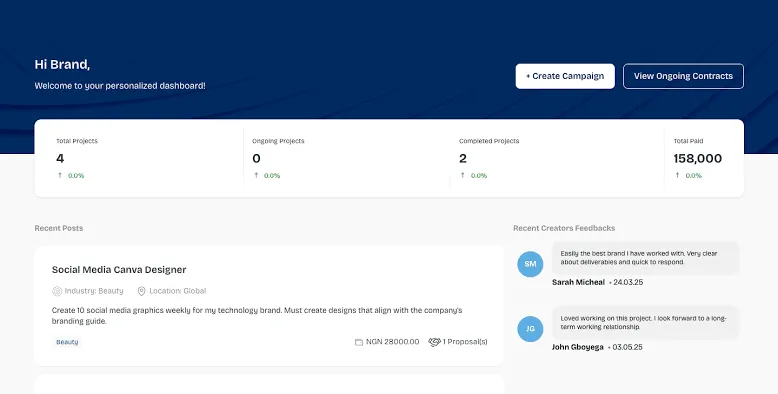
    Contemeleon Problem: Two Worlds, One Missing Connection

    The problem Contemeleon is tackling isn’t complicated. It’s just painfully familiar to anyone who has ever created something on the internet or tried to hire someone who does.

    On one end, you have businesses across Africa trying to sell, grow, and stay relevant. They know creator marketing works. They see the case studies. And they still struggle.

    Finding creators is hard. Evaluating them is harder. Managing a campaign from brief to result often feels like school group work with the most unserious classmates. Late deliveries, inconsistent communication, hashtags misplaced, metrics missing. It’s a whole project and it can be a messy headache.

    On the other end, you have creators. Talented, smart, hardworking people. People who write, shoot, edit, design, strategize, post, and create. Yet their income looks like a cardiogram. Some brands even disappear after collecting work. Others want ten deliverables for the price of a sachet of water.

    It’s a broken and exhausting cycle. One side has money but no structure. The other has talent but no stability and in between them sits a giant gap no one has properly bridged. This is the gap Contemeleon was built to close.

    The Founder’s Journey: From Creative Writer to Product Leader

    To understand why Contemeleon feels different, you have to understand where it came from.

    Before engineering, before product leadership, before SaaS and AI and scaling strategies, there was writing. The founder started as a creative writer, hustling for gigs, building a portfolio, dealing with inconsistent income, and learning the unspoken rules of the creative world the hard way.

    Every late payment, underpriced job, clients who didn’t know what they wanted until the fifth revision became the fuel to build something better.

    So the founder decided to make it better. She learnt the systems involved in building products, and somewhere along the line, the merging happened: the heart of a creator with the mind of an engineer. That combination became the lens through which Contemeleon was designed.

    Most platforms in this space were built by people who never felt the vulnerability of their target audience pain points, but Contemeleon was different. It was built from memory of the pain.

    Building Contemeleon from Zero

    Contemeleon didn’t start with investor money. It started with 9-5 money and personal savings. This was coupled with belief, skill, and a team assembled through authentic relationships formed over years.

    Bootstrapping has trade-offs. Growth is slower when you can’t “just spend your way to scale.” Every decision is scrutinized. Every naira, every hour, every feature has to justify itself. And in Contemeleon’s case, every constraint sharpened the product. Contemeleon grew like a plant that learned to survive on limited water, we call it the cactus company.

    How Contemeleon Grew While Funding Was Tight

    Building without external funding is tough. Growth takes time and you don’t have the luxury of burning cash to buy attention.

    To solve that, Contemeleon did something right. They decided to start with services.

    Before pushing pure SaaS, they rolled up their sleeves and worked directly with businesses. They executed campaigns manually. They delivered results. They collected feedback in real time. That service-first phase was purely foundational.

    And it worked because businesses need what Contemeleon offers: clarity, structure, and creators who actually deliver. And Contemeleon delivered effortlessly because of their laid down structures.

    This service-led approach is why they’re growing even with limited resources. Each client becomes a case study that reveals what needs to be built next.

    The Milestone That Mattered: Creators Getting Paid

    Ask the founder what milestone makes them proud and you won’t hear CAC, MRR, MAU, or other tech vanity metrics. You’ll hear one thing: “Creators are getting paid.”

    Every time a creator receives money for a campaign through Contemeleon, it’s a moment. It means someone’s stress drops a little. Someone’s rent becomes easier. Someone’s family gets a breather. Someone’s craft is validated. Someone’s confidence rises.

    And Contemeleon wants to scale that. In 2025, the goal is a 7-digit payout to creators. It’s surprising because most companies’ goals are revenues, but Contemeleon is looking for ways to put more money directly into people’s pockets.

    Global from Day One: Onboarding Users Worldwide

    One thing technology does well is remove borders, and Contemeleon leaned into that from the start. We at African Tech Journal like to call it a crossborder platform. Even as a small, bootstrapped company, they built global infrastructure, and it’s working. Users from different countries joined without Contemeleon running global ads or hiring international contractors. The platform simply supports global workflows, so people naturally came in.

    Contemeleon isn’t positioning itself as the “Nigerian influencer platform.” It’s positioning itself as the bridge for creators and businesses everywhere, with Africa as its heartbeat.

    Contemeleon: A Culture Built on Transparency

    If there’s anywhere Contemelon stands out, it should be for transparency. The creative industry is filled with hidden fees, unclear terms, and ghosting, and it’s terrible for upcoming creators, but Contemeleon holds a refreshing stance. Their mantra is to be honest, be open, and treat creators like humans. It sounds normal, but it’s rare in capitalism.

    The founder believes transparency is a strategic advantage. And we agree. You can’t build trust with creators or businesses without it. If Contemeleon wins big, it will be because its community trusts it deeply.

    The Lesson: Don’t Wait for Permission to Change the World

    When you look at Contemeleon’s story, one lesson jumps out. They didn’t wait for approval, big funding, or the perfect product. They started with what they had and built forward. That’s the energy more founders need, especially in Africa, where waiting for funding can stall an entire generation of innovation.

    If you see the problem clearly and you have the skills to build the solution, start building.

    Contemeleon didn’t wait for perfect conditions. They started bootstrapping and launched without full feature parity with global competitors. They’re building while fundraising, iterating while scaling.

    Contemeleon’s Vision: $10M in Creator Payouts and Proving a New Model Works

    Contemeleon’s expansion plans are ambitious but grounded, and they’re designed to prove something bigger than just company growth.

    In the next 2 years:

    • Expand to three new markets
    • Pay out $10,000,000 in income to creators

    Let’s break that down.

    Three new markets means going beyond Nigeria, strategically selecting regions where the creator economy is exploding but infrastructure is lacking. Likely targets are Kenya, South Africa, Ghana, countries with growing digital populations, strong creative communities, and businesses ready to invest in influencer marketing.

    $10 million in creator payouts means facilitating enough campaigns, at scale, to generate that much income flow to creators.

    That will also help African talents participate meaningfully in a global economy as contributors.

    Why This Story Actually Matters

    Contemeleon represents something bigger than one platform.

    They’re proof that:

    • You can bootstrap meaningful impact without VC funding
    • Transparency and community can be competitive advantages
    • African solutions can compete globally from day one
    • The creator economy needs infrastructure that values people over extraction
    • Ten years of lessons compound into solutions that matter

    Contemeleon is still early and building, but the vision is clear, the team is aligned, and the mission is urgent.

    • For creators: If you’re tired of inconsistent income and opaque processes, there’s a platform being built with you in mind.
    • For businesses: If you want influencer marketing that actually works, with transparent processes and measurable results, Contemeleon is here.
    • For investors: If you believe people-first platforms can win, this is the opportunity to place a bet on one. .

    Contemeleon Technologies is currently bootstrapping toward scale. If you’re a creator looking for fair opportunities, a business seeking authentic creator partnerships, or a strategic partner who believes in people-first platforms, reach out to them.

    We know you’ll thank us afterwards because at African Tech Journal, we bring you guys good innovations that influence our lives positively as Africans.

  • Post-Event Recap: Inside the 2025 10Alytics Global Hackathon- Africa’s Biggest Data Challenge

    Post-Event Recap: Inside the 2025 10Alytics Global Hackathon- Africa’s Biggest Data Challenge

    The 2025 edition of the 10Alytics Global Hackathon has officially wrapped and once again, it proved why it remains Africa’s premier data competition.

    From thousands of registrations to project submissions, this year set a new benchmark for innovation, skill, and global participation.

    If joined the 48-hour sprint or are catching up on the highlights. Here’s a full breakdown of what happened.

    What Exactly is the 10Alytics Global Hackathon

    The 10Alytics Global Hackathon is a high-energy, 48-hour virtual competition where Data enthusiasts compete to solve real-world problems using datasets, all while racing against the clock.

    Prizes include: Up to $52,000 in cash, Scholarships, Industry visibility, Global networking opportunities, Portfolio-ready project experience.

    2025 Edition

    The 2025 edition happened November 29–30, 2025, Fully Virtual (Zoom + YouTube Live) and Open to participants worldwide

    With thousands joining from across Africa, Europe, the Americas, and the Middle East, the hackathon has grown into a global showcase of Africa’s rising data talent.

    What Happened During the Hackathon

    DAY 1 – Kickoff, Dataset Reveal & Orientation

    2,000+ registrations recorded, 300+ participants joined live across YouTube, Instagram, and LinkedIn

    Judges were introduced alongside their career journeysand participants received problem statement briefing, competition rules & submission guidelines

    From dataset exploration to community bonding, Day 1 set the stage for intense analytics work behind the scenes.

    DAY 2 — Final Presentations & Live Judging

    After 11 hours of analysis, visualization, and modeling

    The top 30 were shortlisted, 13 finalists presented live on the YouTube stream for the Judges, Presenters had 10 minutes each to pitch their solutions, and judges scored each project in real-time.

    Winners & Rewards

    • $2,000 in cash prizes shared among the top 3 winners
    • Top 4–10 finalists secured internship placements to grow, build, and accelerate their tech careers

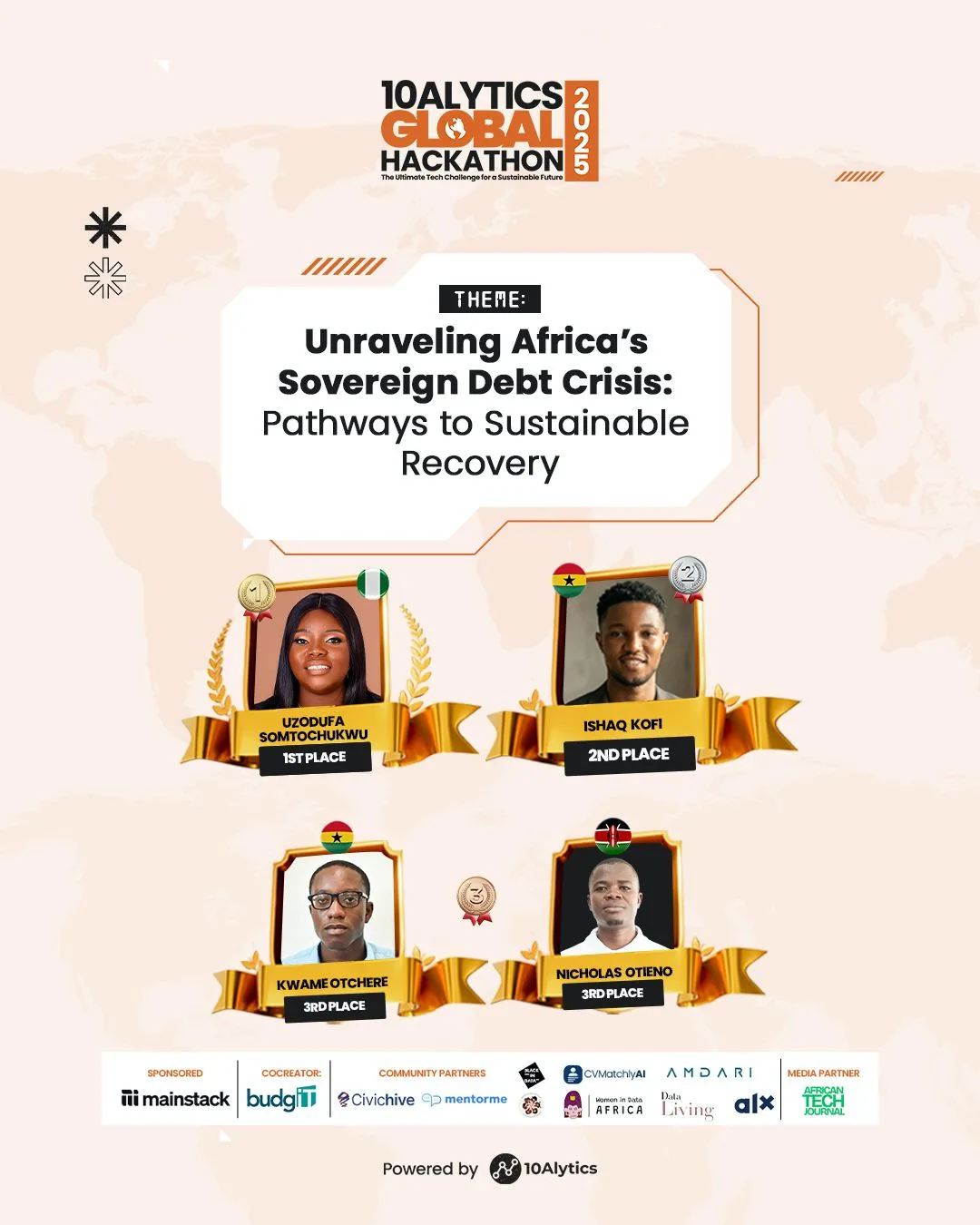
    Uzodufa Somtocochukwu came prepared, and it absolutely showed! Her sharp timing and unforgettable presentation style wowed the judges. Competing against brilliant talents from Ghana, Kenya, and Nigeria, she earned an impressive 81.71%, sealing her victory.

    Right behind her was Ghana’s own Ishaq Kofi, securing a strong second place. And in a plot twist nobody saw coming, Kenya’s Nicholas Otieno, who pitched last, delivered a standout performance that tied him with Ghana’s Kwame Otchere for third place.

    The Ecosystem Behind the Hackathon

    The 10Alytics Global Hackathon is deeply rooted in the broader mission of 10Alytics, a leading EdTech company committed to equipping Africans and the global diaspora with industry-ready technology skills. For five years, 10Alytics has built and nurtured talent for the global tech workforce, helping more than 2,500 individuals transition from the classroom into their first tech roles across the UK, US, Canada, Europe, Africa, and Asia.

    The organization delivers premium, experiential training across high-demand fields such as Data Analytics, Business Analysis, Data Engineering, Data Science, Financial Analytics, HR Analytics, Scrum, CyberSecurity, DevOps Engineering and Product Design. Their Team brings deep practical experience, ensuring that learners receive hands-on, career-driven training that truly prepares them for real-world challenges. Maintaining a community of 10,000+ learners & alumni globally

    2025 Hackathon Strategic Partners

    • BudgIT — Co-creation partner
    • Mainstack — Official sponsor
    • African Tech Journal – Media Partner

    Community Partnerships with organizations such as Data Living, Women in Data Africa, Civic Hive, ALX Nigeria, MentorME, Amdari, Women in Data Network, Amdari, and the African Tech Journal.

    The 10Alytics Global Hackathon is more than a competition. It is a platform that as over the years created a community for data enthusiasts to use their skills to solve real-world problems.

    It proves that African data professionals have consistently demonstrated that they can compete at global standards when given the right platforms to showcase their abilities.

    At a time when millions of African youth are seeking career pathways, the hackathon bridges the gap, connecting skills to opportunities, learning to earning, and talent to global recognition.

    Partnership & Sponsorship Inquiries:

    [email protected], [email protected]

  • FUSE Varsity: Bridging the Gap Between New Graduates and The Real-World

    FUSE Varsity: Bridging the Gap Between New Graduates and The Real-World

    Graduation has a way of putting your life in sharp focus.

    You’ve survived years of reading, lab work, and late-night exam prep. Your parents are beaming. Your certificate is crisp. On the surface, everything looks fine. But underneath the excitement, there’s a quiet emptiness you can’t ignore. You’ve earned the degree, yet you don’t feel ready for the world outside the school gate.

    For many African graduates, that fear is valid. 

    That question became the foundation of FUSE Varsity, a homegrown edtech solution built around relevance, clarity, and online learning.

    The Uncomfortable Truth About African Education

    Anyone who passed through the Nigerian university system understands the disconnect. It’s not a lack of intelligence or effort. Students work incredibly hard despite unstable systems, outdated materials, and limited resources. After navigating missing scripts and endless delays, many graduates still discover that a degree alone doesn’t open doors.

    Building Without Glamour

    The team focused on clarity, structure, community, and results.

    Competing with well-funded online platforms on appearance made no sense. Instead, FUSE asked a more grounded question: what actually helps people stay, grow, and apply what they learn? The answer shaped everything.

    Convincing people wasn’t easy. Degrees still carry emotional weight in Nigeria. Questions came fast: “Why do I need this?” “How is this different from YouTube?” “What if I still don’t get a job?”

    Why Community Changed Everything

    FUSE learned early that content alone isn’t enough. Learning needs connection. That’s why cohort-based learning became central. Learners moved together, shared wins, received feedback, and stayed accountable.

    They weren’t abandoned after programs ended. They joined a 3,500+ member community that continued to support and challenge them. Feedback wasn’t ignored—it shaped courses, support systems, and the platform itself.

    Growing With Discipline

    By 2024, the focus shifted to scale. That led to FUSELearn, an AI-supported extension designed to personalize learning without replacing human connection.

    Partnerships with organizations like the Lagos State Government, Selar, and Workpoint helped FUSE reach over 2,000 learners and support real career transitions.

    The Bigger Picture

    FUSE feels like home because it understands African realities like power issues, data limits, financial pressure. Learning works with life, not against it.

    By 2030, FUSE aims to empower over 30,000 learners with skills, confidence, networks, and opportunities.

    It’s not just education. It’s preparation for the real world—and that’s the gap FUSE exists to fill.

  • TEDxAjegunle: Beyond Boundaries, A New Generation Rising

    TEDxAjegunle: Beyond Boundaries, A New Generation Rising

    When people talk about Ajegunle, Lagos’ most storied community, they often focus on the noise — the chaos, the grit, the clichés. But beneath the stereotypes lies a pulse. A rhythm. A place where brilliance is not imported but born.

    This November, that rhythm will take on a global stage. TEDxAjegunle returns — reintroduced, reimagined, and redefined — as one of Nigeria’s most anticipated idea platforms of 2025.

    Its theme, “Beyond Boundaries: Where Limits Become Launchpads,” isn’t just a tagline; it’s a declaration. It captures what Ajegunle has always been — a community that turns constraint into creativity, scarcity into strength, and struggle into story.

    Reclaiming the Narrative

    TEDxAjegunle’s comeback is more than a local event — it’s a cultural reawakening.

    Rooted in one of Lagos’ most misunderstood yet inspiring neighborhoods, the event seeks to challenge old narratives and reframe how the world sees communities like Ajegunle. For years, the district has been synonymous with hustle and hardship, but it has also birthed pioneers — from world-class footballers to innovators, creatives, and entrepreneurs who have rewritten what it means to rise from the grassroots.

    In the words of one of the organizers, “Ajegunle has never lacked talent; it has only lacked amplification. TEDxAjegunle is that amplifier.”

    A Stage Where Stories Become Launchpads

    The 2025 edition brings together a dynamic lineup of visionaries who embody the event’s spirit — individuals who have broken through limitations to create something extraordinary.

    Among them:

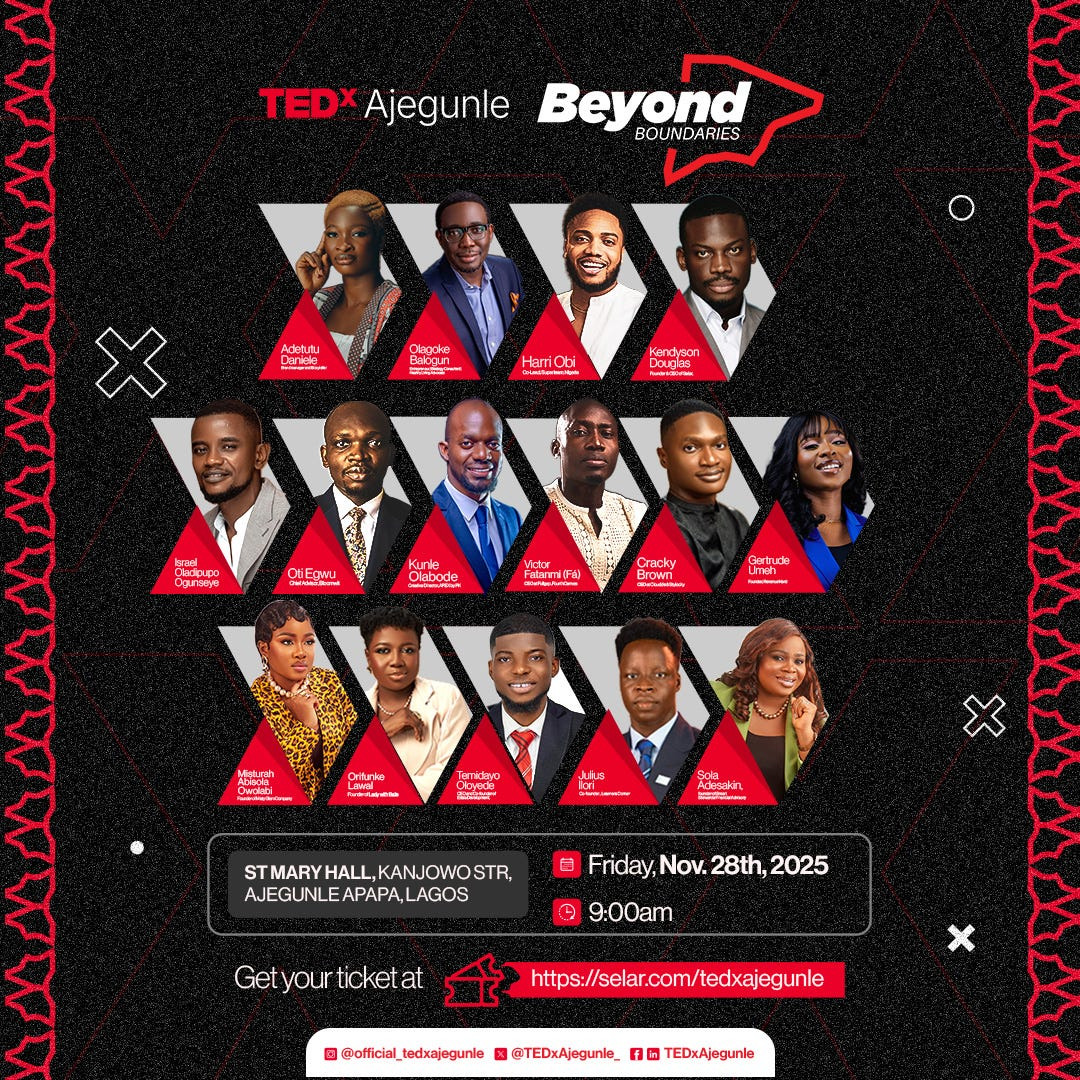
    • Douglas Kendyson, the mind behind Selar, Africa’s leading platform for digital entrepreneurs, helping over 1.5 million users monetize their ideas.
    • Gertrude Umeh, Founder of Revenue Nerd, creating access and visibility for Africa’s growing tech sales community.
    • Victor Fatanmi (Fá), CEO of Fullgap & FourthCanvas, shaping design and technology as forces for the future of work.
    • Sola Adesakin, Founder of Smart Stewards, building financial literacy networks across 40+ countries.
    • Harri Obi, Co-lead at Superteam Nigeria, bridging blockchain technology and creative collaboration.
    • Misturah Abisola Owolabi, Founder of Misty Glam Company, redefining inclusion and advocacy through fashion.
    • Orifunke Lawal, Founder of Lady with Balls, leading a fearless movement of women redefining leadership and impact.
    • Olagoke Balogun, CEO of So FreshNG, growing Nigeria’s healthy food culture into a national movement.

    Each speaker carries the essence of “Beyond Boundaries” — they are living proof that limits are often the first step toward transformation.

    Where Community Meets Global Relevance

    For a neighborhood long painted as the “underdog” of Lagos, hosting a TEDx event is not merely symbolic — it’s revolutionary.
    Ajegunle is stepping into global conversations, not as a case study in struggle, but as a blueprint for resilience and innovation.

    TEDxAjegunle aims to blend world-class storytelling with local authenticity — TED-style talks infused with cultural performances, fireside chats, and youth showcases. The stage will feature students, technologists, and creators, side by side with seasoned business leaders — a deliberate attempt to bridge generations through shared purpose.

    It’s this fusion that makes TEDxAjegunle different: it’s not about imported ideas; it’s about homegrown brilliance projected onto a world stage.

    The Power of Place

    The choice of venue — St. Mary Hall, Oregie, Ajegunle-Apapa — matters deeply. It’s not a convention center. It’s not a fancy auditorium. It’s a space close to the people whose stories will be told.

    Ajegunle’s narrow streets and open markets have always been laboratories of innovation — where music, trade, and technology find unexpected intersections.
    Now, the same streets that raised legends will host conversations that could birth the next generation of them.

    As one of the speakers, Cräcky Brown, puts it:

    “You can’t talk about innovation in Lagos without talking about Ajegunle. This is where ideas survive the pressure test of reality.”

    Redefining What’s Possible

    From the outside, TEDxAjegunle might look like a single-day conference.
    But to those who understand the context, it’s much more — a movement of visibility, access, and pride.

    It’s about reminding Nigeria, and the world, that brilliance can rise from anywhere. That impact isn’t confined to tech hubs in Yaba or skyscrapers in Victoria Island — it can emerge from the heart of Ajegunle, carried by those who dare to think beyond boundaries.

    Event Details

    Date: November 28, 2025
    Venue: St Mary Hall, 13 Kanjowo St, Oregie, Ajegunle-Apapa, Lagos
    Access: Open to the public — tickets available now
    More Info: TEDxAjegunle official page

    Final Word

    In an age where innovation is often measured by funding rounds and venture headlines, TEDxAjegunle reminds us of something timeless: that ideas — not resources — are the ultimate currency of change.

    Ajegunle is not waiting for permission to tell its story anymore.
    It’s already writing it — in bold, beautiful, and boundary-breaking strokes.